
When the Trump-appointed chair of the FCC publicly threatened ABC with regulatory retaliation unless it punished Jimmy Kimmel for a monologue about Charlie Kirk, the move shocked the entertainment industry and nation. Within hours, ABC pulled Jimmy Kimmel Live off the air “indefinitely.” What should have been dismissed as satire became treated as sedition. Free speech groups condemned the decision as cowardly capitulation to government pressure, while Trump cheered from abroad, calling the suspension “what had to be done.”
This moment is about more than one late-night host or one crude joke. It represents a familiar tactic from authoritarian history: silencing cultural figures who have the power to challenge official narratives. Writers, comedians, scientists, professors, and artists are often the first to be targeted because their voices travel widely and invite others to think differently. Fascist regimes, from Mussolini’s Italy to Hitler’s Germany, understood this instinctively. Controlling the press was not enough. The state had to dominate the culture.
But the word fascism is often thrown around loosely. Critics accuse opponents of it casually, stripping it of meaning. So what exactly does the term mean? According to Merriam-Webster’s Dictionary, fascism is:
“a political philosophy, movement, or regime that exalts nation… above the individual and that stands for a centralized autocratic government headed by a dictatorial leader, severe economic and social regimentation, and forcible suppression of opposition.”
This definition captures the essentials. Fascism is about elevating the nation above individual rights. It is about rallying citizens around a single leader who embodies the state. It imposes strict regimentation on society, reducing people to the whims of the regime. And it enforces obedience through threats and force: censorship, legal persecution, or taking action against those who dissent.
Historians add crucial texture to this. Robert Paxton, in The Anatomy of Fascism (2004), describes fascism as “a form of political behavior” driven by obsession with national decline, humiliation, and victimhood. It builds cults of unity and purity and thrives when wealthy elites ally with mass movements that glorify aggression and scorn democracy. Hannah Arendt, in The Origins of Totalitarianism (1951), warned that fascism feeds on diversion and the collapse of shared truth. When people no longer trust institutions or one another, they turn to movements that promise certainty and belonging, even at the cost of freedom.
Jason Stanley, in How Fascism Works (2018), identifies recurring tactics: mythologizing a “lost” past, demonizing outsiders, spreading propaganda, and weaponizing fear. None of these features alone make a system fascist, but together they create a regime that undermines democracy from within. Seen through this lens, the FCC’s threat to punish ABC is not an isolated dispute between regulators and a comedian. It is part of a larger pattern: the use of government power to silence dissent, intimidate corporations, and chill constitutional free expression. History shows us this is how fascism gains its foothold, not with tanks in the streets, but with the slow normalization of repression with the blame being placed on those who are targeted.
That is why it is urgent to revisit the question: what are the signs that a democracy is tipping into fascism? The historical record offers at least ten clear warning signs. Each serves as a mirror we can hold up to this moment in the United States.
1. Attacks on Free Expression and Popular Figures
Fascist movements consistently target cultural figures. Mussolini’s Italy censored journalists, silenced playwrights, and forced newspapers into state-aligned syndicates. Nazi Germany banned “degenerate” art, drove scientists into exile, and turned the media into propaganda mills. Robert Paxton in The Anatomy of Fascism (2004) describes these acts as essential to consolidating control because they dismantled networks of solidarity outside the state. Silencing public voices prevents citizens from forming independent ideas.
The Kimmel case fits the pattern. He joins a long list of satirists and journalists facing intimidation when their work offends those in power. Trump has shown again and again that he sees the press not as a constitutional safeguard but as an enemy to be tamed. He threatened an ABC reporter this week at the White House by suggesting that “‘Maybe we should go after you,” a direct challenge to the principle that even the president must face questioning. He has launched a 15 billion-dollar defamation lawsuit against The New York Times for coverage he disliked, part of a broader campaign of legal harassment aimed at intimidating major media outlets. He has even reached millions in settlements with media companies after dragging them into costly court battles and holding up corporate mergers—victories not in the courtroom of law but in the courtroom of intimidation, where the real message is that dissent carries a price.
Nor is Jimmy Kimmel alone. Stephen Colbert, one of Trump’s most consistent critics on late-night television, was pushed off the air under a cloud of pressure, his departure publicly celebrated by Trump allies. Each example is a piece of the puzzle: a creeping campaign to shrink the space where cultural criticism and satire can survive.
When Trump repeatedly labeled reporters “enemies of the people,” he echoed Stalinist language once used to justify purges. The cultural sphere becomes dangerous not because of what artists or journalists say but because of what they enable: the ability of citizens to laugh, to doubt, to question, and to imagine alternatives. That is why they are targeted.
United States: [ ] Yes [ ] No
2. The Cult of the Leader
One of fascism’s defining characteristics is the transformation of politics into worship of a single leader. Stanley Payne in A History of Fascism, 1914–1945 (1995) shows how Mussolini styled himself as Il Duce, Hitler as Führer, and Franco as Caudillo. Their images saturated public life, from posters to textbooks, erasing the distinction between leader and nation.
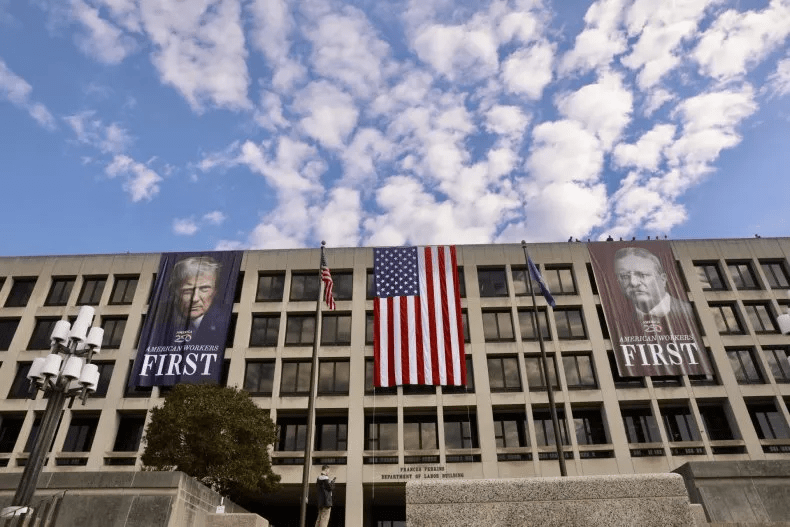
The United States is seeing disturbing echoes. Trump’s slogan “I alone can fix it,” spoken at the 2016 Republican National Convention, encapsulates the authoritarian model. It reframes democracy, where institutions and citizens share responsibility, into a monarchy of one. His rallies, complete with ritualistic chants, mass displays of red MAGA hats, merchandise, and staged adoration, resemble what historian Emilio Gentile calls “political liturgy.” The sea of identical hats is more than casual branding. Like the uniforms of fascist movements in the twentieth century, they function as visible markers of loyalty, signaling who belongs to the leader’s community and who does not.
Fascist leader cults serve two purposes: they elevate the leader as beyond criticism (e.g. Epstein files and adultery forgiveness by the Christian right), and they justify persecution of opponents as attacks on the nation itself. When Republican figures describe Trump as divinely chosen, they reinforce this cult dynamic. Former Congresswoman Michele Bachmann once said, “Trump is highly biblical, and I believe he is God’s anointed.” That kind of rhetoric removes accountability and installs loyalty as the highest political value. In such an atmosphere, criticism of the leader becomes equated with betrayal of religion and the nation, and political liturgy turns into a substitute for democracy.
United States: [ ] Yes [ ] No
3. Fusion of Corporate and State Power
I argue the main focus of the tariffs hasn’t actually been foreign competitors—it has been on American companies themselves, putting at stake billions of dollars to pressure them to yield to Trump. Furthermore, even countries that have played ball with Trump, like South Korea, face continued shakedowns; witness the hundreds of Korean workers arrested by ICE at a new battery plant in Georgia. Meanwhile, the U.S. government now holds stakes in major corporations like Intel despite prior right wing cries of socialism from the auto industry bailout. TikTok also had to recently accept binding conditions just to remain in the American market.
Hannah Arendt warned of this dynamic in The Origins of Totalitarianism (1951): authoritarian regimes consolidate power when corporate elites collaborate with the state. In Nazi Germany, industrial giants like Krupp and IG Farben became not just partners but extensions of the regime, fueling war production and exploiting labor. Italian fascism followed a similar script, with Fiat rewarded for loyalty as labor unions were crushed and profits guaranteed. Fascism has always worked this way—demanding loyalty, not neutrality, from business.
United States: [ ] Yes [ ] No
4. Persecution of Minorities and Outsiders
Historian Richard Evans in The Third Reich in Power (2005) documents how Nazi Germany incrementally criminalized Jews, Roma, and other minorities long before the Holocaust. Laws banning Jews from professions, propaganda equating them with vermin, and orchestrated violence like Kristallnacht made them scapegoats for every national problem. Fascism requires an enemy within. Trump has called his political opponents “vermin” and said immigration is “poisoning the blood” of the U.S., echoing this language.
Trump’s Muslim ban, immigrant detention camps (e.g. Alligator Alcatraz), and laws targeting LGBTQ+ youth all operate through the logic of exclusion. Recently, ICE raids on low-wage workplaces—illustrate how immigration enforcement becomes a tool to terrorize marginalized communities while protecting political power. The Supreme Court’s decision allowing ICE to racially profile based on race, language, and economic status only deepens this dynamic, signaling that suspicion is justified if someone looks or sounds “foreign” or works a low-wage job.
This rhetoric is hardly fringe. Congressman Steve King’s infamous declaration—“We can’t restore our civilization with somebody else’s babies”—frames demographic diversity itself as a threat to survival. That is not the language of democracy but of exclusion. Persecuting minorities serves two enduring goals. First, it distracts the majority from ongoing economic and political failures by blaming vulnerable groups. Second, it consolidates power by defining national identity in narrow, exclusionary terms.
United States: [ ] Yes [ ] No
5. Glorification of Violence and Political Militias
Michael Mann in Fascists (2004) describes how Mussolini’s Blackshirts and Hitler’s Brownshirts acted as both enforcers and theater. Their violence was not hidden but celebrated as patriotic. Fascism does not merely tolerate violence, it sanctifies it as cleansing the nation of enemies.
In the United States, violent rhetoric and actions has become increasingly normalized. When Congressman Matt Gaetz tweeted “Now we can hunt them down” after the Portland protests, it was not just bluster. It echoed the fascist tradition of glorifying paramilitary violence. Trump himself told rally-goers in 2016, “Knock the hell out of them, I promise I will pay your legal fees.” That was an open invitation to vigilantism, cloaked in patriotic fervor.
This normalization reached its climax on January 6, 2021, when a violent mob encouraged by Trump at the White House stormed the U.S. Capitol to overturn a democratic election. The Proud Boys and Oath Keepers—groups that Trump had effectively greenlit when he told them to “stand back and stand by” during a presidential debate—played the role of modern Blackshirts. They were paramilitary actors who blurred the line between protest and insurrection, using intimidation and violence to advance political goals. Their presence was not accidental; it was the predictable outcome of years of cultivated grievance and the steady glorification of political violence.
The cycle of violence repeats from history to present. From Charlottesville—where white nationalists marched with torches and a counterprotester was killed—to January 6, violence has been justified as patriotism, enemies dehumanized as traitors, and democracy steadily weakened by the very forces claiming to defend it.
United States: [ ] Yes [ ] No
6. Erosion of Independent Institutions
Timothy Snyder in On Tyranny (2017) argues that institutions cannot save democracy by themselves. They require citizens to defend their integrity. In Weimar Germany, courts consistently treated right-wing violence leniently while punishing leftist dissent. That imbalance paved the way for dictatorship, since citizens could no longer trust institutions to enforce justice evenly.
Modern America has seen its institutions bent to political purpose in ways that echo this history. The Supreme Court has been primarily ruling along partisan lines, eroding confidence in neutrality and creating the perception that outcomes are preordained- especially when it comes to the “emergency docket.” The Justice Department, under Attorney General Bondi, once meant to enforce the law impartially, has been clear in press conferences that they serve as the legal arm of presidential vendettas. Instead of insulating itself from politics, it is increasingly viewed as a tool for punishing critics and shielding allies.
The FBI, similarly, has lost credibility as an independent investigative body. Under Trump’s orbit, its leadership has been attacked, reshaped, and replaced, with right-wing media personalities and podcasters exerting outsize influence on its direction. When law enforcement agencies begin echoing the talking points of partisan commentators rather than impartial investigators, the signal is unmistakable: the state’s power is no longer being used to protect the public, but to protect the regime.
Regulatory bodies like the FCC show the same vulnerability. Instead of acting as neutral arbiters, they have been openly weaponized to punish media critics—as seen in the threats against ABC over Jimmy Kimmel. Trump has also tried to take over the Board of Governors at the Federal Reserve. So far, the Supreme Court has blocked those efforts, even noting in a recent ruling that it was not interested in giving the president direct control. But who knows what lies ahead? Trump has already tried to remove a Federal Reserve governor—the first Black woman to serve—by accusing her of mortgage fraud, a charge a court recently rejected. The pattern is unmistakable: when independence resists, Trump seeks to control it. When institutions become partisan extensions rather than independent regulators, their role as democratic guardrails collapses. Fascism thrives in precisely that vacuum. Without neutral institutions capable of standing above politics, there is no effective check left on authoritarian ambition.
United States: [ ] Yes [ ] No
7. Weaponization of “Law and Order”
Jason Stanley in How Fascism Works (2018) explains that “law and order” is not a neutral phrase, it is a slogan used to criminalize dissent while tolerating violence by political allies. The phrase masks inequality by making state repression appear impartial, when in reality it selectively targets opposition.
This summer National Guard was deployed to Los Angeles and to Washington, D.C., where troops in combat gear patrolled the streets with weapons of war. Marines were also placed on standby, ready to be deployed domestically against citizens. Trump even threatened to send the military into Chicago, prompting an extraordinary and effective pushback from both the Illinois governor and the Chicago mayor, who condemned the idea as an extreme abuse of federal power. More recently, the National Guard was deployed to Memphis, signaling how routine the use of military force against civilians has become.
The trajectory is clear. Executive orders now expand training for the National Guard specifically to prepare the military for domestic deployment in cities. Under the banner of “law and order,” military resources are reoriented inward, against the very people they are sworn to protect.
Meanwhile, Republican legislatures have passed dozens of laws criminalizing protest, from punishing environmental activists who demonstrate at pipelines to shielding drivers who plow into protesters with their cars. These laws do not defend order; they criminalize dissent. Authoritarian leaders always claim to defend law. What they actually defend is their power.
United States: [ ] Yes [ ] No
8. Propaganda and the “Big Lie”
The Big Lie is not only about elections, it extends to every domain where truth can be bent. From the very beginning of Trump’s first presidency, his administration signaled that facts were negotiable. Kellyanne Conway’s infamous defense of “alternative facts” after the inauguration crowd-size dispute set the tone: objective truth could be brushed aside, replaced with whatever narrative served the leader’s ego and agenda.
That lying impulse has spread into official government data. The administration sought to reshape the U.S. Census by adding a citizenship question designed to intimidate immigrant households and skew representation toward Republican strongholds. Data, once a neutral tool for governance, was recast as a weapon of political control.
The Department of Labor offers another example. When the agency’s chief data officer repeatedly delivered unfavorable economic indicators, he was fired. The message was clear: reality would no longer be measured, it would be manufactured. Going forward, the guarantee from Trump was not transparency, but “good news”—regardless of what the numbers actually showed.
Authoritarian regimes have always understood that control over data means control over public perception. Manipulating statistics, silencing dissenting experts, and substituting propaganda for research are all ways of narrowing what citizens can know. When truth itself is unstable, accountability becomes impossible.
United States: [ ] Yes [ ] No
9. Subordination of Women and Control of the Family
Victoria de Grazia in How Fascism Ruled Women (1992) demonstrates how fascism reduced women to reproductive roles. Mussolini offered medals for women with many children. Hitler banned women from most professions, insisting their duty was to home and nation. Such rhetoric suggests women exist primarily to serve national demographics.
Today, the echoes are clear. Abortion bans strip women of reproductive autonomy, while constant media narratives insist that a woman’s “real place” is in the home, not in a career. Senator J.D. Vance put it bluntly: “You have women who think that truly the liberationist path is to spend 90 hours a week working in a cubicle at McKinsey instead of starting a family and having children. What they don’t realise – and I think some of them do eventually realise that, thank God – is that that is actually a path to misery.” The suggestion is unmistakable: women’s fulfillment should be measured by family roles, not professional ones.
Control of women’s bodies is a hallmark of authoritarianism because it turns reproduction into state policy. Atwood’s dystopia is not a fantasy—it is a warning echoing the past, where authoritarian regimes have always sought to make motherhood compulsory and female autonomy expendable.
United States: [ ] Yes [ ] No
10. Elimination of Democratic Opposition
Mark Mazower in Dark Continent (1998) explains that fascism finally triumphs when political opposition is outlawed or neutralized. Once unions, rival parties, and dissenting press are eliminated, citizens have no alternatives.
We now see echoes of that strategy. In the wake of Charlie Kirk’s assassination, Trump and his allies have openly discussed plans to persecute and target so-called “radical left” organizations. The logic is familiar: redefine dissent as danger. In 2020, Trump proposed labeling Antifa a terrorist organization—a move that would have criminalized opposition itself by branding political dissent as terrorism. Now he is actually doing so in 2025. The question now is which political opponent he will target next.
Once opponents are treated as enemies of the state, the path to one-party rule is clear. Historically, what begins with targeting “radical” groups quickly expands to unions, advocacy organizations, critical media outlets, and political rivals. The elimination of opposition is the final step in authoritarian consolidation. And once that step is taken, history shows that rebuilding democratic institutions and norms becomes a difficult, intergenerational project that requires life-threatening sustained collective action to recover democracy.
United States: [ ] Yes [ ] No
Conclusion
So what boxes did you check for the United States? If you found yourself ticking several or almost all, the question is no longer whether the danger exists. The real question is what we do with that recognition.
I argue that many of these fascist actions are unprecedented in presidential administrations at the scale and fervor they are now being implemented. Yet Robert Paxton, Stanley Payne, Hannah Arendt, Richard Evans, Michael Mann, Timothy Snyder, Jason Stanley, Ian Kershaw, Victoria de Grazia, and Mark Mazower remind us that fascism is not a relic of the past. It is a recurring political strategy. Attacks on cultural critics, the cult of the leader, fusion of corporate and state power, persecution of minorities, glorification of violence, erosion of institutions, weaponization of law, propaganda, subordination of women, and elimination of opposition are all historically recognizable. And the signs are here for us to see in the United States.
History teaches that silence is complicity. Fascism does not need a majority. It requires only enough indifference, fear, or resignation to allow the pattern to harden into permanence. But history also teaches that authoritarian drift can be stopped. Citizens who refuse to normalize lies, who protect independent institutions, who defend the rights of the vulnerable, and who insist on accountability can blunt the march of authoritarianism.
Some have tried to argue that critiques like this somehow provoke violence, even pointing to the Charlie Kirk shooting as proof. That is wrong. Violence does not spring from analysis. It grows out of polarization, scapegoating, and the collapse of democratic norms. Kirk, however much I disagree with nearly every part of his assessment of America, had the right to speak his mind without fear for his safety. He was exercising the very freedom that democracy demands.
But defending free speech cannot mean “for me but not for thee.” That is not constitutional, and it is not democratic. The First Amendment exists to protect not just the voices we celebrate, but the voices we find troubling or even offensive (e.g. Jimmy Kimmel). As Justice Oliver Wendell Holmes once wrote, it is “freedom for the thought that we hate.” To defend speech only for those we agree with is to hollow out the principle until nothing remains.
So what can you do right now?
- Speak up in your classrooms, workplaces, and communities, naming propaganda and lies for what they are.
- Defend the vulnerable by standing with those targeted by discriminatory laws, raids, or rhetoric.
- Support institutions of truth—independent journalism, watchdog groups, civil rights organizations, and political associations that hold power accountable.
- Vote and organize because democracy is not self-sustaining; it survives only when citizens actively participate.
- Reject despair because fascism thrives on the belief that resistance is futile. Refuse to surrender hope.
The warning signs are flashing. The question before us is whether we will acknowledge them and act before the pattern becomes permanence. To choose silence is to surrender. To choose speech, solidarity, and action is the patriotic defense of American democracy itself.
Julian Vasquez Heilig is a civil rights advocate, scholar, and internationally recognized keynote speaker. He has served as Education Chair for both the NAACP California State Conference and the NAACP Kentucky State Conference, advancing equity for students and communities. Over the past decade, he has delivered more than 150 talks across eight countries, seeking to inspire audiences from universities to national organizations with research, strategy, and lived experience that move people from comfort to conviction and into action.






 Cloaking Inequity
Leave a reply to jonangel Cancel reply