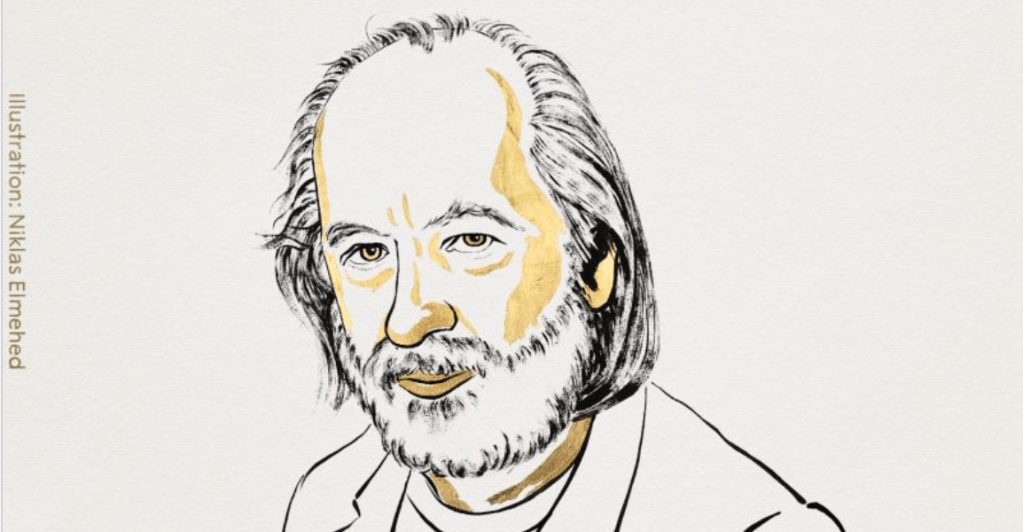
When the Swedish Academy announced that Hungarian author László Krasznahorkai had won the 2025 Nobel Prize in Literature “for his compelling and visionary oeuvre that, in the midst of apocalyptic terror, reaffirms the power of art,” it resonated far beyond the literary world. Krasznahorkai has long been called the “master of the apocalypse,” a writer whose sentences unravel like the world he describes—slowly, hypnotically, and with terrible precision. His stories are not about the end of the world in a cinematic sense, but about the quieter collapse of meaning, faith, and moral vision. In that sense, his fiction feels less like a mirror of the past and more like a warning to the present. The timing of his award could not be more appropriate, as the twenty-first century slides deeper into what many scholars now describe as a global democratic recession.
The Global Context of Decline
Authoritarianism has been on the rise around the world for nearly two decades, and the data is stark. Reports released in 2024 and 2025 by the V-Dem Institute, Freedom House, and the Economist Intelligence Unit paint a picture of accelerating decline. For the first time in twenty years, the number of autocracies now exceeds the number of democracies. The V-Dem Institute’s 2025 report shows that there are ninety-one autocratic regimes, compared with eighty-eight democratic ones. The difference may seem small, but it marks a tipping point. More than seventy percent of the world’s population, approximately 5.7 billion people, now live under autocratic rule.
Freedom House’s Freedom in the World 2025 report documents the nineteenth consecutive year of decline in global freedom. In 2024 alone, sixty countries saw a deterioration in political rights and civil liberties, while only thirty-four showed any improvement. The Economist Intelligence Unit’s 2024 Democracy Index confirms the trend. Its findings reveal that nearly forty percent of the global population now lives under authoritarian rule. What is most disturbing is that the decline is not primarily caused by fragile democracies failing, but by authoritarian regimes entrenching themselves and expanding their reach. They use sophisticated tactics: disinformation campaigns, legal attacks on dissent, manipulation of elections, and the steady weakening of independent institutions.
This is not the return of old-fashioned dictatorships. It is the rise of a subtler kind of control, one that disguises repression as stability and populism as democracy. Krasznahorkai’s homeland of Hungary has lived this transformation firsthand. Viktor Orbán’s government has mastered the art of hollowing out democracy while keeping its outer shell intact. Courts function, but selectively. Media outlets exist, but echo only one voice. Elections are held, but the outcome is rarely in doubt. This slow, bureaucratic suffocation of freedom is exactly the atmosphere that Krasznahorkai has captured for forty years in his fiction.
Waiting for the False Messiah
Krasznahorkai’s first novel, Sátántangó, published in 1985, opens in a remote Hungarian village where the rain never stops and the people are waiting for a miracle. The collective farm where they live has collapsed, and with it any sense of community or direction. The villagers are paralyzed, drunk on despair, and haunted by rumors of a man named Irimiás who was believed to be dead. When Irimiás suddenly returns, the villagers see him as a prophet, a redeemer who will lead them to a new life. But Irimiás is no savior. He is a manipulator, using illusion, flattery, and deceit to consolidate power over those too hopeless to resist.
The relevance of this story to the present moment is almost unbearable. Across the globe, people are once again waiting for saviors who promise to restore greatness, purity, or order. These figures may speak in nationalist tones or in populist slogans, but their message is always the same: trust me, not the system; believe in me, not in democracy. Like Irimiás, they thrive on disillusionment. They exploit exhaustion, cynicism, and fear. The apocalypse in Sátántangó does not arrive as fire from the sky but as a slow surrender of thought and responsibility. Krasznahorkai’s opening motto, borrowed from Kafka, “In that case, I’ll miss the thing by waiting for it”captures perfectly how societies lose themselves not by catastrophe, but by paralysis.
In the United States, too many citizens are now trapped in a similar waiting pattern. They are waiting for a single leader to redeem the political system, for technology to fix civic decline, or for the next election to heal the wounds that democracy itself cannot close. MAGA. The act of waiting becomes the act of submission. Krasznahorkai’s novel warns that when belief in collective action dies, individuals cling to false prophets who promise miracles and deliver only control.
The Circus of Collapse
Krasznahorkai’s second major novel, The Melancholy of Resistance, makes the metaphor even more explicit. A circus arrives in a small town carrying the rotting carcass of a giant whale. The people are captivated by the spectacle, drawn into chaos and violence. As mobs roam the streets, the military fails to restore order, and a strongman rises to impose discipline. The story becomes a parable about how societies trade freedom for security when fear takes hold.
It is difficult to read this and not see our own reflection. The “circus” is no longer a traveling show; it is the twenty-four-hour news cycle, the viral feed, the constant performance of outrage that defines modern politics. The whale, vast and decaying, symbolizes the corpse of truth itself, dragged from one scandal to another, manipulated until its stench becomes normal. The spectacle distracts citizens while the machinery of control advances behind the scenes. Krasznahorkai’s characters descend into confusion because they can no longer tell the difference between the real and the absurd. That confusion is the soil in which authoritarianism grows.
The tactics of modern strongmen are psychological as much as political. They exhaust people with disinformation until citizens no longer know what to believe. They weaponize cynicism, convincing the public that everyone is corrupt, that truth is unknowable, and that resistance is futile. Once this fatigue sets in, manipulation no longer requires force. The people govern themselves through despair. Krasznahorkai’s art reveals that authoritarianism begins not in the palace, but in the human heart, when people give up on meaning.
The Hungarian Mirror
Hungary’s transformation from fragile democracy to illiberal state offers a glimpse into what happens when cynicism becomes policy. Orbán’s government has turned media control, judicial manipulation, and nationalist rhetoric into a science. The country still has elections, but the opposition is fragmented and constrained. It still has newspapers, but most are owned by allies of the regime. It still has laws, but those laws are enforced unevenly. Even its universities, once centers of critical inquiry, have been brought under tighter state and corporate control, with academic freedom curtailed and dissenting scholarship marginalized. This hybrid model, neither fully free nor fully repressive, has become a blueprint for leaders across the world.
The same pattern can be traced in Russia, Turkey, China, India, and even in parts of the United States. The mechanisms differ, but the psychology is the same. Citizens become spectators rather than participants. They internalize helplessness. They retreat into tribes and echo chambers. When institutions weaken, people cling to identity and grievance as substitutes for purpose. Krasznahorkai saw this long before it became measurable data in reports from V-Dem and Freedom House. His novels describe not only how democracies die, but why people stop caring that they do.
Apocalypse as Revelation
The Greek root of “apocalypse” means “unveiling.” Krasznahorkai’s apocalyptic worlds are not about fire and destruction, but about revelation. They show what is exposed when the illusions of progress collapse. In our current era, the unveiling is already underway. What is being revealed is not just the fragility of democratic systems, but the emptiness of the stories we tell ourselves about freedom and progress.
For nearly two centuries, liberal democracies have assumed that education, technology, and markets would naturally lead to greater liberty. That faith has now cracked. We are seeing the unveiling of our own moral exhaustion. The algorithms of outrage and division have replaced the civic imagination that once sustained democracy. The result is not just political decay but spiritual fatigue. Krasznahorkai’s fiction asks whether we can still recognize meaning in a world that has traded reflection for noise.
Art as Resistance
The Nobel Committee praised Krasznahorkai for reaffirming the power of art amid terror. That affirmation is more than symbolic. Art that refuses simplification becomes a form of defiance. It slows us down, reawakens attention, and demands that we see complexity rather than slogans. Krasznahorkai’s long, winding sentences mimic the chaos of the mind searching for order. Reading him requires patience, and that patience itself becomes an act of resistance against a culture addicted to distraction.
In an age when propaganda and entertainment blur, art restores the possibility of truth. It does not deliver easy answers but forces confrontation with ambiguity. That is precisely what authoritarianism cannot tolerate. In every system where power depends on obedience, imagination is the enemy. To think freely is to threaten control. Krasznahorkai’s Nobel reminds us that the fight for democracy is not only fought in parliaments and courts but also in classrooms, galleries, and libraries.
Conclusion: Lessons for Democracy
The United States democracy is particularly in danger to the forces Krasznahorkai describes. Polarization has turned politics into spectacle. Disinformation corrodes trust. Plans for military deployments, voter suppression and institutional manipulation (e.g. fed, IRS, Justice Department, Department of Education, HHS, universities) echo the tactics of nations that once seemed distant in character. The danger lies not in a single authoritarian figure but in a culture that accepts authoritarian habits as normal.
Krasznahorkai’s work tells us that the apocalypse is not a single event but a condition of the soul. It begins when people stop believing that truth matters, when cynicism replaces conviction, and when comfort becomes more desirable than freedom. The data from 2025 only quantifies what his art already knew. The world is tilting toward control because the imagination that sustains freedom is eroding.
Yet the apocalypse, in Krasznahorkai’s view, is also an opportunity. It is the moment when illusions burn away and the truth becomes visible. We can see more clearly now what is at stake. The task ahead is not to wait for a miracle but to rebuild the habits of attention, empathy, and courage that make democracy real. Art, language, and honest storytelling remain the last frontiers of resistance.
Krasznahorkai’s novels end not with redemption but with persistence. His characters continue to move through mud and ruin, searching for light they may never find. Perhaps that is the truest picture of democracy in decline: a struggle without guarantees, a faith without certainty. The apocalypse is not the end of the world. It is the test of whether we still have the will to imagine one worth saving.
Julian Vasquez Heilig is a scholar, writer, and public intellectual whose work explores the intersections of education, democracy, and social justice. A tenured academic and the editor of the the Without Fear or Favor newsletter on LinkedIn, he writes widely about governance, equity, and the future of public life. His blogs often weave together policy, art, and personal reflection to illuminate how societies rise, fracture, and renew themselves. A longtime advocate for inclusive education and civic imagination, Vasquez Heilig’s work has appeared in national media and on his award-winning blog, Cloaking Inequity.





 Cloaking Inequity
Leave a reply to gruntinthetrenches Cancel reply