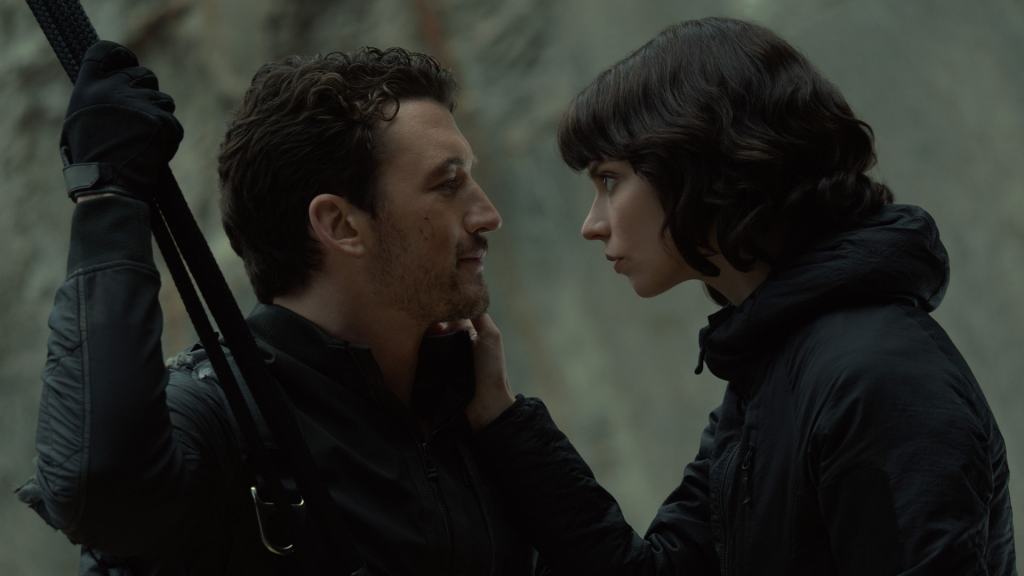
There’s a moment in the film The Gorge on Apple TV that has stayed with me long after the credits rolled. It wasn’t a spectacular action sequence or a heart-wrenching plot twist. It was a quiet line, almost a throwaway, delivered in passing: “Only those who risk going too far can possibly find out how far one can go.”
The words are borrowed from T. S. Eliot’s 1931 preface written for Harry Crosby‘s book of poems, “Transit of Venus. But in that moment, the words felt brand new. Maybe it was the tension of the scene. Maybe it was the fact that I heard them at a time when I’ve been thinking deeply about the difference between living within the limits we’ve been handed and daring to test them. Either way, the line landed with the force of a challenge.
That challenge isn’t just for CEOs, politicians, or superintendents. It’s for all of us, whether you’re teaching in a classroom, launching a small business, raising a family, or working behind the scenes in a job that never makes headlines. The question Eliot poses, and The Gorge reframes, is simple: Are you willing to go far enough to see what you’re truly capable of?
The Comfort of Playing It Safe
Let’s be honest—most people don’t. In fact, most of us are conditioned by school and our families from an early age to stay in the safe zone. We learn to color inside the lines, follow the rules, and keep our heads down. And in many cases, that makes perfect sense. Safety has its place. Not every hill is worth dying on, and not every risk is noble.
But there’s a danger in letting “safe” become the default mode for your life or your work. If every choice you make is designed to minimize discomfort or avoid conflict, you may never find out what you could have done. You might end up spending decades within the boundaries someone else drew for you, boundaries that were never meant to protect you so much as to contain you.
In education, we see this all the time. Teachers with revolutionary ideas water them down to fit district mandates. Students with bold questions learn to stop asking because the system rewards compliance, not curiosity. Administrators talk about equity but won’t touch policies that disproportionately harm marginalized students because it might upset their boss, donors, politicians or powerful parents. Playing it safe becomes a habit, and over time, it becomes an identity.
What It Means to “Go Too Far”
The phrase “going too far” makes people nervous. It sounds reckless. But the kind of “too far” Eliot meant—the kind embodied by Levi Kane, the sniper played by Miles Teller in the film, and the kind I mean—isn’t about carelessness. It’s about intentional, principled risk.
Going too far means you’re willing to step past the invisible line that says, This is enough, don’t push further. It might be speaking up when everyone else in the meeting stays quiet. It might be designing a program that challenges decades of “how we’ve always done it.” It might be telling the truth about harmful practices, even when you know it will make you unpopular.
These are not easy decisions. They can cost you promotions, friendships, or professional stability. But they are the choices that reveal where the real boundaries are, and more importantly, whether those boundaries deserve to exist at all.
Why Risk Matters for Everyone, Not Just Leaders
It’s tempting to think risk-taking is a leader’s job. After all, leaders have the authority to make changes, sign policies, and set directions. But here’s the truth: every organization, every movement, every community needs people at all levels who are willing to take principled risks.
In classrooms, that could mean a teacher throwing out the week’s lesson plan to respond to a real-world crisis their students are experiencing, knowing that authentic learning won’t happen unless they acknowledge the moment. In business, it might mean an entry-level employee suggesting a radical change to a flawed process, even if it’s “not their place.” In activism, it might mean a volunteer showing up to organize when it’s inconvenient or uncomfortable. You don’t have to have a title to make a difference. What you need is the courage to cross that line between what’s comfortable and what’s necessary.
My Own Edge—and the “Grow Your Own” Leap
When I think about my own life, the moments that mattered most weren’t the ones where I played it safe. They were the moments when I said yes knowing the odds weren’t in my favor. Publishing research and blogs that challenged entrenched power. Standing up in congressional hearing and state legislature to discuss research. Partnering with grassroots and civil rights organizations when conventional wisdom said it was politically risky for an untenured professor.
One of the clearest examples came during my time as provost at Western Michigan University. Our College of Education and Human Development was led by an interim dean at the time. She came to me about an emerging idea in the Michigan legislature—something called the “Grow Your Own” program. It wasn’t a done deal. In fact, it was still in the early stages of political conversation, with no guarantee of funding or final approval. The concept was powerful: internal school district employees—paraprofessionals, bus drivers, office staff, and others, could receive support to complete their bachelor’s degree or pursue a master’s degree to become a licensed teacher. It was a way to address Michigan’s teacher shortage by investing in the people already showing commitment to schools and communities.
But here was the challenge: for us to be prepared to lead, and to be ahead of the curve before other public universities in the state even noticed the opportunity, we would have to step out with some of our own financial commitment. That meant hiring staff and creating structures, advising systems, and outreach efforts before there was any certainty that the legislature would pass the bill, or that we would be funded.
It was a gamble. We could have waited, let the state finalize the program, and then built something after the fact. But that would have meant entering the race late, competing with 14 other public universities, and possibly being overlooked. Instead, we decided to take the risk. We invested in readiness, in program design, and in building relationships with school districts. When the legislation passed, we were not just ready—we were ready first.
The result? While I was serving as provost, WMU became home to 1,000 teacher candidates including our GYO candidates. Our teacher preparation program enrollment jumped by 30 percent. And perhaps most telling, 25 percent of all participating districts in the state—despite having 15 public universities to choose from, chose WMU as their partner. That leap wasn’t about luck. It was about foresight, preparation, and the willingness to risk resources and reputation before the outcome was secure. And it was about the recognition that risk, when rooted in purpose, can yield enormous rewards—not just for an institution, but for the state, for future educators, and for the students they will serve.
The Risk-Averse World We Live In
The hardest part about going “too far” is knowing when it’s worth it. Not every battle is yours to fight. Not every moment calls for defiance. But here are a few questions I’ve learned to ask myself before taking a leap: What’s at stake if I stay silent or do nothing? If the answer is injustice, harm, or the erosion of values you care about, that’s a strong signal. Is this about my ego or the greater good? Honest reflection can save you from taking risks for the wrong reasons. Who will be impacted if I succeed—and if I fail? Understanding the human cost and potential benefit can guide your choice. Can I live with myself if do nothing or delay? If the thought of doing nothing or delay keeps you up at night, you probably already have your answer.
We live in a time when institutions, from schools to corporations to governments, are becoming increasingly risk-averse because of authoritarian-style political pressure. Social media backlash can erupt in hours. Funding can disappear overnight. Leaders are trained to think in terms of optics, liability, and brand safety. But the great irony is that many of the problems we face—climate change, racial inequity, educational opportunity, economic injustice, the erosion of democracy—cannot be solved without people who are willing to take bold risks. We cannot manage our way out of these crises. We have to lead our way out, and that requires crossing lines.
Your Own “Gorge” Moment
You may never find yourself in a literal gorge, but you will face moments when the ground feels unsteady and the way forward is uncertain. In those moments, you will have a choice: retreat to safety or test how far you can go. That choice might come in the form of a conversation you have been avoiding, a project you have been putting off, or a truth you have been afraid to say out loud. It might appear in your personal life, your professional life, or in how you show up for your community when it matters most.
The good news is that risk-taking is a skill that can be learned and strengthened. The more you practice it, the more you come to understand where your edge truly lies and how to step beyond it without losing your balance. The more you see that edge as a place of possibility rather than danger, the more likely you are to return to it with purpose and clarity. Over time, you begin to realize that progress, creativity, and courage all live just beyond what feels comfortable.
Without giving too much away, The Gorge explores what happens when someone stops following the rules that keep people small. Levi, the sniper portrayed by Miles Teller, takes risks that defy authority and expectation, and in the process he finds something deeper than survival. What begins as a love story slowly turns into a meditation on loyalty, conviction, and the cost of doing what is right when those in power demand obedience. I gave the film four and a half stars out of five, not because it is flawless, but because it lingers. It makes you think about what it means to take a stand when doing so carries real risk.
In the end, The Gorge does not answer T.S. Eliot’s challenge about how far one can go. That is because it is not a question that can be solved in theory or by proxy. It is a question that must be lived, tested, and experienced in real time. The only way to discover your limits is to risk stepping beyond them. Every time you do, you expand not only your sense of what is possible, but also your capacity to live with integrity and intention.
That is what I want to leave you with, whether you are a formal leader or someone working quietly behind the scenes, whether you are in education, business, art, or activism. The edge is waiting for you. The limits you have been told are permanent may be farther out than you imagine. The world does not need more people playing it safe within those boundaries. It needs you, your voice, your vision, and your courage out there finding out just how far you can go.
Julian Vasquez Heilig is a civil rights leader, scholar, and lifelong sci-fi fan who believes great storytelling can teach us as much about humanity as history books can. He has watched The Gorge three times and still finds new meaning in it each time. Julian thinks Apple TV+ produces the best original films and series of any streaming platform, precisely because they focus on quality over quantity. When he’s not writing about education, equity, or democracy, he spends his Saturday nights watching and reviewing thought-provoking films and shows that linger long after the credits roll.






 Cloaking Inequity
Leave a reply to Lawanda Lyons-Pruitt Cancel reply