
Republicans have embraced disruptors to reshape education, often pursuing sweeping changes that advance their priorities. Will newly elected Democratic governors demonstrate the same willingness to challenge the status quo—or play it safe?
That question is now taking center stage in California and Texas, where two new Democratic governors face consequential decisions in the coming weeks about their next education commissioners. Will they appoint bold change agents capable of turning ambitious campaigns into measurable results, or settle for experienced administrators who are more comfortable managing existing systems than transforming them?
Recently, a former state commissioner of education shared something with me by text that I haven’t stopped thinking about: on their first day in office, they brought only what they could carry out in a cardboard box.
“These state chief roles are brutal in their turnover,” they said. “Better take the job on day 1 considering yourself temporary.”
Their verdict on packing light? “Turned out to be a good plan.”
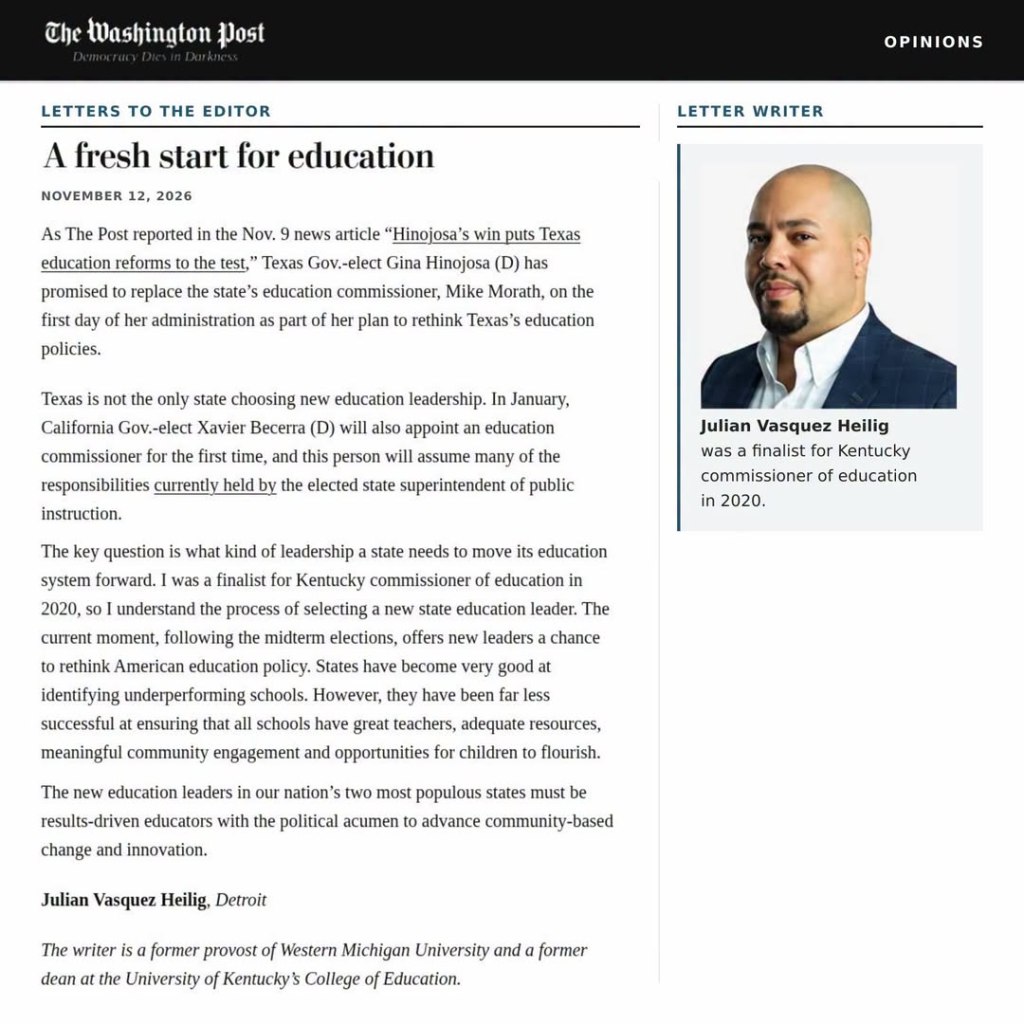
I kept thinking about that box after The Washington Post published my letter to the editor, A fresh start for education, on November 12. I argued that Texas and California need “results-driven educators with the political acumen to advance community-based change and innovation.”
The former state commissioner’s story raised another question: If you know your time in office may be short, what are you willing to accomplish before you leave?
What Does the Safe Choice Really Buy You?
I’m hearing from people in Texas and California that both states may choose superintendents for their top education appointments. That’s unconfirmed, but it raises an important question about how governors define leadership experience. Some superintendents are exceptional change agents. They’ve improved student outcomes, challenged ineffective policies, and built coalitions across divided communities. They absolutely belong in the conversation. In fact, I taught many talented superintendents while serving as faculty at the University of Texas at Austin over an eight-year period. Shout out to the UT-Austin Cooperative Superintendency Program alums!
But the superintendency can also inculcate political survival. To keep their jobs, Superintendents must maintain relationships with elected boards, negotiate with employees, manage budgets, and make decisions that can instantly threaten their employment. Board members who celebrate a leader’s courage during the hiring announcement may feel differently when that leader challenges their authority or policies they helped establish.
Over time, the job teaches superintendents how far they can push before putting their careers and mortgages at risk. That’s a reality of district leadership, not a criticism of those who navigate it successfully. As such, the safest political appointment is not necessarily the one that produces the greatest public benefit.
A California Superintendent Makes an Important Point
After I shared my Washington Post letter and mentioned unconfirmed reports that superintendents are being considered for the commissioner positions, a superintendent from a major urban California school district responded by text with an observation worth considering:
“We need someone with practical skills, but also someone with research background.”
That caught my attention because it came from someone actually leading a large California school district. The superintendent recognized that managing educational institutions and understanding research are complementary qualifications for a commissioner. Universities produce important research about school improvement and educational opportunity. Yet important findings usually struggle to influence policy.
I’ve been fortunate to experience both worlds. As a researcher, I’ve spent much of my career studying educational inequality and public policy. As an academic who has led thousands at the University of Texas at Austin, California State University, Sacramento, the University of Kentucky, and Western Michigan University, I’ve had the opportunity to put that research into practice. Working alongside talented faculty, staff, and institutional leaders, we reversed enrollment declines, achieved record-setting results, and strengthened student success.
The next commissioners must understand both worlds: the evidence that tells us what needs to change and the realities of politics and leadership that determine whether change actually happens. California’s situation makes this especially consequential. Under Assembly Bill 181, the state is now creating a new governor-appointed education commissioner, confirmed by the Senate, who will assume management of the California Department of Education and work within a restructured governance system. The new commissioner will not simply inherit an agency. They will help establish how a new system of statewide educational leadership actually functions. That requires someone who can manage complexity while also examining whether existing structures are serving students and families as effectively as they should.
Republicans Hire Disruptors. Will Democrats Play It Safe?
Donald Trump selected Linda McMahon, a former professional wrestling executive, and previously Betsy DeVos, a major Republican donor, to lead the U.S. Department of Education. Greg Abbott appointed Mike Morath, a former software entrepreneur, to lead the Texas Education Agency. These leaders were disruptors chosen to advance consequential changes in education policy.
I’ve disagreed with most of their priorities, sometimes profoundly. But their appointments raise an uncomfortable question: Why have Republican leaders sometimes been more willing to appoint disruptors, and provide political support for ambitious changes, while Democratic leaders can appear more cautious about challenging established policy? The issue isn’t whether change itself is good; the priorities and consequences matter enormously. The question for California and Texas is whether their governors will identify leaders with demonstrated records of innovation and results and provide the political support necessary to advance meaningful change.
My experience has taught me that transformational leadership requires more than announcing strategic plans or relying on outside consultants to supply the vision that institutional leaders should help develop themselves. It requires creativity, disciplined execution, coalition-building, and the willingness to redistribute authority and resources when existing arrangements aren’t serving students. None of that happens without resistance. The challenge is to engage that resistance constructively while remaining accountable for measurable results.
I’ve experienced this firsthand. At Sacramento State, we tripled enrollment in our doctoral program. At Kentucky, we doubled freshman enrollment. At Western Michigan, first-year enrollment increased 16.3% compared with 2021, and student retention reached an all-time high. Yet, disappointingly, since I stepped down as provost, Western Michigan’s overall enrollment has declined by nearly 1,000 students in just two years. Enrollment reflects many factors, but this contrast reinforces a lesson I’ve learned throughout my career: delivering measurable progress requires bold leadership, while sustaining it requires institutional structures and commitments that endure beyond any individual leader.
One of the hardest lessons of executive leadership is that institutional resistance is rarely just about the policy being changed. It is also about who makes decisions, who controls resources, and whose voices carry influence. Effective change agents must recognize those dynamics, engage critics seriously, and build coalitions strong enough to sustain progress. That requires both courage and political judgment, especially when reform challenges longstanding concentrations of power.
That is why the commissioner searches in Texas and California raise a fundamental question: Will Democratic governors appoint leaders capable of delivering community-engaged, community-informed, and community-led transformation—and provide them with the same political backing that Republican leaders have given their education appointees, even as those appointees have pursued fundamentally different, profit-driven and privatization-based reforms? Will that support endure when meaningful change challenges powerful interests?
Because hiring a change agent is only the beginning. Giving that leader the authority, trust, and political support to deliver meaningful results is the real test of a governor’s commitment to student success. Otherwise, the cardboard box becomes not a precaution, but a prophecy.
What I’d Ask the Finalists
California and Texas face distinct challenges, but the significance of their leadership choices extends far beyond their borders. As two of the nation’s largest and most influential states, their education policies shape national debates and influence reforms elsewhere. The commissioners they select could help establish a new direction for public education across the nation, with immediate implications for other states experiencing leadership transitions, including Nevada, where Governor-elect Aaron Ford (whom I first met in July 2015 at the Council of State Governments West conference in Vail, Colorado, where I presented research on charter schools and civil rights) may have the opportunity to appoint a new superintendent of public instruction. These appointments are therefore about more than managing state education agencies. They are opportunities to demonstrate what community-engaged, evidence-informed, and results-driven leadership can accomplish.
Considering this, I’d ask every finalist to describe a consequential change they delivered when powerful interests resisted it. Who stood in their way? What evidence guided their decisions? How did they build support, navigate opposition, and sustain progress? Most importantly, what actually improved for students and families, and what lessons could other states learn from those results? I’d also ask about a decision they got wrong, because genuine leadership requires the humility to acknowledge mistakes and the courage to change course when the evidence demands it.
Then I’d turn to their first hundred days. What would they change immediately? Which bureaucratic barriers would they dismantle? How would they assess agency performance, engage educators and families as genuine partners, and establish accountability for results? A compelling vision is not enough. The next commissioners must demonstrate that they know how to translate evidence into action, build coalitions, and deliver change at scale.
Conclusion: What Will Remain When the Box Is Packed?
I keep returning to that former state commissioner’s cardboard box because it represents something every public leader should remember: Authority is temporary, and even hard-won progress can be reversed when institutions lack the courage and commitment to sustain meaningful change.
The commissioner searches in Texas and California therefore present a consequential test of leadership. Will Democratic governors appoint education leaders with the research expertise, executive experience, and political judgment to deliver community-engaged, community-informed, and community-led transformation? And will they provide the same level of authority, resources, and political backing that Republican leaders have extended to their education appointees, even when meaningful reform challenges powerful interests? Appointing a change agent is only the beginning. Standing behind that leader through the difficult and often politically uncomfortable work of implementation is what transforms ambitious promises into measurable, lasting results for students and families.
Someday, the commissioners appointed in California and Texas will leave their offices. Their titles are temporary, but their decisions may shape the lives of students and families for generations. Thus, the real question in both searches isn’t who gets to carry a cardboard box into the commissioner’s office. It’s who will leave behind something worth remembering when they carry it out.
Please share.
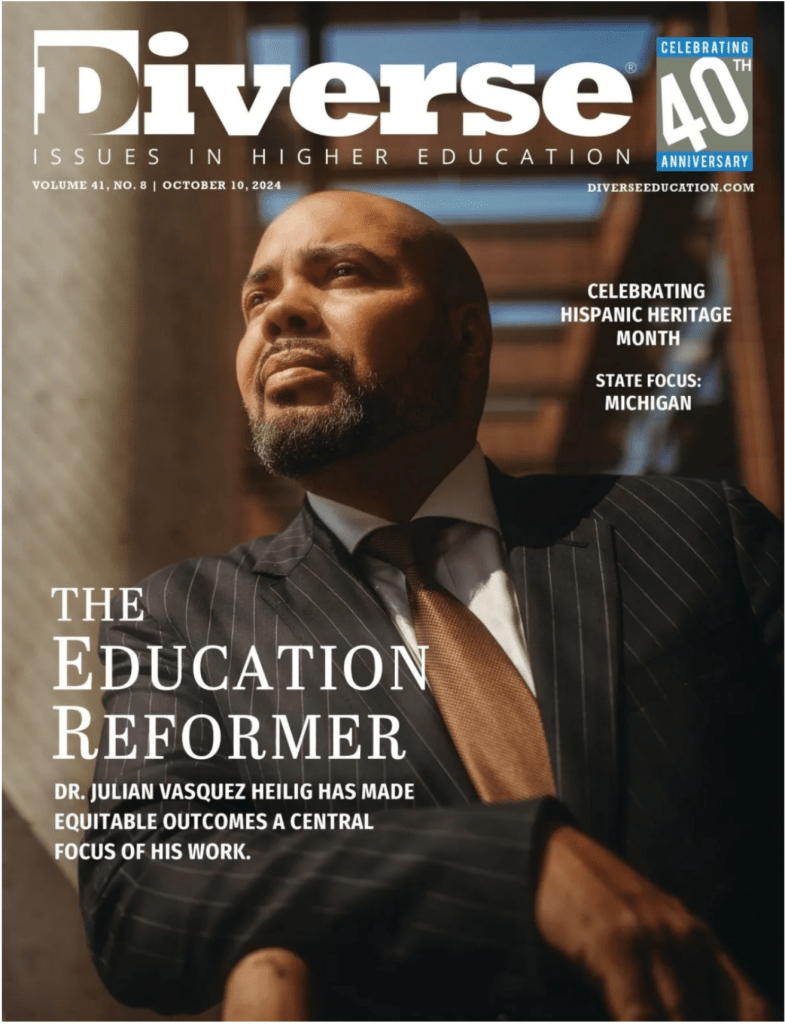
Julian Vasquez Heilig is a nationally recognized public scholar, commentator, and civil rights advocate whose work has appeared on Democracy Now!, MSNBC, Al Jazeera, NBC News, PBS, and Univision. He brings clarity, urgency, and public relevance to complex issues in education, policy, and leadership. For consulting, speaking opportunities, and collaborations, contact jvh@alumni.stanford.edu.






Leave a Reply