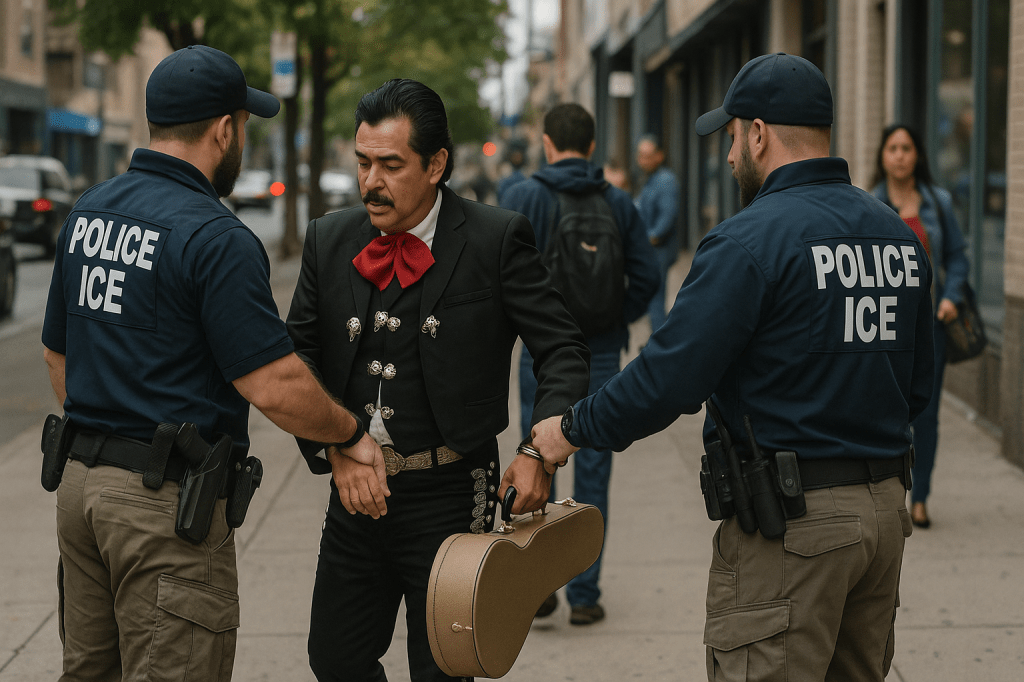
You’ve probably heard about the Supreme Court’s latest decision: being visibly Latino (and working at a car wash, speaking Spanish, etc.) can now count as a legally “relevant factors” for harassment from law enforcement.
The right-wing majority on the Supreme Court LOVES to proclaim “colorblindness.” When it struck down race-conscious college admissions in Students for Fair Admissions, the Court insisted that equal protection requires ignoring race, even where institutions seek to expand opportunity. In that opinion, the Court pronounced: “Eliminating racial discrimination means eliminating all of it,” and “[t]he guarantee of equal protection cannot mean one thing when applied to one individual and something else when applied to a person of another color.”
But when the question shifts from classrooms to cages, the same Court just green-lit “roving militarized patrols” in Southern California that can treat Latino appearance and Spanish language as part of “reasonable suspicion.” In an emergency order staying a district-court injunction, Justice Brett Kavanaugh’s concurrence tried to give racial profiling a rhetorical flourish: “To be clear, apparent ethnicity alone cannot furnish reasonable suspicion; under this Court’s case law regarding immigration stops, however, it can be a ‘relevant factor’ when considered along with other salient factors.” He added that, taken together, factors like a high share of undocumented residents in Los Angeles, congregating at day-labor pickup sites, low-paperwork jobs, and limited English proficiency “can constitute at least reasonable suspicion,” and “reasonable suspicion means only that immigration officers may briefly stop the individual and inquire about immigration status.” So, being Latino is suspicious.
Justice Sonia Sotomayor’s dissent was blistering—and precise about the stakes: “We should not have to live in a country where the Government can seize anyone who looks Latino, speaks Spanish, and appears to work a low wage job. Rather than stand idly by while our constitutional freedoms are lost, I dissent.” She catalogued the “on-the-ground reality”: armed, masked teams with assault rifles and fatigues conducting “Operation At Large” sweeping car washes, tow yards, bus stops, farms, churches and parks.
The political reaction from the Trump regime was immediate. A Department of Homeland Security spokesperson celebrated: “This is a win for the safety of Californians and the rule of law… [DHS] will not be slowed down and will continue to arrest and remove the murderers, rapists, gang members, and other criminal illegal aliens.” However, this is an outright lie as 75% of people taken into ICE custody have no criminal record.
If you’re feeling cognitive whiplash, you’re not alone. In higher education, the conservative majority says the Constitution cannot see race, even to remediate generations of racialized exclusion. In street-level immigration enforcement, the same right wing bloc says the Constitution can see race, indeed, it can count it as a relevant factor to justify a seizure. The Constitution, it seems, must be “blind” to race when race would open doors, and “keen-eyed” when race helps close them. That’s not principled jurisprudence; it’s a radical power-serving double standard.
What the new ruling actually says
To understand the mechanics, focus on their new nonsensical standard. The district court had temporarily barred ICE from conducting stops “based solely on four factors: (i) presence at particular locations such as bus stops, car washes, day laborer pickup sites, agricultural sites; (ii) the type of work one does; (iii) speaking Spanish or English with an accent; and (iv) apparent race or ethnicity.” Kavanaugh responded that, under Fourth Amendment “totality of circumstances” doctrine, those factors together can create reasonable suspicion. He offered that ethnicity alone isn’t enough, but ethnicity with the other factors can be.
Sotomayor countered that this is exactly how racial profiling gets normalized: “Allowing the seizure of any Latino who speaks Spanish at a car wash in Los Angeles tramples the constitutional requirement that officers must have a particularized and objective basis for suspecting the person stopped.” It’s now important to add that in Students for Fair Admissions the Court rejected holistic, multi-factor admissions decisions precisely because they considered race as one factor among many. The irony, and the sleight of hand, is hard to miss.
The “colorblind” promise the Court invoked in admissions
So now let’s focus on the admissions cases where majority extolls and trumpets “colorblindness.” The Court’s opinion in Students for Fair Admissions leaned on a sweeping maxim: equal protection applies “without regard to any differences of race, of color, or of nationality… universal in its application,” and “[i]f both are not accorded the same protection, then it is not equal.” It is hard to reconcile that absolutist rhetoric with a policing regime that treats “apparent ethnicity” as a government-counted suspicion factor.
Sotomayor has long warned about that asymmetry. In her SFFA dissent, she noted that that SCOTUS has repeatedly tolerated race-conscious burdens (e.g., policing at the border) even as it dismantles race-conscious benefits (e.g., admissions), pointing to Brignoni-Ponce and Martinez-Fuerte, cases that permitted “Mexican appearance” as a “relevant factor” for stops and did not forbid referrals “largely on the basis of apparent Mexican ancestry” at checkpoints. That line has now been revived and expanded by the right wing justices, from border highways to the streets and workplaces of Los Angeles and beyond.
Five specific contradictions
So let’s summarize and focus on SCOTUS’ five most egregious contradictions.
- Colorblind for opportunity, color-coded for suspicion: In SFFA, the majority says the Constitution cannot count race even to expand opportunity because equal protection is indivisible. In the LA raids case, the concurrence says the Constitution can count race as a “relevant factor” to restrict liberty (stop and harass), so long as it is bundled with other generalized cues. So, being Latino.
- Individualized review vs. demographic heuristics: SFFA condemns crude generalizations and demands individualized, non-stereotyped assessments in admissions. Here, Kavanaugh’s “totality” argument relies on broad demographics: “extremely high number… of illegal immigrants in the Los Angeles area,” certain jobs “attractive to illegal immigrants,” limited English as probabilistic shortcuts to justify seizing whoever happens to fit the profile. I see it, you see it. That’s the very logic SFFA derides in another context.
- Strict scrutiny with pages of analysis vs. a one-paragraph order on the shadow docket: Admissions cases went through full briefing, argument, and long opinions justifying a categorical rule against race-conscious benefits. The LA decision arrived through an emergency stay with no majority reasoning, exactly the kind of “grave misuse of our emergency docket” the dissent flags, yet it reshapes day-to-day constitutional policing for millions.
- “Equal protection can’t mean different things” vs. one Constitution, two racial rulebooks: The majority’s SFFA mantra that equal protection cannot “mean one thing… and something else” depending on who you are, now reads increadibly hollow and disingenous when the same Court accepts “apparent ethnicity” as a stop factor that predictably sweeps up Latino U.S. citizens alongside undocumented people (as the record clearly shows). If “both are not accorded the same protection, then it is not equal.”
- Hostility to “racial balancing” vs. reliance on racialized prevalence: SFFA attacks any appeal to racial compositions or statistical end-states as illegitimate “balancing.” Yet the concurrence here again leans on population prevalence by stating “extremely high number and percentage of illegal immigrants in the Los Angeles area” and their typical workplaces/language—to justify suspicion. That’s demographic profiling via fancy caveat.
Why this matters beyond constitutional theory
On paper, Kavanaugh says the stop is “brief,” a simple inquiry. On the ground, Sotomayor details agents “carrying handguns and military-style rifles,” racking weapons, pushing a Latino U.S. citizen against a fence, and confiscating his REAL ID and harassing him until he proved, again, he belonged. This is not an abstract legal seminar at Harvard about standards of review; it is a template for racialized policing that chills work, school, worship, and daily life for anyone who “looks Latino” in one of America’s most diverse regions. Local reporting and public officials underscore how these tactics deliberately sow fear and license aggressive behavior by law enforcement.
Meanwhile, the government line frames the order as necessary to target “murderers, rapists, gang members.” The district court record, however, and the dissent emphasize how these sweeps predictably capture citizens and lawful residents—because the triggers are not individualized wrongdoing but appearance, language, location, and job type. It’s a Latino-focused dragnet. And given this supremacy (not a typo) court’s willingness to treat “apparent ethnicity” as a relevant factor, there’s a real risk that, when the right case reaches the Court, it will extend this “hunch and vague” stop-and-frisk logic to everyday policing, effectively making it lawful for all Americans.
Let’s call the new doctrine what it is: Selective “colorblindness”
The right wing on the Court is not neutral about race; it is selective, embracing a Plessian, separate-and-unequal approach. The majority strikes down race-conscious remedies at gateways to opportunity while welcoming race-coded suspicion on sidewalks and shop floors. The pattern serves power: close the doors labeled “education, mobility, leadership,” and open the funnels labeled “surveillance, detention, removal.”
If the Court truly believed that “eliminating racial discrimination means eliminating all of it,” it wouldn’t keep carving out zones and devising doctrines that let federal government agents use “apparent ethnicity” to justify seizures of citizens and non-citizens alike. It would demand particularized, non-racial indicators before the state lays hands on anyone. Until that standard is real, let’s be honest about the through-line: this isn’t about principle; it’s about racialized power, colorblind when race opens doors, color-coded when race shuts the door of the cage.
Julian Vasquez Heilig is a nationally recognized education leader, scholar, and advocate for equity. He has analyzed Supreme Court education jurisprudence and offered critiques. In the classroom, he has taught School Law at The University of Texas at Austin (EDA 388L) and Legal Issues for Educational Leaders in the doctoral program at California State University, Sacramento (EDD 611). Vasquez Heilig has provided expert testimony for state legislatures, the U.S. Congress, the U.S. Commission on Civil Rights, and the United Nations, and has served as an expert witness in court matters involving education policy. His legal and policy scholarship appears in venues such as Law & Inequality: A Journal of Theory and Practice, Stanford Law & Policy Review, Berkeley Journal of African-American Law & Policy, Journal of Law and Education, Kansas Journal of Law & Public Policy, and the Hispanic Journal of Law & Policy. Vasquez Heilig brings jurists’ attention to access and policymakers’ focus on opportunity by translating complex legal debates into actionable strategies for equity in American education.



 Cloaking Inequity
Leave a comment