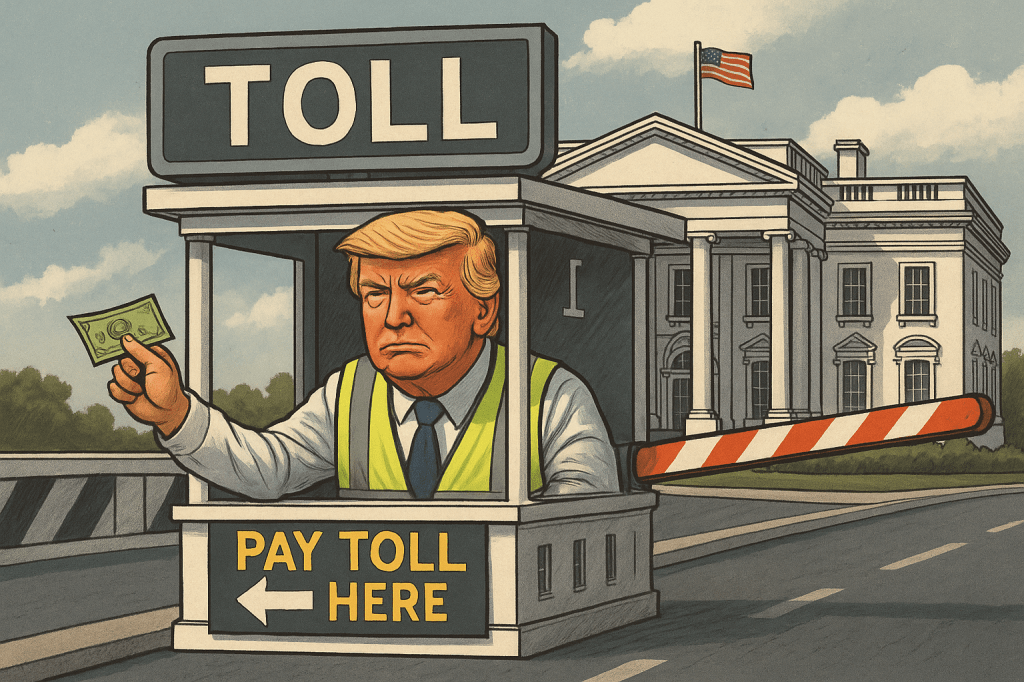
Picture this as satire: you’re driving down Pennsylvania Avenue and the White House has become a tollbooth—pure metaphor, not a factual claim. Inside, a neon-vested Donald Trump leans out and says, “Pay up,” lowering the striped barrier. What follows is commentary and opinion based on publicly reported facts from U.S. and international outlets. Those reports describe payments, settlements, lobbying, and access-seeking by governments, corporations, and wealthy individuals before and during Trump’s time in office. Taken together, they raise questions about how money and proximity intersect with influence. This piece offers my interpretation of that reporting; readers can review the numerous sources in the media and judge for themselves.
Here’s what could be the real story behind Trump’s latest tariffs. He has announced a fifty percent tax on kitchen cabinets and vanities and a thirty percent tax on upholstered furniture that will take effect by early 2026. To the public, it looks like toughness on trade and the return of “America First” economic nationalism. But beneath the headlines, it could be the same old shakedown. These tariffs are likely not about rebuilding American manufacturing. They are probably about building Trump’s system of leverage over corporations and billionaires.
Trump’s latest pitch is to give the tariffs back to the people, claiming he will return the money collected from foreign importers as direct payments to American citizens. It sounds populist and simple. But as before, the people paying these tariffs are not foreigners. They are Americans. The farmers, contractors, and small business owners who already absorb the costs of tariffs through higher prices would rather see them go away altogether. Instead, Trump is likely using the pain they feel as political theater, buying loyalty with their own money while convincing them that tariffs are somehow a gift.
The Tollbooth Strategy
Trump’s tariff system can functions as a tollbooth disguised as policy. He can essentially manufacture economic pain through sweeping tariffs, then could theoretically provide relief through subsidies, carve-outs, or selective payments for those who play ball with him. The illusion is then that he is redistributing wealth to the working class. In my opinion, the reality is that he is redistributing political dependence like dictators do.
The pattern has not changed. Tariffs create chaos. Prices rise. Workers and industries suffer. Then Trump swoops in with subsidies, declaring that he has saved those very people from the crisis he created. In 2018 and 2019, farmers devastated by the trade war with China received billions in bailout payments. Those payments came not from Chinese tariffs but from American taxpayers. The money softened the pain long enough to secure rural political loyalty while concealing the deeper damage.
Now the same dynamic has returned. The new tariffs will raise prices on furniture, cabinets, and building materials. When the pressure mounts, Trump will likely use the collected funds as a political slush pool, distributing them to targeted groups as proof of his supposed generosity. It is not economic strategy. It looks like political choreography, designed to make people feel grateful for a problem he created that they never wanted in the first place.
The TikTok Test Case
The TikTok saga offers the clearest glimpse into how Trump appears to turn economic power into personal advantage. In 2020, he first threatened to ban the app, citing national security and data risks from China. The move threw millions of users and a global company into uncertainty. Media reports say that behind the scenes, tech giants lined up to buy at a discount, I mean “rescue” the app from Trump’s declaration (satire). Some reports said Microsoft and Walmart were poised to take over its U.S. operations.
Then Oracle appeared as the surprise winner. Its chairman, Larry Ellison, was one of Trump’s strongest allies and donors. According to media reports, he had hosted Trump at private fundraisers and poured millions into pro-Trump causes. Suddenly, Oracle was declared TikTok’s “trusted technology partner.” Trump claimed victory for protecting America’s data, but the real message seemed to be that: loyalty pays.
That episode revealed how Trump wields public power like a classic dictator. He creates a crisis, declares himself the savior, and rewards those who align with him. So it seems it was not about TikTok or data protection. It was about control. By 2025, Trump’s allies in Congress had revived scrutiny of Chinese tech firms, and the same playbook was back in motion. Each new review became another tollbooth, another chance for access and to reward allegiance.
The 2025 Tariffs on Furniture and Cabinets
In October 2025, Trump invoked Section 232 of the Trade Expansion Act to impose steep tariffs on furniture and cabinets, claiming these items were essential to national security. Cabinets and vanities now face fifty percent tariffs. Upholstered furniture will carry thirty percent. Even timber and wood imports are taxed at ten percent. The announcement triggered panic among manufacturers, retailers, and consumers alike.
Restoration Hardware’s stock plummeted. IKEA and other major chains began scrambling to adjust. North Carolina manufacturers, once supporters of Trump’s trade rhetoric, warned that the tariffs would cripple supply chains rather than save them. Domestic factories rely heavily on imported components, and higher import prices will drive smaller suppliers out of business. The tariffs are being marketed as protection for American industry, but in practice they punish the very people they claim to defend.
Trump’s response was predictable. He argues that the tariffs are making America great again and hinted he would redistribute the “tariff money” to citizens as checks, echoing the farm bailout payments. Yet, once again, it is Americans footing the bill at every stage. Families will pay higher prices for home goods, and taxpayers will fund the rebates meant to make them forget the cost. The scheme transforms self-inflicted economic harm into political theater.
The Billionaire Kowtow
The tollbooth strategy also serves a second audience: billionaires and corporations. For them, tariffs are not penalties but openings—chances to negotiate, protect profits, and secure favor in exchange for loyalty. A well-timed endorsement, a generous campaign donation, or a strategic investment can make problems vanish in mob-like fashion (Said in Senator Ted Cruz mob accent). Trump’s circle understands this game because it runs on fear and access. After the TikTok confrontation, corporate America took note of how swiftly pressure could turn into opportunity for those who played along.
Major media companies, manufacturers, and financial institutions have learned that criticism can bring punishment while cooperation brings privilege. Executives now line up for tariff exemptions and favors, knowing that the more chaotic the economic landscape becomes, the more valuable proximity to Trump is. In just the past year, Disney’s ABC agreed to pay $15 million toward Trump’s presidential library to settle a defamation suit; Paramount/CBS paid $16 million to resolve his lawsuit over a 60 Minutes interview; Meta agreed to roughly $25 million to settle his 2021 platform-suspension case; and YouTube agreed to $24.5 million to settle over its 2021 ban. In this system, business success depends less on innovation and more on loyalty, as economic uncertainty itself becomes the currency of power.
This approach turns governance into a marketplace. Instead of crafting long-term policy, Trump seemingly sells access by creating scarcity and chaos, then monetizes relief. The process rewards submission and punishes independence. Billionaires who cooperate are given exemptions, contracts, and favorable treatment. Those who resist can find themselves publicly ridiculed, targeted by tariffs or even facing threats. The message is that in Trump’s economy, loyalty is likely the only stable currency.
Who Pays the Real Price
The people who engaged in this system are the same ones being told they are winning. Consumers will pay hundreds or thousands more for everyday products. Small businesses will struggle to stay afloat. Farmers will again be forced to rely on subsidies rather than stable trade because their trade partners (e.g. China and Canada) want to have nothing to do with them. The burden falls hardest on working Americans who have no lobbyists, no carve-outs, and no chance to negotiate exemptions.
Trump has apparently learned to convert pain into loyalty. By presenting rebates and payments as gifts from his administration, he can essentially transform economic hardship into dependence. I have noticed that people harmed by tariffs are often publicly thanking him for the temporary relief he doles out afterward. It is the political version of robbing someone’s house, then handing them a flashlight and calling it charity.
The Toll Never Ends
Trump’s tariffs, threats, and bailout promises are not tools of national renewal. They are tools of dictatorial control. The pattern repeats itself across every sector he touches. He creates the problem, sells the solution, and is empowered to collect loyalty from both sides of the exchange. His latest promise to give tariffs back to the people is simply the next iteration of that game.
The farmers and workers who will receive these payments are not villains; they are victims of age old political con. They are being paid with their own money and told it is a gift. The truth is that I suspect they would rather see the tariffs disappear entirely. But that would deprive Trump of a tollbooth. The toll is what can keep the political and financial machine running.
The danger is not just economic. It is civic. Trump’s version of governance replaces shared prosperity with personal dependence. It tells Americans that their livelihoods depend not on fair systems or functioning markets, but on the whims of one man. The White House was never meant to be a tollbooth, yet that is exactly what it seems like it has become. And the longer it operates that way, the higher the price for everyone forced to play along.
Julian Vasquez Heilig is a scholar, public intellectual, and policy analyst who writes about the intersections of education, democracy, and power. He has spent his career examining how systems—whether in higher education, public policy, or politics—use influence, money, and narrative to shape outcomes. His blog Cloaking Inequity and Without Fear or Favor newsletter on Linkedin explores the hidden structures that govern American life, from public education to presidential politics, and challenges readers to see how leadership, integrity, and equity intersect.





 Cloaking Inequity
Leave a reply to The Hidden Costs of Being Ruled by the Politicians – Cloaking Inequity Cancel reply