
Have you ever started imagining a future that didn’t exist yet?
I was looking at houses in Honolulu, a city where I did not live. I had not been offered a job there. I was not even sure I would become a finalist for President of the University of Hawaii. Yet somewhere along the way I had allowed myself to imagine the possibility. I had started looking at neighborhoods and schools and commute times because I wanted to know what life might look like if things worked out.
Anyone who has participated in a serious job search understands what happens next. You begin to mentally furnish a future that does not yet exist. You picture yourself in the role and imagine your first day. You may even wonder where you would buy groceries and where your family might spend weekends. The opportunity slowly transforms from a job opening into a possible chapter of your life.
Then comes the email or phone call. Another candidate has been selected. Thank you for your interest. We wish you the best in your future endeavors. Every rejection seems to have been written by the same committee somewhere in the clouds. The language changes slightly but the outcome remains the same.
What is not usually said about rejection is that you are not simply losing a job. You are losing a future you allowed yourself to imagine. The disappointment for me was about the community I had hoped to serve and letting go of a story that felt increasingly possible. Looking back now I can smile about the Hawaii presidential search. At the time I absolutely could not.
The funny thing about rejection is that it always feels permanent in the moment. We human beings have an incredible ability to sometimes convince ourselves that whatever is directly in front of us will determine the rest of our lives. We assume that one opportunity lost will define us forever. Then years later we struggle to remember why we were so concerned.
Today also happens to be my birthday, and perhaps that is one reason these thoughts have been on my mind. Birthdays have a way of inviting reflection. They encourage us to look backward at the roads we have traveled and forward toward the roads we have yet to walk. What strikes me is how many of the disappointments that once seemed so important eventually became footnotes in a much larger story.
The Courage to Keep Showing Up
Yesterday I was reminded of all of this when I saw what may be the most honest post I have ever encountered on LinkedIn. A professor announced that he had just received his one hundredth rejected grant proposal. To celebrate the occasion he brought doughnuts to work. Not after his hundredth funded grant. Not after a major award. Not after receiving national recognition. After his one hundredth rejection.
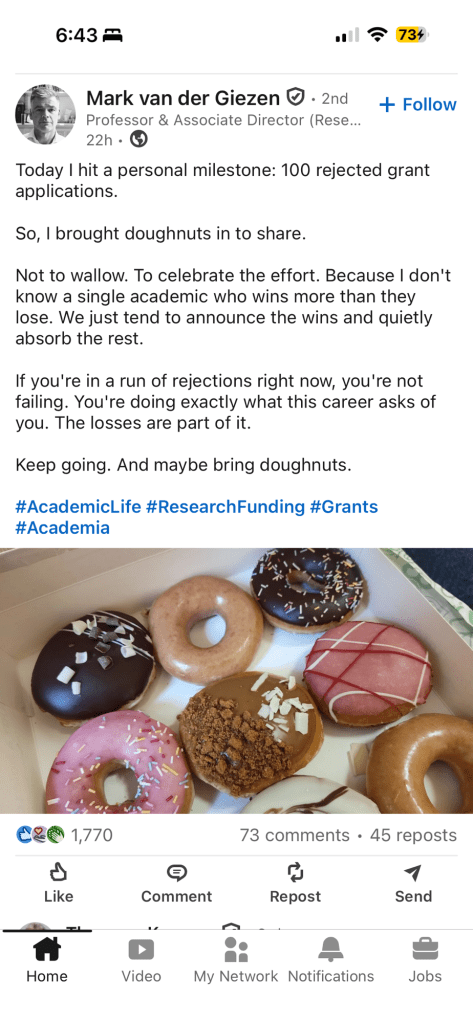
I laughed when I saw the post because it felt more honest than most professional stories online. Social media often gives the impression that successful people spend their lives gliding effortlessly from one achievement to another. Almost everyone is honored and humbled and excited and grateful at the same time! Apparently nobody gets rejected anymore. Apparently nobody receives bad news. Of course we all know that is nonsense.
Nobody accumulates one hundred rejected grants by accident. Nobody reaches that milestone by sitting comfortably on the sidelines. One hundred rejected grants means one hundred attempts and one hundred ideas and one hundred moments when he believed strongly enough in a possibility to risk hearing no. The professor was not celebrating rejection… he was celebrating persistence.
His post immediately reminded me of Roger Federer. In a commencement speech at Dartmouth in 2024, Federer revealed that he won only fifty four percent of the points he played during his professional career. Think about that for a moment. One of the greatest tennis athletes in history lost nearly half the time. One of the most dominant champions in modern sports spent much of his career watching points go to someone else.
The statistic sounds absurd until you realize what it means. Most people think success looks like constant victory. Most people imagine that extraordinary individuals somehow avoid failure. Federer reminds us that greatness often looks very different. Greatness is losing repeatedly without allowing those losses to define who you are.
The lesson extends far beyond tennis. A denied grant is a lost point. A rejected resume is a lost point. An unsuccessful interview is a lost point. An award that goes to someone else is a lost point. The challenge is remembering that losing a point does not mean losing the match.
The Losses Nobody Sees
One thing I tell my graduate students is that you hear more no’s as you get older. Whenever I say that I can see concern spread across the room. Many of them assume I am describing decline or disappointment. What I am actually describing is growth and opportunity.
Many graduate students have spent most of their lives succeeding. Strong grades led to admission into college. Success in college led to admission into graduate school. By the time they arrive in a doctoral program they have accumulated an impressive collection of accomplishments. For many of them, but not all, rejection has been relatively rare because one success has often led directly to another.
I remember being in a similar position when I applied to college. I had certainly experienced setbacks but I had not heard many major no’s in life. More importantly it was a different era. Generation X did not apply to twenty or thirty institutions. Most of us applied to far fewer schools because the process was different and the competition was different. Honestly, the stakes felt lower than they do for many students today.
Students now intensely compete against extraordinary applicants with GPAs beyond 4.0 from around the world. Universities such as Stanford and Harvard and Michigan and Texas receive applications from remarkable young people with exceptional accomplishments. Students can literally do everything right and still receive disappointing news. Sometimes rejection is not a reflection of talent or effort. Sometimes there are simply more deserving people than available opportunities. It’s math.
The older I get the more I realize that hearing more no’s is often evidence that life is expanding rather than shrinking. Early in our careers there are only so many opportunities available to us. As careers develop new possibilities appear that did not even exist a decade earlier. Grants and fellowships and leadership searches and speaking invitations and awards all create opportunities for success. They also create opportunities for disappointment.
That reality helps explain why accomplished people accumulate so many rejections. They are hearing more no’s because they are pursuing ambitious goals. The person who never receives a rejection letter may not be winning more often. Sometimes that person has simply stopped placing themselves in situations where rejection is possible.
Today, on my birthday, that lesson feels especially meaningful. The older I get, the more interested I am in understanding what those experiences taught me. Understanding the journey as I wrote about in a recent blog. Make a difference and success matter, but so do setbacks. Both leave their mark. Both shape who we become.
Recognition Beyond Results
Last week I received a reminder of why this matters. Several colleagues had nominated me for a prestigious award that will be announced in August. Whether I ultimately receive the award is almost beside the point. The nomination itself was deeply meaningful because it came from people whose judgment I respect, including my former advisor and friend Linda Darling-Hammond. Knowing that colleagues believed my work was worthy of recognition means far more than any eventual outcome. In many ways, being nominated by people I admire and respect was simply greatest honor of all.
What affected me most was a conversation with the chair of the award committee. As she explained the committee’s reasoning she said that over recent years I had been “fearless” writing and saying the things that needed to be said. She noted that I had often done so despite knowing there could be political consequences.
That comment has stayed with me during my birthday week. Birthdays have a way of encouraging reflection and inviting us to look back over the winding paths our lives have taken. I realize now that some of the things that matter most are often invisible to us in the moment. Courage has its own audience… and its own detractors. One of the lessons life has taught me is that the negative stories some people tell about us publicly or behind our back, often in service of their own agendas, are not usually the same as the experiences others have when they actually know us. Over time, I have found that firsthand experience has a way of cutting through assumptions, rumors, and misconceptions.
Conclusion: What Birthdays Teach Us
The professor with the doughnuts understood something important. Roger Federer understood it too. The people who accomplish meaningful things rarely organize their lives around avoiding rejection. They understand that a life without rejection is often a life spent safely on the sidelines. They keep showing up and taking chances and imagining futures that may or may not happen.
The longer you live life the more no’s you will hear. That is not bad news. It often means you are still growing and still risking and still pursuing something worthwhile. The people who eventually hear the most yeses are often the same people who survived the most no’s.
As I reflect on another birthday today, that may be the lesson I appreciate most. The years have taught me that life is rarely a straight line. The future we imagine is often not the future that arrives, and that is not usually a bad thing. Some of life’s greatest blessings enter through doors we never intended to open.
Looking back, many of the experiences that shaped my life began with disappointment. Had every search gone my way, had every opportunity unfolded exactly as I hoped, I would not have met many of the people who changed my life. I would not have served some of the communities that became so important to me and ignited my passion. I would not have learned some of the lessons that proved most valuable. I would not be writing these words today.
For those of you who have already spent many decades building lives and careers, birthdays can bring a different set of questions. Humans may begin to wonder whether their most important contributions are behind them or still ahead. We may find ourselves counting years or the number of pills we have to take everyday instead of possibilities. I believe that purpose does not retire. As long as we remain curious, willing to learn, and committed to serving others, there are still communities to impact, ideas to pursue, and contributions to make. Many of the most meaningful chapters of life and career are written after people assume the story is winding down.
That is why birthdays for me now are less about counting years and more about gaining perspective. They remind me that our lives are not defined by a single rejection, a single award, a single job, a single mistake, or a single accomplishment. They are defined by whether we continue showing up when the outcome of life is uncertain. And if you eventually collect one hundred rejections along the way, you might want to bring doughnuts. You’ve earned them. I’ll take the blueberry doughnut(s). Some choices get easier with age 🍩🫐.
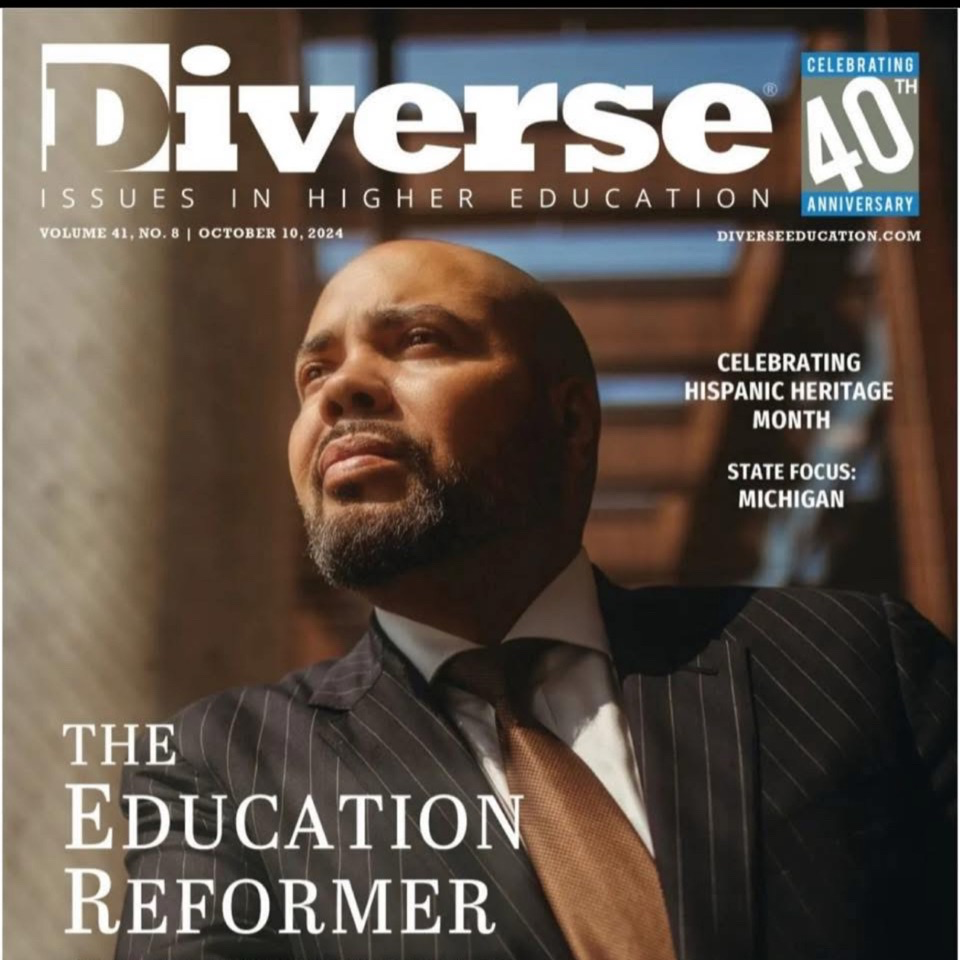
Julian Vasquez Heilig is a nationally recognized public scholar, commentator, and civil rights advocate. He has appeared on major media platforms including Democracy Now!, MSNBC, Al Jazeera, NBC News, PBS, and Univision. His media work reflects a longstanding commitment to making complex policy and leadership issues accessible, urgent, and meaningful.







Leave a Reply