Liberals keep reaching out asking me to read Tyler Austin Harper.
Not one liberal. Not one conversation. It has happened enough the past few days that I have started wondering why. Why has Tyler become the Black writer some liberals want Black intellectuals to read? Why are these particular essays, the ones questioning DEI, affirmative action, anti-racism, and the legitimacy of how Black scholars enter elite institutions, the essays that keep getting passed along?
I do not presume to know the motives of the liberals sending them to me. Some undoubtedly think Tyler is an excellent writer. Some probably find his brief stint as an assistant professor of environmental science as compelling. Some have actually been highly critical of his writing. And so I keep wondering whether Tyler has become something he describes in his own writing: the last Black person they talked to. In his Atlantic essay “Why I Quit the Tenure Track,” Tyler describes what he calls the “last Black person I talked to” problem. In his telling, some liberal white academics become so accustomed to deferring to the lived experiences of people of color that they struggle when Black people disagree. Tyler relays that the solution is simply to become the last minority person a white administrator hears before making a decision.
It is one of the strangest observations in the essay. It may also explain something about his essay’s growing appeal. Tyler occupies an unusually useful rhetorical position to some in the contemporary debate over higher education. He is a Black writer who left higher education as an assistant professor of environmental studies to now critique DEI, affirmative action, progressive racial discourse, and elite academia as a former “insider” of the institutions that championed those ideas. That gives some readers something enormously valuable: permission. I am not saying diversity lowered standards. Tyler Austin Harper is saying it. I am not saying progressive academics have become obsessed with race. He is saying it. I am not questioning whether some Black professors deserved their appointments. A former Black assistant professor is doing that. For example, one reader messaged me:
You know Tyler is black, right? He wrote a great article about why he left Bates. Did you read that one?
Tyler becomes the last Black person they talked to. That does not make his arguments wrong. Though they are wrong, more on this is a moment. However, identity should never immunize an argument from criticism, nor should it disqualify one. Tyler makes several important arguments about contemporary higher education that deserve serious consideration: Universities tokenize faculty of color. They impose racialized service burdens. They sometimes substitute diversity rhetoric for structural change. They exploit contingent faculty while issuing statements about justice. They can become bureaucratic, hypocritical, and intellectually conformist.
I have spent enough of my own career in higher education as a department leader, dean, and provost to recognize many of those contradictions. I write about them often. But Tyler repeatedly takes evidence of institutions behaving badly around race and transforms it into evidence that racial equity has caused institutions to behave badly. Those are profoundly different arguments.
From Tokenism to a Theory of Black Qualifications
Tyler’s description of his experience at Bates College, where he was an assistant professor of environmental studies, contains episodes that, at first glance, would seem to concern anyone committed to racial equity in universities. But after reading his telling of them, I am not so sure. He says he was repeatedly recruited for what he calls “Minority Work.” He describes being asked to help organize Martin Luther King Jr. Day despite having no scholarly expertise on King. Honestly, I would have been honored to be asked. During a faculty search, he recounts an incident in which a colleague apparently assumed that another scholar’s research on the African diaspora overlapped with Tyler’s scholarship simply because Tyler was Black. That assumption was certainly worth challenging. But Tyler’s telling also left me wondering whether every awkward request, clumsy assumption, or ordinary burden of faculty life needs to be interpreted as an injury. By this point in his account, I began to understand why Tyler was not particularly well suited to faculty life.
That being said, faculty of color have described uncomfortable experiences in higher education for generations. Scholars have called them cultural taxation, invisible labor, identity taxation, and racialized service. Universities recruit Black professors and then expect them to mentor every Black student, serve on every diversity committee, appear in every brochure, explain every racial controversy, and demonstrate that the institution is making progress. I should add that I would consider much of this work an honor; I have embraced it throughout my career. But not everyone does, nor should every faculty member of color be expected to simply because of who they are.
Yet, Tyler does reach an astounding conclusion about his own experience as an assistant professor: Bates had hired him “to be visibly Black first and a scholar second, if at all.” I believe that feeling deserves to be taken seriously. But then something remarkable happens as he continues. Tyler begins extending the suspicion allegedly directed toward him to other faculty of color. This is where we immediately part ways.
After participating in a faculty search in which he believed colleagues were prepared to hire a substantially weaker candidate of color, Tyler writes that he began wondering whether other newly hired minority professors at Bates were actually qualified. His experience had made him suspicious of the legitimacy of other scholars of color. Wow. That should have been the moment for the essay to interrogate one of racism’s most successful accomplishments, a colonized mind. Instead, it becomes the primary evidence for Tyler’s argument.
The racial stigma attached to affirmative action has always operated this way. A Black professor walks into the room carrying an invisible question that professors of other demographics usually do not: Did you really earn your place here? The Black scholar can publish more, teach better, earn more grants, and accumulate more credentials, yet the suspicion survives because the suspicion was never really about the résumé. Interestingly, Tyler argued he knows this because he says he experienced it himself as an assistant professor of environmental studies. Yet his essay validates and support the suspicion for everyone else. What a turn of events.
One Search Committee Is Not a Theory of Higher Education
And so, Tyler recounts the faculty search in which he believed a candidate of color was academically weaker than another finalist. He describes her research dismissively and argues that some colleagues were prepared to overlook serious scholarly deficiencies because of race and her enthusiasm for equity work. But anyone who has participated in enough faculty searches knows how contested these personal judgments can be. Search committees constantly and vigorously disagree about research quality, teaching effectiveness, methodological sophistication, interdisciplinarity, institutional fit, curricular needs, grants, future trajectory, and the relative importance of each criterion. One professor’s obvious choice can be another’s obvious rejection. So you didn’t like what she brought to the table, other people did. Get over yourself Tyler.
So, one disputed faculty search cannot carry the explanatory weight Tyler places upon it. Yet from this experience, Tyler reaches for one of the most inflammatory analogies imaginable, describing what he witnessed as “a sort of woke Jim Crow.” But Jim Crow was a system explicitly designed to subordinate Black people after slavery and Reconstruction. Whatever one thinks about DEI initiatives, comparing equity practices to Jim Crow does more than critique university bureaucracy. It collapses the profound historical distinction between an oppressive racial regime designed to exclude and subordinate Black people into an analogy that gives people who already oppose equity a remarkably comfortable argument: racial inclusion is simply Jim Crow in reverse. It turns efforts to address racial inequality into the moral equivalent of the system that produced and enforced it. That is not serious historical analysis from a former assistant professor of environmental studies. It is rhetorical sleight of hand, and it is nonsense. His Jim Crow phrase is memorable. That is precisely why it is dangerous when he severely misuses it.
Then Came the Death of Jason Arday
Tyler’s errors become much more serious in his essay entitled The Truths That Failed Jason Arday. Tyler begins from a principle with which I strongly agree. Following Arday’s death, he asks the public to “treat him like a person.”
Yes.
Treat him like a person.
Not a diversity statistic. Not Cambridge’s inspirational Black professor. Not evidence for the success of DEI. Not evidence for the failure of DEI. Not a symbol for Black excellence. Not a symbol for Black incompetence. Not a person who made every good choice in life. A person. But Tyler’s essay struggles to follow its own command. His ironies pile up. He dutifully catalogs the allegations surrounding Arday in succession: plagiarism, questionable qualifications, disputed elements of his biography, medical claims, athletic accomplishments, publishing claims. Tyler ultimately describes him as a “serial fabulist and unrepentant plagiarist.”
Then comes the sentence that stopped me in my tracks. Tyler writes that “only a Black person with Arday’s dubious qualifications and seemingly invented biography could have been elevated to the top of the mountain in academia and publishing.” Only a Black person. Consider the magnitude of that claim. Tyler is no longer claiming that Cambridge failed to vet someone adequately. He is no longer claiming that publishers became captivated by an extraordinary biography. He is no longer claiming that universities sometimes tokenize Black scholars. Blackness itself has become explanatory and problematic. Arday’s ascent to this ONLY becomes possible because he was Black. Shame on you Tyler for manipulating your audience to get them there. That is precisely the trope Black academics have confronted for generations and that you disingenuously decried previously.
Academia Was Never the Meritocracy Tyler Imagines
There is a historical problem with Tyler’s argument that cannot be ignored. Elite academia was never a pristine meritocracy that diversity initiatives suddenly corrupted. It still isn’t. I’ll tell you stories the next time you see me. Universities have always distributed opportunity through pedigree, patronage, elite networks, recommendation letters, disciplinary fashions, social capital, family connections, institutional prestige, and relationships with powerful scholars. For generations, institutions explicitly restricted participation by race, gender, religion, nationality, and class.
Mediocre people did not arrive in elite institutions with DEI. They were already there! And when a professor of any majority demographic turns out to be mediocre, fraudulent, abusive, intellectually unserious, or simply wrong, we rarely ask whether his appointment proves that the majority demographic are systematically unqualified for academia. He or she or they failed. Not their whole race or gender. However, that distinction frequently disappears when the scholar is Black. And we know why.
A Black professor accused of misconduct can quickly become evidence that affirmative action failed in Tyler’s world and writing. A questionable appointment becomes evidence that “high” standards collapsed. An embellished biography becomes evidence that White liberals have lost their minds about race. The individual becomes the race. That is the trope Tyler should be dismantling. Instead, his framing thirstily reinforces it.
Character Assassination Is Not Accountability
This becomes particularly troubling because Jason Arday is dead. Serious allegations always deserve serious investigation. Plagiarism matters because scholarship depends on citing our colleagues when we use their work. Although the White House operates on a different standard these days (ex. Epstein Files), no racial justice worthy of the name requires us to pretend misconduct did not occur. But, as I wrote yesterday, accountability and annihilation are different things.
Arday died before the investigations and public controversies surrounding him had fully run their course. That fact should make The Atlantic especially disciplined about distinguishing allegations, established facts, interpretations, and speculation. Instead, Tyler’s essay assembles virtually every sensational google search claim surrounding Arday and then offers a wild psychological theory for how his story may have developed. Tyler imagines how intoxicating the attention of admiring white liberals might have felt to someone who had “come up hard.”
Maybe, but probably not.
But we do not know. Tyler is speculating.
And when speculation about a dead man’s psychology is placed beside the most damaging allegations about his character, something has changed. We are no longer simply evaluating evidence. He is purposefully constructing a character. That begins to look dangerously close to character assassination. The irony is that Tyler recognizes the cruelty of the spectacle. He writes that Arday was “fetishized in his downfall by white conservatives.” Yet the essay sensationalizes and underscores much of the material that made that spectacle possible. You cannot condemn the public dissection while sharpening another scalpel to hand to the operating mob.
Why Are Liberals Sending Me This?
Which brings me back to the messages I keep receiving. Why Tyler Austin Harper? Again, I cannot know what motivates everyone who has sent me his work. But I do know what motivated at least one reader. After I told her that, in my view, Tyler’s piece amounted to character assassination, and that I thought his articles were, to quote myself, “garbage.” She responded in a way that was particularly revealing. I had not raised Tyler’s race as a reason to accept or reject his argument. She did. She told me this:
He [Arday] made up all that sh_t about himself. The fact that the algorithms of social media spread it and made him feel hounded is evidence of racism. But the fact the guy got that far was DEI.
In November 2024, Tyler appeared at the Federalist Society’s National Lawyers Convention on a showcase panel titled “The Age of Group Identity: What Is It? How Did We Get Here? How Do We Move Beyond It?” The panel also included Heather MacDonald and Gail Heriot, prominent critics of DEI. To be clear, simply appearing at a Federalist Society event does not make Tyler a member, affiliate, or right-wing, and the organization itself explicitly says as much about people listed on its website. That is not my point. My point is about the public curriculum and the ideological portability of arguments. Tyler’s critiques can travel from The Atlantic, to liberal readers who send his essays to Black colleagues, to one of the country’s most influential conservative legal gatherings. Different audiences may encounter Tyler for different reasons, but his Blackness is giving particular authority to arguments about DEI, affirmative action, group identity, merit, and the qualifications of Black scholars that some readers may be far less comfortable making in public themselves without his permission.
That is why I keep returning to Tyler’s own “last Black person I talked to” formulation. After he left his faculty role as an assistant professor of environmental science, he mocked the academics at Bates who he said searched for racial authorization from whichever Black person had most recently offered an opinion. Yet his essays can provide precisely that opportunity: A Black person said this. Tyler becomes the last Black person they talked to, and his arguments enter the public curriculum carrying an authority.
So every time someone sends me one of Tyler’s essays as though his “Blackness” settles an argument about DEI, affirmative action, or the qualifications of Black faculty, the same ritual is happening again. Tyler Austin Harper becomes the last Black person they talked to.
But Black intellectual life has never spoken with one voice. We debate. We disagree. We challenge one another. That is not a weakness of diversity. That is diversity. No Black scholar gets to be the final word on Black people, Black faculty, or the policies designed to address generations of exclusion. So if Tyler was the last Black person you talked to, consider this my contribution to the conversation.
Now I’m the last Black person you talked to.
Please share
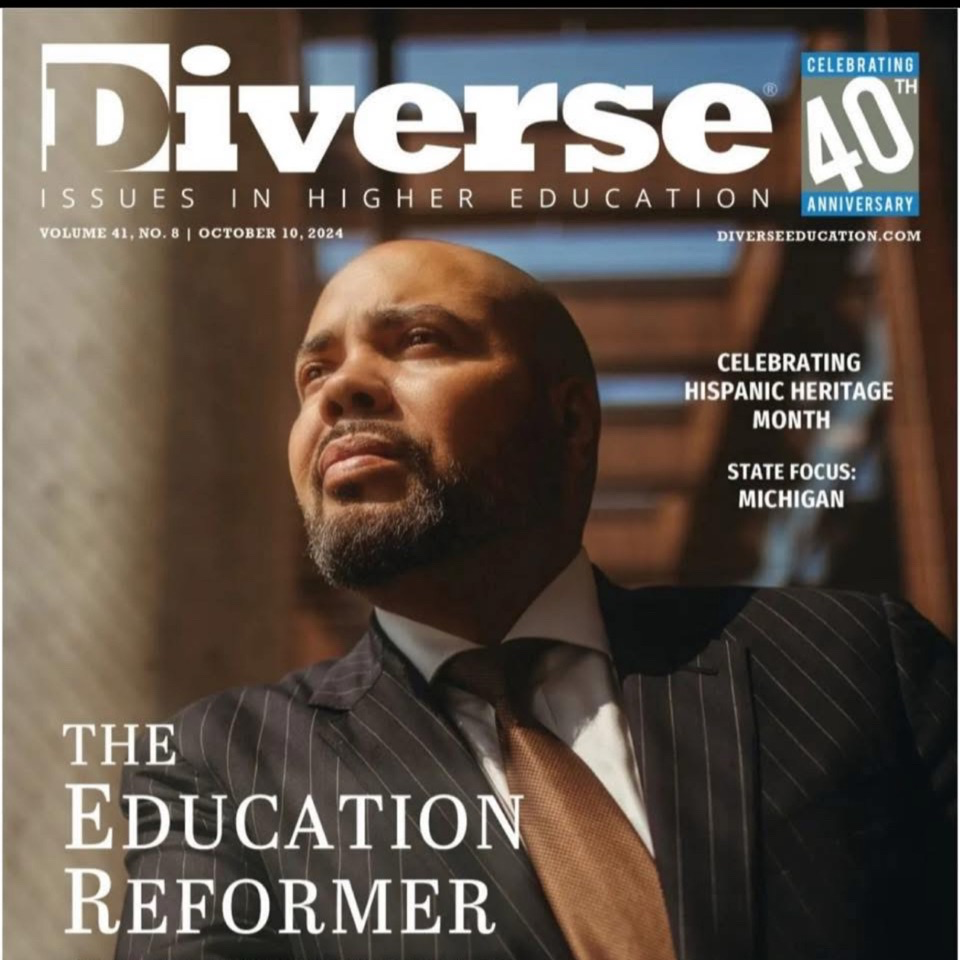
Julian Vasquez Heilig is a nationally recognized public scholar, commentator, and civil rights advocate. He has appeared on major national platforms including Democracy Now!, MSNBC, Al Jazeera, NBC News, PBS, and Univision. His media work reflects a longstanding commitment to making complex policy issues accessible, urgent, and meaningful for the public.




Leave a Reply