
Fourteen years ago, Gina Hinojosa was a mother fighting to save her son’s elementary school. Today, she is preparing to govern Texas. Sometimes the most extraordinary political journeys begin with something as ordinary, and as powerful, as a mother’s love.
In 2011, facing severe budget pressures compounded by inadequate state funding, the Austin Independent School District identified historic Pease Elementary as a potential closure. Imagine discovering that the place where your child was learning to read, making friends, and beginning to imagine his future might disappear because officials needed to reduce expenses. Imagine being told that the decision came down to budgets and efficiency, as though a spreadsheet could measure what a neighborhood school means to the families who love it.
Gina could have complained, signed a petition, and hoped somebody would listen. Instead, she organized with other parents, ran for the Austin school board in 2012, and won. Fourteen years later, that same mother is the governor-elect of Texas, having defeated Greg Abbott despite being dramatically outspent 8-1. The woman who once fought to protect her son’s school now has an opportunity to influence the education of approximately 5.5 million Texas public school students.
I have spent much of my career studying politics and public policy and the people who shape it. Yet few political journeys illustrate so clearly how ordinary families can become agents of extraordinary change. Gina’s story reminds us that history does not always begin with powerful people making grand speeches at a convention. Sometimes it begins with a worried parent who decides her child’s future is too important to leave in someone else’s hands.
From One Elementary School to the Governor’s Mansion
Gina grew up in Brownsville, along the Texas-Mexico border, attended public schools, graduated from the University of Texas at Austin 🤘, and earned her law degree at George Washington University. She worked defending workers and civil rights, but motherhood helped bring her into education governance. She became Austin school board president in 2015, helping oversee improvements in teacher compensation, finances, and school accountability while avoiding the closures initially threatened during her leadership.
In 2016, she won election to the Texas House of Representatives. Three years later, she helped negotiate a major school finance package that increased classroom investment. That same year, she joined Representatives Mary González and Shawn Thierry in publishing Whose Choice Is School Choice? They raised a question central to my own research: What happens when schools get to choose their students instead of families being able to choose their schools? Their concerns about charter admissions, special education, and funding reflected a larger conviction that public education must serve every child.
There is something extraordinary about that progression. Gina did not begin with a grand ambition to govern millions of people. She began with one school, one neighborhood, and parents afraid of losing something precious. Her responsibilities expanded from one district to the Legislature and now to the governor’s office. The very education policies that compelled her to challenge the status quo ultimately set her on a path to lead the state that created them, and gave her the opportunity to change them.
I First Met Gina at Our 2014 NPE Conference
I first met Gina in 2014 at the Network for Public Education (NPE) conference in Austin. She was then vice president of the Austin school board, participating in a panel about how the East Austin community had organized to push a charter school out of its district and elect a new school board majority. The panel brought together parents, educators, a former student, and community organizers. These were not wealthy donors or political insiders. They were ordinary people who had discovered that collective action could change the decisions affecting their children’s schools.
I have been involved with NPE since its earliest days, including the founding meeting in Diane Ravitch’s Brooklyn home in 2012. Over the past 14 years, I have watched grassroots advocates I first met at our conferences become powerful voices for public education across the country. I have seen parents become organizers, teachers become community leaders, and ordinary people build extraordinary movements. Some victories took years of persistence, while others came only after heartbreaking setbacks. Many of these advocates have devoted decades of their lives to fighting for children and their schools, often without recognition, resources, or the promise that their efforts would ever succeed. But what I could never have imagined when I met Gina at our Austin conference in 2014 was that, just 12 years later, the school board member fighting alongside parents and teachers would become the governor-elect of Texas.
In April 2025, Gina returned to speak at our NPE national conference in Columbus, Ohio, before more than 400 public education advocates. She was addressing people who understood the exhaustion of attending school board meetings, organizing neighborhoods, and challenging powerful interests. Eighteen months later, she was elected governor. For every person who has wondered whether speaking up makes a difference, her journey provides a remarkable example of where community engagement can lead.
Without Villains, There Can Be No Heroines
Sometimes the villain in a story is not a single person but a system of policies supported by three decades of political leadership that leaves families feeling powerless. For decades, Texas communities have endured battles over school funding, high-stakes testing, vouchers, closures, and state district takeovers. Behind those arguments are children whose childhoods cannot be postponed while adults debate their futures. Every year spent fighting over education is another year in the life of a child who will never get that time back.
The political irony is striking. In 2024, Governor Abbott supported primary challenges against Republican legislators who opposed his voucher agenda. Nine incumbents lost their primaries. Two years later, Texans elected Hinojosa, a longtime voucher opponent, and Ernest Bailes, one of those defeated Republicans, joined her transition team. Their political differences did not erase their shared concerns about public schools.
Perhaps the most important lesson is that the struggle over public education is not always Republican versus Democrat. Sometimes it is communities versus decisions made without them. Rural, urban, and suburban families may disagree about national politics while sharing the conviction that their neighborhood schools deserve investment, capable teachers, and a meaningful voice in decisions. The love parents and their neighbors have for their children can transcend the political divisions that so often separate adults.
What If Texas Becomes the World’s Education Success Story?
Texas now has an opportunity to become known for improving education rather than fighting over it. Imagine substantial gains in reading, mathematics, graduation rates, and college readiness. Imagine teachers receiving the support they need, parents helping shape school improvement, and communities becoming genuine partners in accountability. Imagine educators from around the world wanting to visit Texas to learn how those partnerships helped children succeed.
The work will not be easy, but Gina has already promised to begin changing the direction of Texas education on her first day in office by replacing Texas Education Agency Commissioner Mike Morath. That commitment is about more than changing the person at the top. It represents an opportunity to rethink an agency that has too often been associated with high-stakes testing, school takeovers, and top-down accountability rather than meaningful partnerships with educators, parents, and communities.
The next TEA commissioner will have an extraordinary opportunity to demonstrate that accountability should mean helping schools succeed, not simply identifying which ones have failed.
Ultimately, the success of this new direction will not be measured by political headlines or changes in leadership alone, but by children learning to read, teenagers walking across graduation stages, and teachers rediscovering the joy and purpose that brought them into the classroom.
I believe the greatest opportunity is demonstrating that rigorous academic expectations and community participation can strengthen one another. Imagine schools where parents and communities are treated as actual partners rather than the problem, teachers as professionals rather than disposable, and students as young people with extraordinary potential rather than numbers on testing spreadsheets. What if Texas became the place that showed America how to improve public education by listening and empowering the people closest to its children at the local level?
Conclusion: The Mother Who Refused to Give Up
When the improvements in education come, and believe me they will, others will rush to take credit. Former officials will claim they planted the seeds of success, and those who resisted change will try to rewrite history. But they had 30 years to deliver the improvements they promised and failed spectacularly to transform educational outcomes. Let us never confuse those who defended the old system with those who had the courage to change it.
November 3, 2026, is the discontinuity. It marks the moment Texas voters chose a different direction. As academic achievement, graduation rates, and educational opportunities improve, let the evidence show what changed and who made it possible. Remember the teachers who persevered, the parents who organized, the researchers who challenged failed policies, and the communities that refused to abandon their children. They deserve recognition, not political revisionism.
Above all, remember a mother named Gina Hinojosa, whose extraordinary journey began with a fight to save her son’s elementary school and carried her all the way to the governor’s mansion. The very education policies that inspired her to challenge the system helped create the leader who now has an opportunity to transform it. Let Texas stop making headlines for fighting over education and start making history for improving it. And when future generations ask how it all began, let us tell them about a mother who stood up when her child’s school was threatened, who refused to be silenced, and who discovered that the love of a parent could become the beginning of something much greater.
Please share.
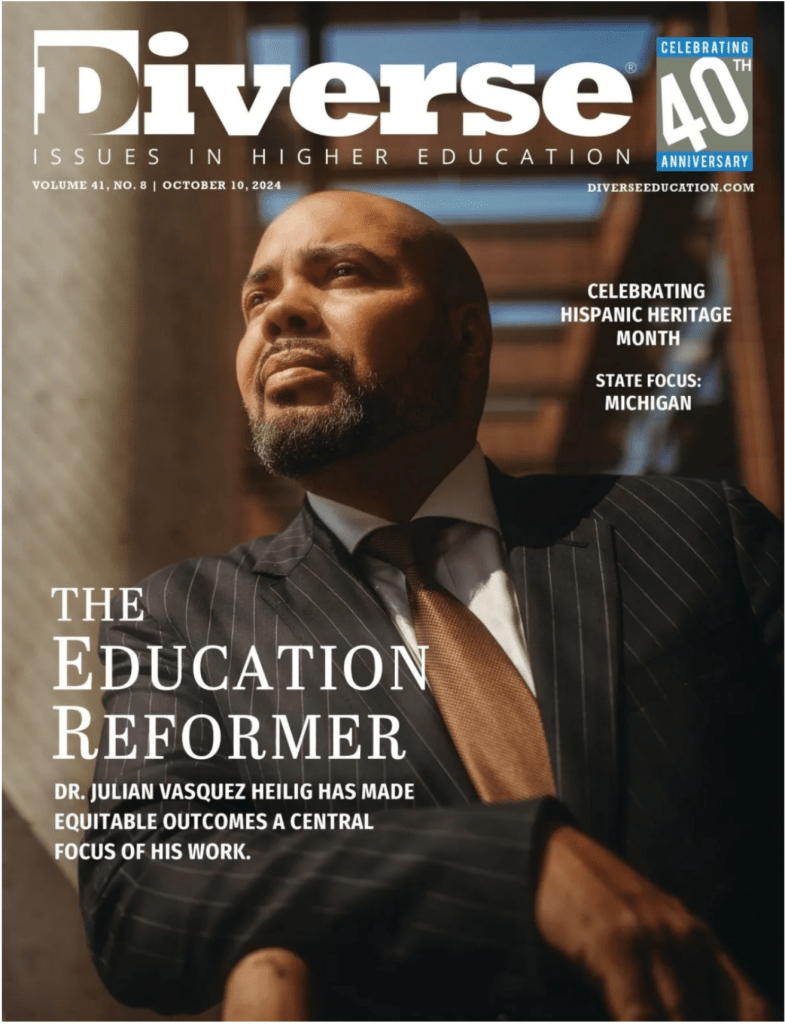
Julian Vasquez Heilig is a nationally recognized public scholar, commentator, and civil rights advocate whose work has appeared on Democracy Now!, MSNBC, Al Jazeera, NBC News, PBS, and Univision. He brings clarity, urgency, and public relevance to complex issues in education, policy, and leadership. For consulting, speaking opportunities, and collaborations, contact jvh@alumni.stanford.edu.


Leave a Reply