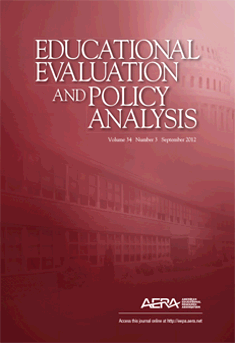
Accountability Texas-style: The progress and learning of urban minority students in a high-stakes testing context

Vasquez Heilig, J. & Darling-Hammond, L. (2008). Accountability Texas-style: The progress and learning of urban minority students in a high-stakes testing contextEducational Evaluation and Policy Analysis. 30(2), 75-110.

This study examines longitudinal student progress and achievement on the elementary, middle, and high school levels in relation to accountability policy incentives in a large urban district in Texas. Using quantitative analyses supplemented by qualitative interviews, the authors found that high-stakes testing policies that rewarded and punished schools based on average student scores created incentives for schools to “game the system” by excluding students from testing and, ultimately, school. In the elementary grades, low-achieving students were disproportionately excluded from taking the high-stakes Texas Assessment of Academic Skills tests, demonstrating gains not reflected on the low-stakes Stanford Achievement Test-Ninth Edition. Student exclusion at the elementary level occurred through special education and language exemptions and missing scores. Furthermore, gaming strategies reduced educational opportunity for African American and Latino high school students. Sharp increases in 9th-grade student retention and disappearance were associated with increases in 10th-grade test scores and related accountability ratings.

Vasquez Heilig, J. & Darling-Hammond, L. (2008). Accountability Texas-style: The progress and learning of urban minority students in a high-stakes testing context. Educational Evaluation and Policy Analysis. 30(2), 75-110. This study examines longitudinal student progress and achievement on the elementary, middle, and high school levels in relation to accountability policy incentives in a large urban district in…

22 responses to “Accountability Texas-style: The progress and learning of urban minority students in a high-stakes testing context”

  1. […] ethnic studies courses improve student achievement. State curriculum standards have been popular since the late 1990s. However, those standards often exclude communities of color. Since U.S. schools are now majority […]

    Like

  2. […] rates approaching 100%. We of course know that the Texas and Houston testing miracles were a façade uncovered by research and common sense. No one really believes anymore that Texas had an education miracle in the 1990s— […]

    Like

  3. […] So do you want the good news or the bad news first? It’s a question my parents often asked me a child growing up. Which do you want to hear first? I’ll start with the bad news. High states testing has been around for a long time (See the post After Thousand of Years, #China Changing Mind on #Testing ? #edreform). Historically, the task of the test has been to sort people for their roles in society (See the post Walking Away From High Stakes Tests, A Noble Lie). Only recently has the argument been made that we can test to “identity low-performing schools” or to “close the achievement gap.” This retread of arguments onto the long standing practice of testing has been quite clever and became national policy with the No Child Left Behind Act imported from the Texas by President George W. Bush and former Secretary of Education Rod Paige (See the peer reviewed paper Accountability Texas-style: The progress and learning of urban minority students in a high-stakes te…) […]

    Like

  4. […] back in the 9th grade and thus were often not given the opportunity to test in the 10th grade (See Accountability Texas-style: The progress and learning of urban minority students in a high-stakes te…). Which meant that they would never graduate because a battery of exit tests were/are required to […]

    Like

  5. […] Want to see Cloaking Inequity’s first post ever? Click here. […]

    Like

  6. […] are determined to allocate a number to every aspect of education. No Child Left Behind accentuated the current infatuation with quantitative data in educational policy. Arne Duncan continued the quantitative love affair […]

    Like

  7. […] In conclusion, I will leave you with a few quotes from Texas high school administrators included in my EEPA article. […]

    Like

  8. […] the education miracle in Texas that spawned No Child Left Behind a decade ago— another elegant illusion of numbers? Some say the skeptics are wrong in their analyses of recent educational success in […]

    Like

  9. […] What did the Texas data actually say prior to NCLB? Was there a “Texas Miracle” that necessitated the import of Texas-style high-stakes testing and accountability to be the law of the land? (See also Accountability Texas-style: The progress and learning of urban minority students in a high-stakes te…) […]

    Like

  10. […] positions staked out in any given topic under study. I remember early in my career, I published a peer-reviewed paper based on my dissertation critical of No Child Left Behind and high-stakes test… that didn’t sit well with certain people at UT-Austin— I was given a stern talking to. Then, […]

    Like

  11. […] are positions staked out in any given topic under study. I remember early in my career, I published a peer-reviewed paper based on my dissertation critical of No Child Left Behind and high-stakes test… that didn’t sit well with certain people at UT-Austin— I was given a stern talking to. Then, in […]

    Like

  12. […] even be borderline plagiarism. President George W Bush’s No Child Left Behind, the genesis of nationally mandated high-stakes testing and accountability in the United States has been left alone. Obama’s “waivers” and Race to the Top policies […]

    Like

  13. […] For context, Texas has been fudging the data in their accountability system for decades. See for example, Accountability Texas-style: The progress and learning of urban minority students in a high-stakes te…. […]

    Like

  14. […] The other day I received the June 2013 issue of EEPA. Honestly, I don’t always crack it open, but several of the articles caught my eye and the entire issue became plane reading. The topics range from CTE and mathematics achievement to Success for All to Vouchers. If you don’t have access to the current issue, I have grabbed a summary statement and then pasted the citations and abstracts below (Also, check out my EEPA article Accountability Texas-style: The progress and learning of urban minority students in a high-stakes te…). […]

    Like

  15. […] For more on Texas role as a progenitor of high-stakes testing and accountability check out At-risk student averse: Risk management and accountability and Accountability Texas-style: The progress and learning of urban minority students in a high-stakes te…. […]

    Like

  16. […] so the student stops getting counted in the denominator. [This sounds strangely similar to this and this] Karen Harper Royal can probably tell you more about that as she’s on the front line and […]

    Like

  17. […] was critical of high-stakes testing and accountability and was offensive to an influential alumnus. Here is that paper in case you are curious. Despite “being called into the principal’s […]

    Like

  18. […] In conclusion, I will leave you with a few quotes from Texas high school administrators included in my EEPA article. […]

    Like

  19. […] relative to other states? Warning: This ranking is contrary to the reams of state-controlled (aka contrived) data released by the Texas Education Agency such as dropout and graduation rates etc. The Street […]

    Like

  20. […] the education miracle in Texas that spawned No Child Left Behind a decade ago— another elegant illusion of numbers? Some say the skeptics are wrong in their analyses of recent educational success in […]

    Like

  21. […] Legislature, for gifting us the framework for NCLB, TEKS social studies standards (Okay, it was the SBOE, but they gave them […]

    Like

  22. […] dropout and graduation numbers (See for example IDRA; Losen, Orfield, & Balfanz, 2006; Vasquez Heilig & Darling-Hammond) suggesting that student leavers have underreported since the inception of accountability in the […]

    Like

Cloaking Inequity is an online platform for justice and liberty-minded readers. I publish reflections, analysis, and commentary on education, democracy, culture, and politics.

Subscribe to stay informed whenever I publish new content. I never send spam, and you can unsubscribe anytime—no strings attached.

Go back

Your message has been sent

Email me at jvh@alumni.stanford.edu