
When White House Advisor Stephen Miller sat across from the CNN interviewer in October 2025, his delivery was measured, his words chosen with precision. As he spoke about presidential powers, he began with confidence, saying, “Under Title 10, the President has plenary authority,” and then suddenly stopped. The feed “froze.” The connection was “lost.” The CNN host was dumfounded. The clip went viral in minutes. Some laughed at the glitch, others saw it as another surreal broadcast moment, but the timing was too deliberate to ignore. Miller understands how attention works. His pregnant pause was not an accident. It was a strategy.
By invoking the term plenary authority and then letting the words hang in the air, he planted a seed. Most viewers had never heard the phrase before. It sounded legal, powerful, and mysterious. The ambiguity created fascination. Within hours, millions were asking what “plenary authority” meant, who had it, and why Miller had used it. The pregnant pause made the phrase larger than the segment itself. It became a provocation disguised as a glitch.
The term is not new, but it carries a long and troubling history. It has been used to justify unchecked power, unreviewable decisions, and the idea that one person or institution can act without limits. The word “plenary” means complete, total, or absolute. When combined with “authority,” it becomes a claim to supremacy. That is why the phrase deserves attention. It signals not just an idea about law, but an intention about power.
The Legal Origins of Plenary Power
The idea of plenary authority comes from U.S. constitutional law, where it has been used for more than a century to describe areas of government that supposedly operate beyond ordinary checks and balances. The courts support the concept, and once they did, presidents and legislators began to use it to justify almost anything. In Chae Chan Ping v. United States in 1889, the Supreme Court upheld the Chinese Exclusion Act by declaring that Congress had “plenary power” over immigration. That phrase meant Congress could exclude anyone it wished, without judicial review. It was the foundation of the modern immigration system and one of the earliest moments when the phrase was used to defend racial exclusion.
Fifteen years later, in Lone Wolf v. Hitchcock, the Court again used the same phrase, this time to justify the violation of treaties with Native nations. The Court ruled that Congress had “plenary authority” over tribal affairs, meaning it could break its own promises at will. Both cases show how the language of plenary power was born in the context of domination, not protection. It was a doctrine for those who governed, not for those who were governed.
From there, the phrase spread to other areas of law. It appeared in opinions about national security, foreign relations, and presidential war powers. In 1936, the Supreme Court in United States v. Curtiss-Wright Export Corp. described the president as holding “plenary and exclusive power” in international affairs. That ruling gave the executive branch broad justification to act unilaterally abroad, including the authority to target vessels and individuals without trial in the Caribbean, all without congressional oversight. Later presidents cited the same logic to expand surveillance, wage war, and declare emergencies. The phrase became a key that opened every locked door in the Constitution.
How Dictators Use the Language of Full Authority
Though “plenary authority” sounds like American legal jargon, the concept behind it has a much older and darker history. Authoritarian leaders have long claimed the need for total power under the guise of restoring order, fighting corruption, or defending the nation. In each case, the argument is the same: extraordinary times demand extraordinary authority. For example, Trump is currently claiming that multiple Democratic led cities are “hellholes” requiring military intervention.
When Benito Mussolini rose to power in Italy in the early 1920s, Parliament granted him poteri plenari, plenary powers, to stabilize the country after years of turmoil. The authorization was supposed to be temporary. Instead, Mussolini used it to dissolve Parliament and rule by decree. Within two years, the democracy that had existed in Italy was gone. Plenary authority had become dictatorship.
In Germany, Adolf Hitler followed a similar script. After the Reichstag fire in 1933, the German legislature passed the Enabling Act, giving him volle Befugnisse, full powers, to enact laws without parliamentary consent. The law promised to “remedy the distress of the people.” Within months, Hitler had eliminated political opposition, outlawed unions, and centralized power in his office. The concept of plenary authority was the legal disguise for totalitarianism.
Spain’s Francisco Franco used plenos poderes, plenary powers, to consolidate rule after the Spanish Civil War. Russia’s Vladimir Putin has repeatedly invoked полномочия в полном объёме, plenary powers, to rewrite the constitution and dismantle regional autonomy. Turkey’s Recep Tayyip Erdoğa claimed emergency plenary powers after the failed coup attempt in 2016, arguing that national survival required it. Each case demonstrates how quickly the idea of plenary authority shifts from justification to habit. Once a leader acquires unlimited power, there is no reason to return it.
Trump’s renewed interest in invoking the Insurrection Act is not about safeguarding democracy, it is about manufacturing the unrest needed to dismantle it. By deploying immigration officers, Marines, and National Guard troops under the guise of restoring order and immigration enforcement, his administration has deliberately transformed public safety into political theater. In Chicago, ICE agents fired live ammunition at a motorist, injuring an unarmed Latina woman, then lied about it according to body cameras. New video footage from this week shows a priest praying peacefully before being shot in the head with a rubber bullet six times. These are not isolated acts of misconduct; they are deliberate violations of freedom of speech and religious freedom—part of a calculated effort to provoke confrontation and portray peaceful protest as rebellion. Even as citizens demonstrate nonviolently, some donning clown costumes and inflatable suits to mock the absurdity of the administration’s claims, the White House insists that insurrection is underway. This fiction serves a political purpose: to fabricate the legal justification for deploying troops under the Insurrection Act. Federal judges have already found the Department of Homeland Security’s accounts of these incidents unreliable, and another court has condemned Trump’s efforts to send militarized units into Oregon. Now, reports of Texas troops preparing to cross into blue states at his direction reveal a deepening threat to constitutional governance. The invocation of “plenary authority” to rationalize such moves follows a familiar authoritarian pattern—power seized in the name of order and national defense, then turned against the very people it claims to protect.
The Pause as a Political Act
Stephen Miller’s use of the term and his carefully timed silence fit within that tradition of authoritarian communication. Modern strongmen rarely seize power through open declarations. Instead, they test boundaries through language. They float legalistic terms that sound technical rather than threatening. The public becomes accustomed to hearing words like “total authority,” “emergency powers,” or “national security mandate.” Each phrase chips away at the expectation of limits.
Miller’s pause was a digital performance. It turned a complex phrase into a viral authoritarian-themed mystery. The unfinished sentence gave the impression that something secret had been interrupted. Viewers filled in the silence with their own imagination, and that was the point. The ambiguity made it powerful. The clip spread across platforms with millions of views, drawing attention to the term and making it part of public conversation. Miller understood that a pause could be louder than continuing further.
The tactic reflects how modern political communication operates. In an era of fragmented media, spectacle has replaced substance. Theatrics of control now serve as proof of strength, and moments of tension are staged to provoke attention and signal dominance. By invoking the language of law and then suspending it midair, Miller transformed a dense legal concept into a viral moment. The clip spread not because of its substance, but because of its spectacle—yet the message still landed exactly as intended.
The Tollbooth Logic of Plenary Authority
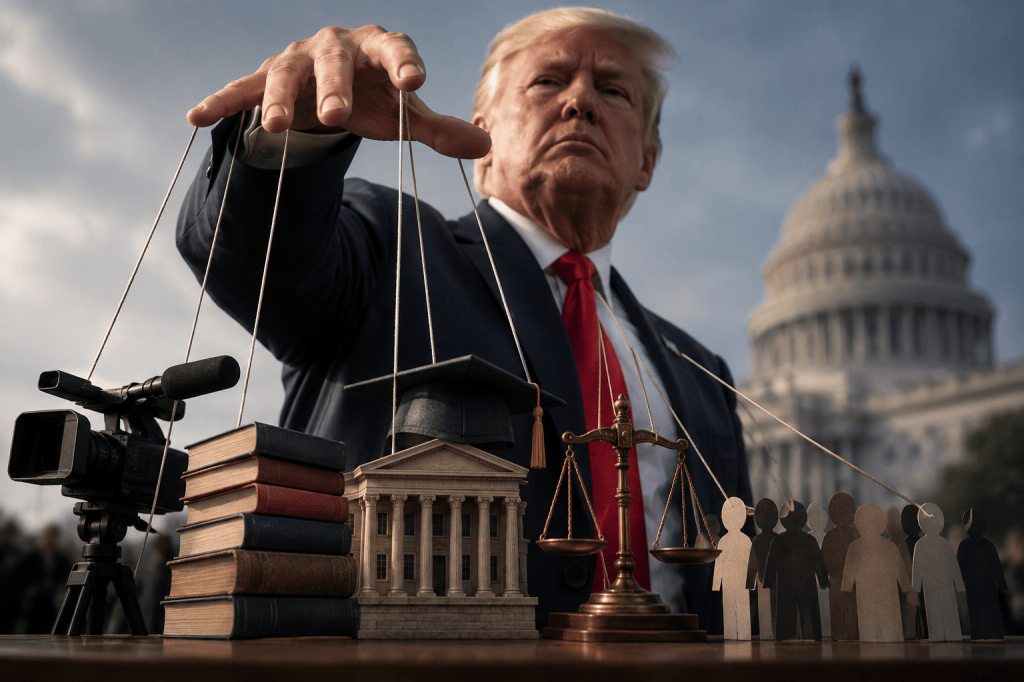
The return of the term also aligns with Trump’s larger governing style. His politics depend on creating crises and then monetizing the solutions. Tariffs, immigration orders, and executive decrees all serve the same purpose. They cause chaos, drive fear, and force others—corporations, nations, and individuals—to seek relief. The relief is then sold in the form of access, loyalty, or exemption. That is why I am calling this model the tollbooth strategy. Everyone must pass through, and everyone pays. This is what dictators do. (I’ll discuss this more next week in a piece I am working on.)
Plenary authority is the intellectual framework that justifies that system. If the president’s authority is total, then every negotiation, favor, or punishment can be framed as legal. It transforms governance into transaction. In Trump’s tollbooth model, tariffs are not about economic policy but about leverage. Law enforcement is not about justice but about discipline. National security is not about defense but about control. Everything becomes a tool of exchange, and every citizen becomes a client at the tollbooth.
This vision of power is deeply corrosive because it teaches the public to equate strength with impunity. When the leader acts without limits, those who follow him begin to believe that limits themselves are signs of weakness. The rule of law becomes conditional, the truth becomes negotiable, and the machinery of government begins to serve the person instead of the people.
The Historical Pattern of Plenary Power
The history of plenary authority reveals a consistent pattern. It begins with a claim of necessity. A nation is in danger, a system is broken, or an enemy is at the gates. The leader insists that normal rules cannot apply. Once that argument is accepted, the power granted rarely fades. The Weimar Republic’s Article 48 emergency powers were designed for short-term use but lasted until the republic collapsed. Mussolini’s temporary decrees became permanent until Italy was defeated in World War II. In every case, the moment the public conceded the idea of plenary authority, democracy was already in retreat.
What makes this moment especially dangerous is that the conversation has already shifted. Instead of rejecting the idea outright, people now debate (e.g. SCOTUS) the degree to which plenary authority might be justified. The concept of a Plenary Presidency has entered public life without resistance. That normalization is what Miller’s pause accomplished. It made the idea sound legitimate, almost academic. The danger is not that one man uses the term, but that a society begins to accept it as normal.
Why We Must Talk About It
Stephen Miller’s use of “plenary authority” was not random. It was deliberate political theater. He introduced a term with deep authoritarian roots into mainstream discussion. By turning it into a viral clip, he ensured that millions would encounter it without context. That is how soft power works in the digital age. It does not shout; it insinuates. It spreads ideas not by persuasion but by curiosity.
If Miller wanted to start a conversation, then it should be an honest one. We should talk about where the term comes from, what it has meant in history, and what it signals about the future. “Plenary authority” has never been a democratic principle. It has always been the vocabulary of those who see law as an obstacle rather than a safeguard. It has justified colonization, internment, dictatorship, genocide, and political purges. It is the language of leaders who want to remove every barrier between their will and the world.
The pause on CNN may have seemed like a glitch, but it was also a warning. It reminded us that power rarely announces its intentions directly. It creeps forward, disguised as legality, wrapped in the calm tones of authority. To understand why that matters, we only have to look backward. Every regime that has claimed plenary authority began with a promise of protection from crime, minorities, immigrants etc. Every one of them ended with submission for the populace.
If democracy is to endure, it must resist the seduction of absolutes. The word “plenary” should never belong to a single person or office in a free and democratic society. It belongs to the people collectively, expressed through law, accountability, and consent. The conversation Miller wanted to start is now ours to finish. We should finish it by remembering that freedom depends not on who holds power, but on whether that power is ever allowed to become plenary.
Julian Vasquez Heilig is a scholar, writer, and public intellectual who examines how power, policy, and narrative shape American life. He has deep experience in institutional leadership and the tensions between authority and accountability. Through his blog Cloaking Inequity and LinkedIn Without Fear or Favor series, he analyzes political strategies that hide beneath legal language, exposing how rhetoric, spectacle, and leverage transform governance.



Leave a comment