Have you ever trusted someone to do what they said they would… only to discover that, when it mattered most, they didn’t?
Now ask yourself the same question about an organization.
When I was in elementary school, one of my teachers insisted on reading Laura Ingalls Wilder’s Little House books to our class every afternoon during lunch. Even then, I never particularly enjoyed them. As I grew older, I became increasingly uncomfortable with their portrayal of Native Americans and the broader colonial narrative they reflected.
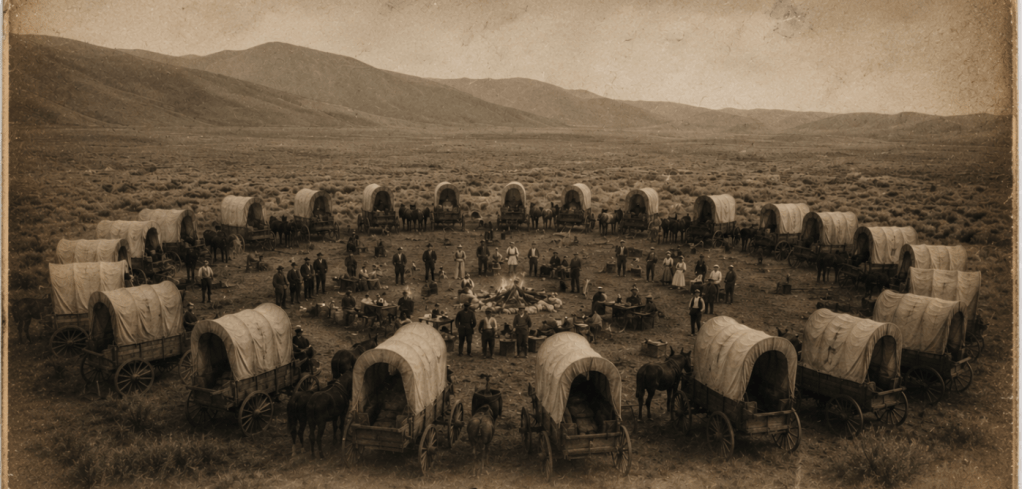
One passage has become especially infamous, in which Laura’s mother declares that “the only good Indian is a dead Indian.” This reflects a worldview that divided people into those who belonged inside the circle and those who were viewed as threats outside it. The wagon trains were presented in the books as innocent families defending themselves against an ever-present danger. Yet history is far more complicated. Those wagons were moving across and into lands already inhabited by Indigenous peoples, participating in a broader American project of displacement and dispossession. The need to circle the wagons arose because of the journey itself.
That realization stayed with me. The wagon circle was more than a survival strategy. It became a way of understanding organizations. When difficult questions arise, institutions often circle the wagons around themselves. The people inside the circle belong. Those outside are viewed with suspicion. Protecting the institution becomes the highest priority. Yet history reminds us that circling the wagons does not necessarily mean those inside are right. Sometimes the instinct to protect ourselves prevents us from confronting the uncomfortable truth that the institution itself may need to change.
Today, many organizations regularly build their own wagon circles. The names change. The structures change. But the instinct remains remarkably familiar. Questions become threats. Accountability becomes intrusion. Critics become the problem. Leaders convince themselves they are protecting the institution when, in reality, they may be protecting it from the very information it most needs to hear.
I recently watched that instinct unfold in real time. I’ve told part of the story recently, but there are some updates. My eighteen-year-old daughter was serving as a summer counselor at Camp Mohaven in Ohio. According to her account, the only substantive conversation she had with the camp director before being let go concerned the living conditions in the counselors’ cabins. For example, some counselors had reported that rodents were crawling on them while they slept. Several days later, she was called into a meeting.
According to her account, she was told, in summary, “We do things differently at Camp Mohaven.” She was relieved of her duties as a counselor. She was instructed to gather her belongings in the middle of Saturday night, directed into camp director Joe Ottinger’s vehicle, and shortly after midnight on Father’s Day, she and another young counselor were abandoned by him at the Toledo train station to navigate a dangerous night.
Whether those events are connected is not a legal conclusion yet. It is a question. Accountability does not begin by assuming motives. It begins by asking whether the facts deserve careful examination.
That was my expectation. As both a father and someone who has spent his career studying institutions, I immediately emailed Ohio Conference of Seventh-Day Adventist’s President Robert Cundiff when she was abandoned requesting emergency assistance. I also immediately spoke directly with Camp Director Joseph Ottinger by phone.
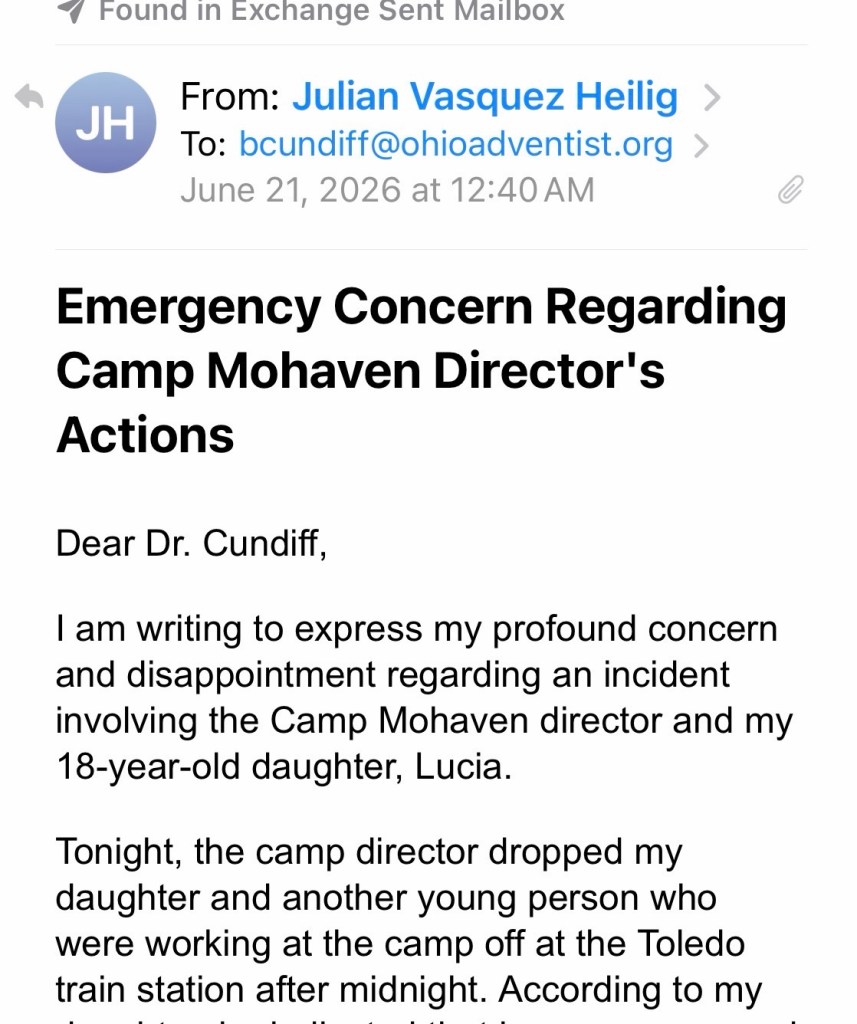
My questions have been straightforward. I want to understand why two young counselors had been abandoned at a train station after midnight, whether the reported health conditions at the camp have been adequately addressed, and what policies governed decisions of this kind. I assumed a conversation would focus on understanding what had happened. Instead, I found myself watching the wagons begin to circle.
When the Wagons Begin to Circle
The events that led me to contact conference leadership are important. What happened afterward, however, is what transformed this from a single incident into a case study for the public of a much broader phenomenon. It is that institutional response, not simply the original event, that I hope readers will consider.
During my conversation with Joe Ottinger, he defended the decision to transport the two counselors away from camp and leave them stranded at the Toledo train station after midnight because they were 18. Several days later I received an email from president Bob Cundiff expressing his “hopes” and “prayers” while declining my request for a meeting. The phrase “thoughts and prayers” has become almost proverbial in American life because it is so often offered after tragedy in place of meaningful engagement or action. In that moment, I immediately found myself wondering whether I was witnessing a similar dynamic.
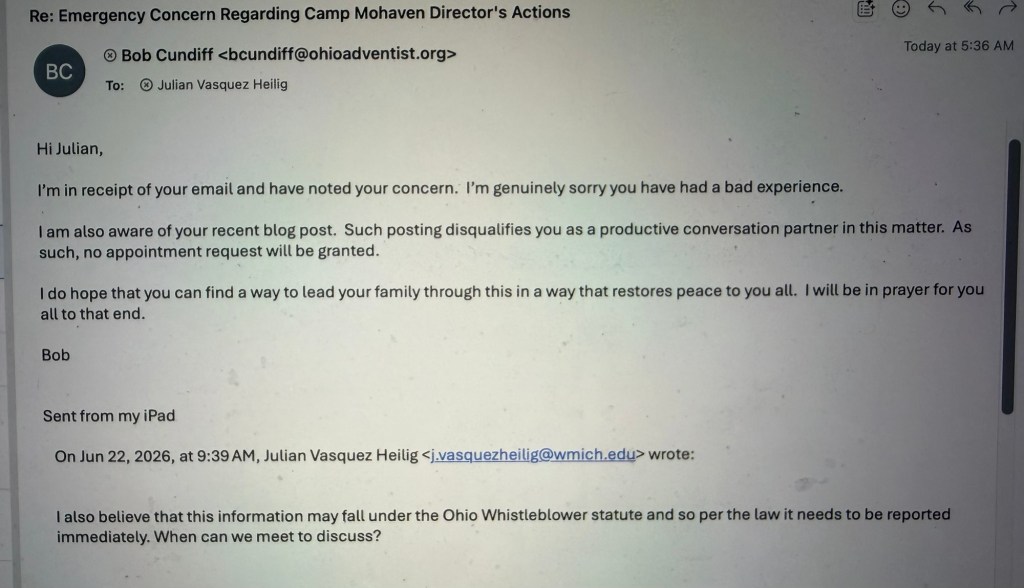
His reason was not that my questions lacked merit. It was that I had discussed the matter publicly and was therefore no longer considered a “conversation partner.” What struck me was that another family has since shared with me that, after raising concerns about a separate incident involving Camp Director Joe Ottinger, they were likewise unable to secure a meeting with the conference president even though they had not asked the public for help. I cannot speak to the full details of their experience, and it is ultimately their story to tell. But according to their account, it suggests a broader pattern that deserves attention.
That president’s response struck me not simply as a father but as someone who has spent his career studying institutions. The questions I raised concerned safety, reported health conditions, and accountability. Yet, the center of gravity shifted away from those concerns and toward the person raising them. The discussion became less about whether policies had been followed, the safety of teens, and more about whether I should have spoken out about their actions and turned to the public for assistance. The issue itself became secondary. The messenger became primary. That is often the moment the wagons begin to circle.
Organizations rarely announce publicly that they are becoming defensive. Most leaders sincerely believe they are protecting something important. They believe they are preserving stability, preventing misunderstanding, or safeguarding the institution’s reputation. Yet in doing so, they often make a subtle but consequential shift. The central question is no longer, What happened? It becomes, How should we respond to the person asking what happened? Once that shift occurs, accountability becomes increasingly difficult because the institution has begun protecting the wagon circle rather than examining what happened inside it.

For example, since these events, I have heard that president Bob Cundiff has been onsite and reportedly told Camp Mohaven staff that my daughter was not abandoned at the Toledo train station as described (I have Life360 records documenting the timeline), that there is no rodent problem at the camp (I have video evidence provided by staff to the contrary), and that the situation is simply “lies.” I have also been told that camp staff were instructed not to provide outsiders with evidence of the rodent problem if they care about the camp. If those statements attributed to president Bob Cundiff and Camp Mohaven leadership are inaccurate, I would sincerely welcome a clarification.
Why Institutions Become Defensive
This pattern has been studied for decades. Yale Professor Chris Argyris called these behaviors defensive routines, organizational habits that shield leaders from uncomfortable information. Harvard Professor Ronald Heifetz drew a distinction between technical and adaptive leadership. Technical challenges can often be solved with existing procedures. Adaptive leadership requires something far more difficult: the willingness to confront the possibility that the institution itself may need to change.
Healthy organizations investigate concerns from all sides before defending themselves against them because they understand that accountability strengthens trust. Defensive organizations often reverse that order. Their first instinct is to protect leaders, policies, or reputation, and only later, if ever, to determine whether the underlying concern has merit. The order matters because it reveals what the organization values most.
History also offers sobering reminders of the cost of getting that order wrong. The Catholic Church sex abuse crisis became a defining institutional failure not simply because misconduct occurred. Institutions encounter misconduct. What transformed individual cases into a global crisis was the repeated decision to protect the institution before fully confronting the concerns being raised.
Michigan State University‘s response to Larry Nassar sex abuse scandal also followed a similar pattern. Warnings surfaced over many years, yet organizational systems often proved more effective at preserving normal operations than at addressing uncomfortable truths. In my view, MSU’s current turmoil, including the sanctioning of trustees, is due in part to the sanctioned trustees’ efforts to increase transparency surrounding the quasi-privatization of the university’s athletics program. I see this as a continuation of the institution’s longstanding cultural issues.
The lesson from both organizations is not that every complaint is valid. It is that healthy institutions investigate all sides first and defend later. The greatest threat to an institution is rarely the person asking difficult questions. More often, it is a culture that convinces itself difficult questions are the threat and the cover-up that ensues. That realization has changed how I think about leadership. As a former program and department leader, dean, and provost, I certainly made a mistake here and there. Every leader does. But I came to believe that my responsibility was to create an environment where people felt safe enough to raise concerns before those mistakes became crises so we could go a different direction.
Looking back, I also realized something about my daughter. Her first instinct was not to undermine an institution. It was to step forward to solve a problem affecting her fellow counselors. Whether the timing of her dismissal and those concerns are ultimately connected in a lawsuit deserves careful examination. Accountability does not presume guilt. It insists that questions deserve answers.
Conclusion: The Courage to Choose Truth
Bible history offers a powerful example of this principle in Jeremiah 38. This past weekend, I prayed what Christians sometimes call a fleece (Judges 6:36-40), asking God to give me wisdom about how to navigate the situation my daughter faced. I recognize that not everyone shares my faith or believes God answers prayer in this way, but I can only describe what happened next.
I arrived at Detroit City Temple expecting to hear Pastor Neville Lendor preach. Instead, to my surprise, Dr. Abraham F. Henry, president of the Lake Region Conference of Seventh-day Adventists, was present in the congregation. Pastor Lendor spontaneously yielded the pulpit and invited him to bring the morning message. Before beginning, Dr. Henry explained that he had not preached from Jeremiah 38 in nearly five years but had felt impressed that this was the sermon he was called to deliver.
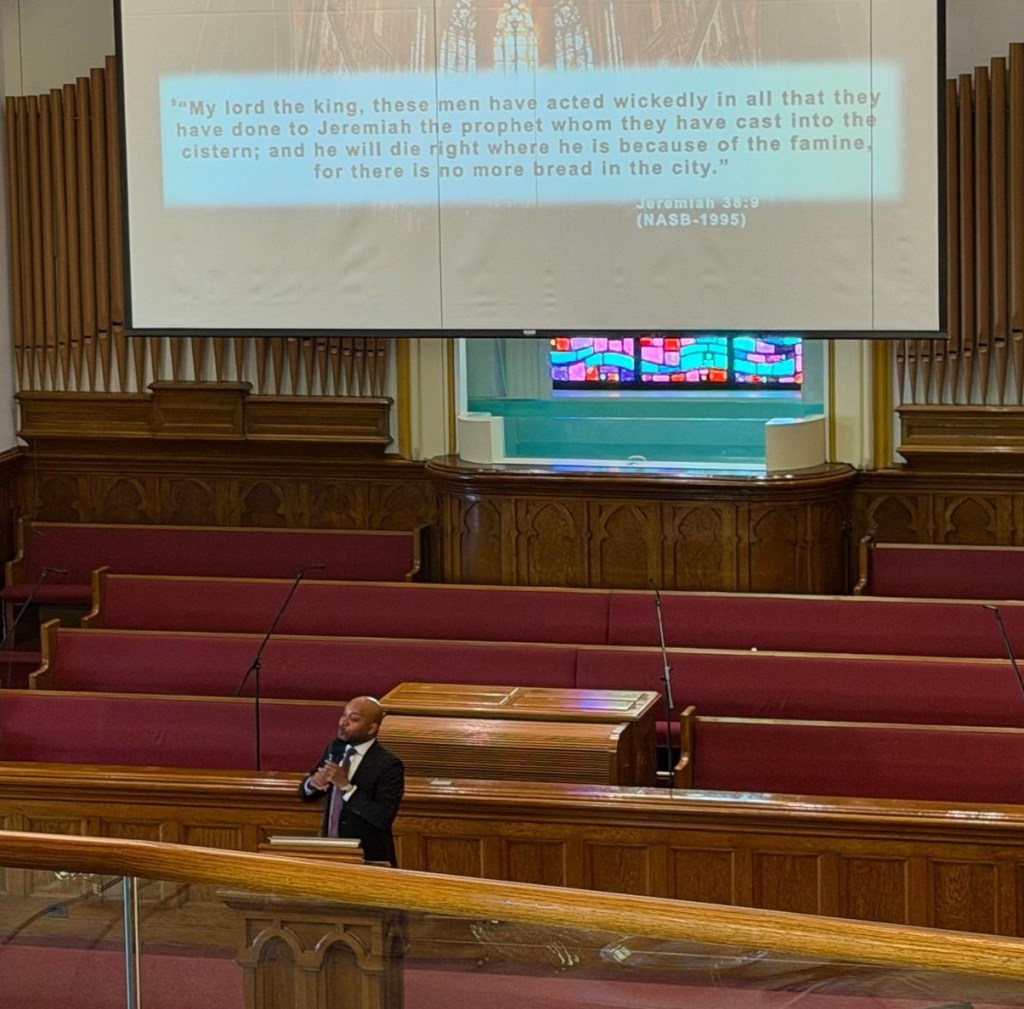
Jeremiah faithfully delivered an uncomfortable message, yet the leaders of Israel chose to silence the messenger rather than confront the truth he proclaimed. They lowered the prophet into a cistern filled with mud while convincing themselves they were protecting the nation. Yet the moral hero of the story is Ebed-melech, an African servant in the king’s court, an outsider who had the courage to challenge the decision, rescue Jeremiah, and call the king to do what was right. The danger was never Jeremiah’s message. The danger was a nation that had become more committed to protecting itself than listening to the truth. Jeremiah 38 reminds us that institutions are ultimately judged not by whether uncomfortable voices emerge, but by how they respond when they do.
I had never met President Henry before. After the service, I introduced myself, thanked him for the message, and shared that I believed God had impressed him to preach it because, earlier that morning, I had prayed for wisdom. I did not ask him for help or intervention. I simply wanted him to know that, for me, his sermon had been an answer to prayer.
Institutions shape lives. They educate our children, care for our families, steward our faith, and serve our communities. They deserve our loyalty, but they also deserve our honesty. If we truly believe in the missions they proclaim, we should want them to become the very best versions of themselves. Accountability is not about tearing institutions down. At its best, it is an act of hope. It reflects the belief that organizations can learn, leaders can grow, trust can be restored, and the values we proudly proclaim can become the values we faithfully live.
Every institution eventually faces a moment when it must choose between protecting its reputation and pursuing the truth. The instinct to circle the wagons may feel natural, but history, scholarship, and Scripture point to a better path. Institutions are strongest not when they silence uncomfortable voices, but when they have the courage to listen to them. In the end, the measure of an institution is not whether difficult questions arise. It is whether those questions are met with humility, honesty, and the courage to choose truth.
Julian Vasquez Heilig is a scholar whose work often asks whether institutions do what they say they will do. That question first emerged during his doctoral research at Stanford University, where, years before the federal No Child Left Behind Act, he examined whether Texas’s standards-based accountability system genuinely improved schools or merely created the appearance of improvement. It has since shaped more than two decades of scholarship and leadership—as a professor studying education policy, a dean and provost leading complex organizations, and a public scholar writing about education, philanthropy, faith, culture, and public life. Recently, a journalist described his writing as focusing on institutional accountability, a phrase that resonated because it captured the thread connecting his research, leadership, and public engagement. CV
Prefer to listen? I recorded an audio version of this essay on Substack: https://professorjvh.substack.com/p/when-the-wagons-circle







Leave a comment