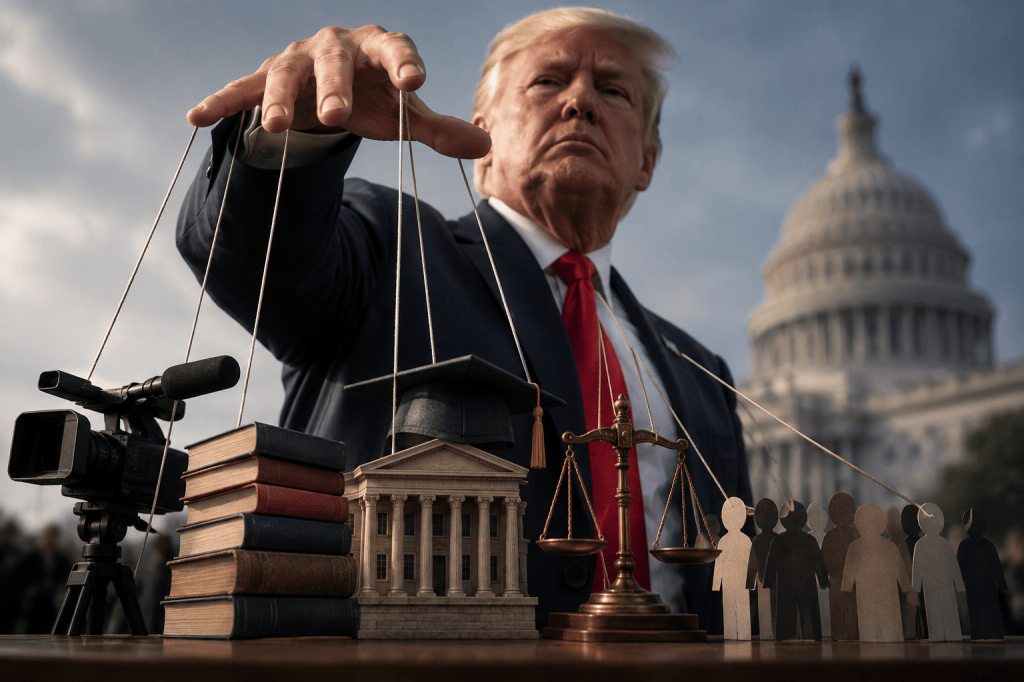
President Donald Trump delivered an incredibly disorganized prime-time speech intended to persuade Americans that the nation’s elections are fundamentally corrupt.
He invoked China, voting machines, mail ballots, noncitizens, intelligence officials, and alleged fraud in Michigan, yet the evidence he presented did not establish that votes were altered or that an election was stolen. CNN’s annotated review repeatedly separated possible cybersecurity vulnerabilities from actual proof of fraudulent ballots or manipulated election results.
Trump has claimed for years that the 2020 election was stolen from him, despite all recounts, audits, court decisions, and election officials from both parties finding no widespread fraud capable of changing the outcome. As such, the speech appeared designed to weaken confidence in future elections while creating a potentially illegal path for unprecedented federal action such as the administration’s recent threats to jail Secretaries of State and other officials.
I actually remember an election that felt stolen, but it was 2000, not 2020. Al Gore won the national popular vote, while George W. Bush received Florida’s electoral votes after the United States Supreme Court stopped the recount of actual votes and Bush was certified ahead by only 537 votes. Gore had legitimate reasons for every disputed ballot to be examined, yet he conceded because the stability of the country mattered more than his personal claim to the presidency. By contrast, Trump has chosen the opposite course by transforming his defeat into a continuing assault on the legitimacy of voting. That contrast was on my mind as I watched John Lewis: Good Trouble.
A Father and a Daughter
It is not often that you get to watch a film while sitting next to a member of Congress. I first wrote about that experience in a post titled “When Inspiration Brings Tears,” but I intentionally saved my complete review of John Lewis Good Trouble for the anniversary of his death. In the private screening I was seated beside Congressman Raul Ruiz, M.D. His parents were farmworkers who built their lives through perseverance and sacrifice, reflecting the American promise Lewis spent his life defending. Congressman Ruiz attended the screening with his wife and daughters, making the evening both a public gathering and a deeply personal family experience.
During several moments in the documentary, Congressman Ruiz leaned toward his eldest daughter and whispered the history unfolding before them. At one point, he identified a scene in which he appeared with John Lewis. He spoke to her softly, explaining the importance of voting rights and the continuing dangers of voter suppression. Their conversation was personal and was never intended for the people seated around them. Yet listening to a father pass those lessons to his daughter became the emotional highlight of my visit to Palm Springs.
The Discipline Behind Good Trouble Film
John Lewis: Good Trouble is more than a biographical documentary. It is a civic meditation on democracy, discipline, and moral endurance. The film refuses to romanticize the civil rights movement as distant history. Instead, it situates John Lewis’s life as a living framework for democratic participation during moments of political strain. For viewers concerned with freedom, the documentary functions as both a historical archive and an urgent warning.
One of the most arresting sequences recounts Lewis’s memory of approaching the Edmund Pettus Bridge in Selma. “As we approached the Edmund Pettus Bridge, we saw a sea of blue,” he recalls. Law enforcement officials framed the peaceful march as a threat to public safety. Protesters were ordered to disperse, go home, or return to their churches because the march would not continue. The visual juxtaposition of unarmed citizens facing state authority captures a central tension in democratic systems: when does the state protect order, and when does it suppress speech and participation?
The brutality that followed, with Lewis beaten and bloodied for demanding voting rights, underscores the fragility of rights that many now take for granted. The film’s power lies not only in depicting political violence but also in revealing the discipline behind resistance. Viewers witness nonviolent training sessions in which students are shoved, insulted, and subjected to racial slurs in preparation for public protest. The footage is visceral because the participants knew that humiliation, arrest, assault, and possibly death awaited them. Nonviolence was not passive because it was a deliberate strategy requiring preparation, emotional control, and extraordinary courage.
Martin Luther King Jr. explained in the film that the movement would meet the capacity to inflict suffering with the capacity to endure suffering. The Nashville sit-ins at the McClellan’s lunch counter illustrate how organized and sustained protest forced institutional change. Students were insulted, attacked, and arrested in large numbers, yet they continued returning. Nashville became the first major southern city to desegregate its lunch counters not because injustice suddenly softened. Segregation became unsustainable because organized Americans exposed it and refused to disappear.
For readers of Cloaking Inequity and Without Fear or Favor, the relevance is unmistakable. The documentary demonstrates how systems can cloak exclusion in procedural language such as public safety, order, local control, states’ rights, and election integrity. The protesters’ chant, “Arrest us, don’t beat us,” reflected an insistence on lawful accountability rather than arbitrary force. They understood that civil disobedience could result in arrest, but they rejected the idea that a badge granted unlimited authority to injure another human being. That distinction remains deeply relevant in contemporary debates over state power, detention practices, policing, ICE immigration enforcement, and protest rights.
Voting, Principle, and the Abuse of Power
Lewis’s life story provides the moral grounding for his activism. He picked cotton as a child in rural Alabama, wore a tie every day to high school, and carried his Bible. He embodied dignity in spaces designed to deny it. The film emphasizes his warmth, humor, accessibility, and commitment to human relationships. On a political stage often dominated by ego and spectacle, Lewis remained anchored in relationships and principle.
The documentary also highlights Lewis’s remarkable endurance. He was arrested more than 40 times during the civil rights movement and five additional times while serving in Congress. Inspired by the teachings of Dr. King, he embraced what he later called “good trouble.” His famous instruction to speak when something is not right, fair, or just operates as both moral guidance and democratic imperative. Protest, in Lewis’s framing, was not disruption for its own sake because it was a corrective mechanism within democracy.
Throughout the documentary, Lewis reiterates that the vote is the most powerful tool citizens possess in a democratic society. This assertion resonates at a time when voting access, registration procedures, mail ballots, identification rules, and election administration are under attack in prime time speeches and proposed federal legislation. The film positions voting rights not as procedural technicalities but as foundational to democratic legitimacy.
Lewis’s fear that he might awaken one morning and discover democracy was gone transforms civic participation from an optional activity into a moral responsibility. Democracy rarely disappears in a single dramatic moment because it is more often weakened through repetition, intimidation, exhaustion, and the normalization of lies.
That is what made Trump’s speech last week so problematic. He moved from legitimate concerns about cybersecurity directly to unsupported claims about corrupt mail ballots, illegal voting, and stolen elections. He portrayed disagreement with his new agenda of voting restrictions as evidence that his opponents wanted to cheat. He also attacked media organizations that declined to carry the address live and suggested they should face consequences (even though President Biden had a political speech that the networks didn’t cover also). In my view, his theory of action in the speech was not a responsible effort to strengthen public confidence in elections. It was an unprecedented use of presidential authority to convince Americans that elections are legitimate only when a politician approves of the outcome.
Conclusion: Love, Organization, and the Work Before Us
The emotional core of the film rests in Lewis’s insistence on love as a political practice. He said, “I had to keep loving the people who declined to give me service,” as he reflects on Jim Crow segregation. This declaration challenges viewers to understand love not as sentimentality but as disciplined resistance to dehumanization. Love did not require silence, submission, or acceptance of injustice. It meant refusing to surrender one’s humanity while confronting people and institutions committed to denying it.
Equally powerful is Lewis’s warning in the film not to become lost in a sea of despair. He acknowledged setbacks and delays while maintaining faith in democratic progress. He believed the nation would eventually move forward, but his hope was never passive. His patriotism was neither naïve nor blind because he understood that loving a country requires honesty, accountability, and a commitment to improvement. “Love your country like you love yourself,” he urged, reminding us that genuine love requires confrontation when something is wrong.
John Lewis’ Good Trouble asks citizens to protect the vote because it belongs to the people. Others attack confidence in voting because the people resoundly reject them. Lewis accepted suffering to expand democracy, while others use power to narrow public trust in it. The anniversary of Lewis’s death should therefore be more than an occasion for admiration. It should be a moment of decision about whether we are prepared to make the necessary good trouble democracy and freedom requires.
I give Good Trouble ⭐⭐⭐⭐½.
Please share.
Julian Vasquez Heilig is a nationally recognized policy scholar, public intellectual, and civil rights advocate. He is a recipient of more than 30 honors, including the 2025 NAACP Keeper of the Flame Award, Vasquez Heilig brings both scholarly rigor and grassroots commitment to the fight for equity and justice.




Leave a comment