You can steal history in 0.04 seconds.
I was a sophomore at the University of Michigan in 1994 when Colorado quarterback Kordell Stewart launched a football 64 yards through the air on the final play of the game. Michael Westbrook came down with it in the end zone, and Colorado defeated Michigan 27–26 in what became known as the “Miracle at Michigan.” I was living in a high-rise at the time, and I remember seeing people standing in stunned silence in the Big House stadium after Michigan lost. It felt as if Ann Arbor itself had stopped moving.
More than two decades later, I watched another impossible Michigan loss from afar. I was living in Sacramento in 2015 when Michigan’s punter mishandled a snap on what should have been the final play against Michigan State. Jalen Watts-Jackson recovered the ball and returned it 38 yards for a touchdown as time expired. I was thousands of miles from the Big House, but the loss was still traumatic. Michigan had won the game until, suddenly, it had not.
Saturday night was different because this time I was there, and the miracle belonged to Michigan.
I attended the game, including with my daughter Lucia, who has just begun her freshman year at the University of Michigan. Near the end, she insisted that we leave because, as she told me,“You look miserable.” Michigan trailed Western Michigan 12–7 with less than two minues to go in the game and appeared headed toward one of the most embarrassing losses in program history after being nearly 30-point favorites to win before the game.
We became separated while leaving the stands, so I waited near the big block M where we had taken a photo before the game. Then I heard something happening inside the stadium. I walked back in just in time to witness what may become another entry in the history of miracles at the Big House.
Where Did That Second Come From?
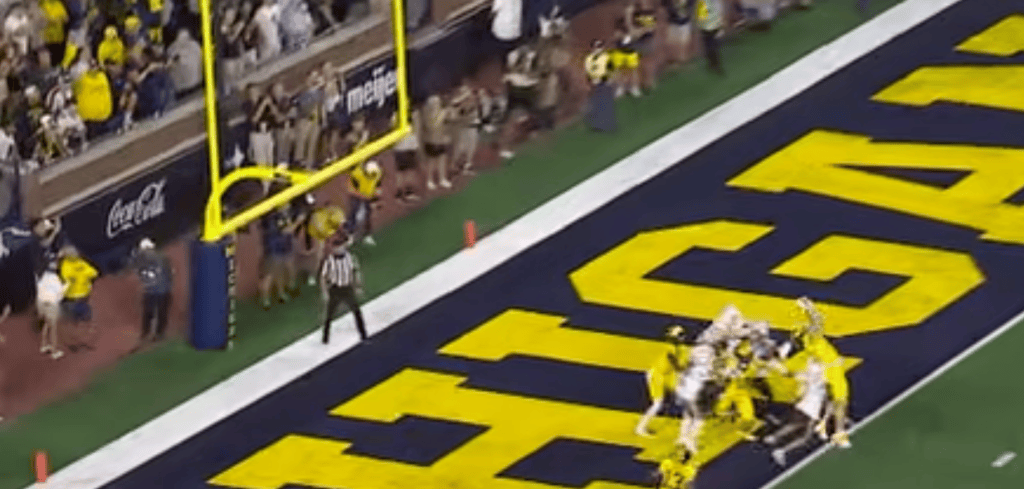
Michigan had already thrown what appeared to be its final Hail Mary with 8 seconds remaining. After that, the stadium clock showed zero, Western Michigan’s players began celebrating, and nearly everyone assumed the game was over. NBC’s broadcast replay appeared to confirm that impression, and its rules analyst questioned how officials could possibly restore any time.
The replay officials, however, had access to the synchronized angle that placed the play beside a direct image of the stadium clock. That feed showed Western Michigan defender Micah Davis touching the ball after stepping out of bounds while a fraction of a second remained. Because the game clock displays whole seconds, that fraction (.04) became one second by NCAA rule.
As The Athletic, published by The New York Times, reported, the video “appeared to back up the decision.” The Big Ten later released the synchronized replay to the MAC conference and the public with audio of the officials discussing what they saw in real time. The conference’s evidence showed a fraction of a second and why the replay officials restored one second even though the television clock had already reached zero in the stadium. Here it is:
There was also some historical irony buried inside the controversy. The Athletic noted that the Big Ten has used a neutral clock operator since 2002. The policy followed Michigan’s controversial 2001 loss at Michigan State, when the home-team clock operator, who became known as “Spartan Bob,” left one second for the Spartans to run the play that produced the winning touchdown.
The independent Big Ten timekeeping official safeguard created after Michigan lost a disputed second helped validate the second that saved Michigan 25 years later.
Quarterback Bryce Underwood received one final opportunity. He stepped back and launched the ball nearly 60 yards through the air. No. 6, JJ Buchanan, a transfer who followed new head coach Kyle Whittingham from Utah, rose from a crowd of players and came down with it in the end zone. Officially, it was a 47-yard touchdown. Michigan won 13–12, and the Big House erupted. I had walked back into the stadium at precisely the right moment.
Who Was I Rooting For?
Many people have asked whom I was supporting. That is not actually a difficult question. I was rooting for Michigan. I am a proud member of the University of Michigan Class of 1997. I remember Kordell Stewart, then Appalachian State, and the Michigan State punt disaster. There are losses that Michigan football fans carry for decades, and I was not looking to add another one.
But my connection to Western Michigan University meant that a Broncos victory would not have left me entirely unhappy. I am a tremendous admirer of Coach Lance Taylor and had the opportunity, while serving as provost, to address the team after practice. That day, I told the players they could win the Mid-American Conference championship, and they did.
On Saturday night, the Broncos showed everyone why. Western forced three turnovers, intercepted Underwood twice, recovered a fumble, and held Michigan scoreless for most of the game. Western’s new kicker, Dieter Kelly, went four-for-four and accounted for all 12 of the Broncos’ points. This was not a fluke performance by a team waiting for Michigan to make mistakes. Western created those mistakes, controlled the game, and stood four fractions of a second away from its first victory over Michigan.
That performance brought me back to something I once read about young athletes. The writer argued that there is a difference between players who possess talent and those who have what coaches sometimes call “the dog.”
Talent Is Not the Dogg
Talent is easy to recognize. It looks like speed, strength, athleticism, intelligence, recruiting stars, enormous stadiums, and national rankings. Michigan entered the game ranked No. 16 and favored by more than four touchdowns. Western arrived from the Mid-American Conference with less money, less depth, and considerably less national attention. For nearly four quarters, none of those differences mattered. Eventually, everyone competing at a high level has talent. The deeper question is what happens when talent does not produce the outcome you expected.
What happens when you are a heavy favorite and almost nothing works? What happens when you are the underdog, surrounded by more than 110,000 people, and hardly anyone outside your locker room expects you to win? That is when the Dogg reveals itself. It takes me back to rapper Snoop Doggy Dogg and the phrase “Nuttin’ but da Dogg in me.” People have spent decades developing more respectable professional language and research for this quality. We call it resilience, the ability to recover from adversity, or grit, the determination to continue despite obstacles. Those concepts matter, but the Dogg feels more instinctive. Resilience gets back up, grit keeps going, but the Dogg has teeth.
Western Michigan had the Dogg Saturday night. The Broncos were not intimidated by Michigan’s ranking, stadium, history, resources, or recruiting classes. They forced turnovers, stood their ground, and made Michigan fight for every yard. They played as if they belonged there because they did.
Michigan eventually had to find the Dogg too. The Wolverines looked outplayed and nearly defeated, but they continued until every measurable fraction of the game had disappeared. When they were unexpectedly given one more second, Underwood still had to make the throw, Buchanan still had to fight through a crowd, and both had to believe something extraordinary remained possible.
The Dogg Also Requires Discipline
The most surprising moment after the game came when Western Michigan President Russ Kavalhuna appeared at a press conference to question the ruling. In all my years around college athletics, I could not remember seeing a university president take that step after a game. Coaches and players ordinarily speak to the media, while disputed calls are addressed through conference procedures. Seeing the president enter that space struck me as unusual and, frankly, a little uncomfortable.
I understood the instinct behind it. Western Michigan’s players had come within a fraction of a second of the greatest victory in program history, and a president should want students to know that their institution stands behind them. Kavalhuna also acknowledged that he had not yet seen the replay and said he wanted the team to receive another look if one was possible.
Leadership requires judgment about when and how to intervene. Once the Big Ten released synchronized video supporting the ruling and the MAC commissioner said he was satisfied with the explanation, fans continuing to frame the result as fixed or an institutional injustice risked drawing attention away from what Western’s players had accomplished. The Broncos do not need anyone to manufacture a case for their excellence. They have already made it themselves. They forced three turnovers, controlled most of the game, and nearly defeated a nationally ranked Michigan team in the Big House. Their performance deserved to remain the story.
Having the Dogg in you does not mean challenging every painful decision on social media as a fan. It also means possessing the discipline to distinguish between a genuine injustice and a result that is simply difficult to accept. A good dog does not bark at everything that moves. The Dogg is willing to fight, but it also knows which fights matter, who should lead them, and when it is time to prepare for the next game.
Conclusion: What Remains After the Clock Reaches Zero
Sports can be cruel because they compress the distance between history and heartbreak into fractions of a second. For Michigan, 0.04 seconds became one more opportunity. For Western Michigan, it became the distance between the greatest victory in program history and one of its most painful losses.
Michigan left with the win, but Western Michigan left with something significant too. The Broncos demonstrated that their MAC championship was not an accident. They entered the Big House, confronted one of college football’s most powerful programs, and brought it within a fraction of a second of defeat. No disputed ending can erase that performance.
Professional life produces moments like that as well. The promotion goes to somebody else, the article is rejected, the grant is not funded, or the opportunity disappears just as we begin to believe it is ours. Talent may get us into the arena, but disappointment reveals what resides beneath it. Can we absorb a painful result without allowing it to define us? Can we defend the people we lead without losing our discipline? Can we return to work after standing 0.04 seconds away from history?
Western Michigan did not receive the result it wanted. Michigan received one more second and turned it into a miracle. Both teams, however, revealed something about themselves when the game became hardest. Talent brought the Wolverines and the Broncos to the Big House. The Dogg kept them both fighting until there was literally no time left.
Please share.
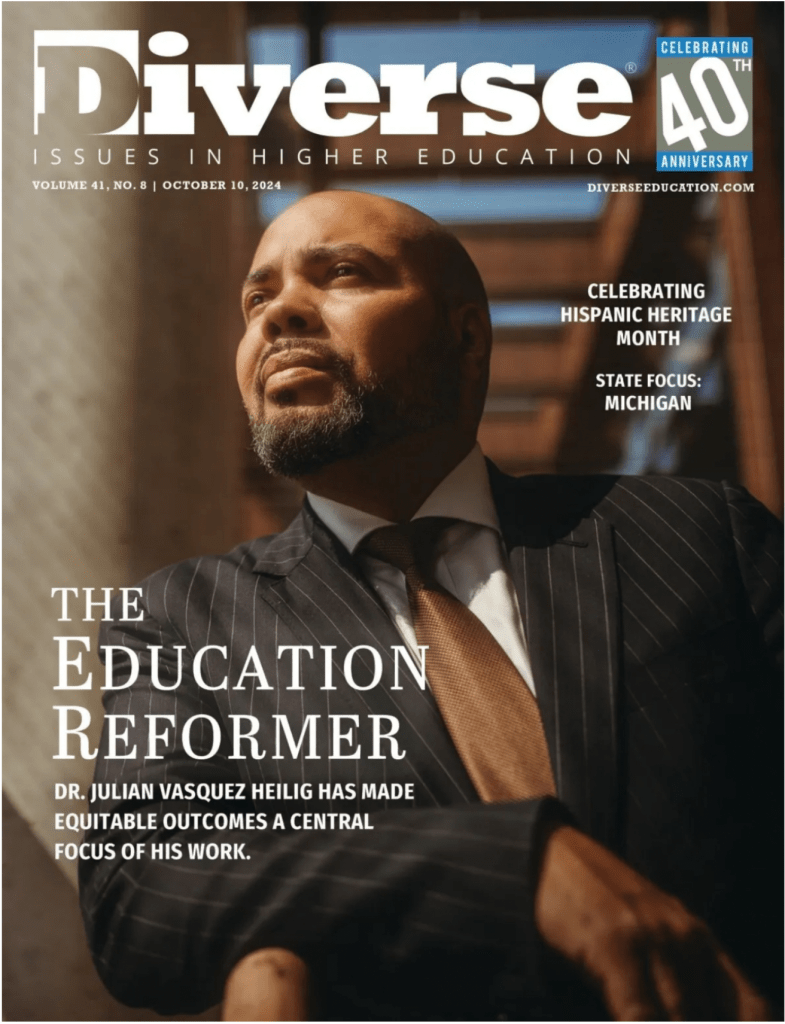
Julian Vasquez Heilig is a nationally recognized public scholar, commentator, and civil rights advocate whose work has appeared on Democracy Now!, MSNBC, Al Jazeera, NBC News, PBS, and Univision. He brings clarity, urgency, and public relevance to complex issues in education, policy, and leadership. For consulting, speaking opportunities, and collaborations, contact jvh@alumni.stanford.edu.




Leave a Reply