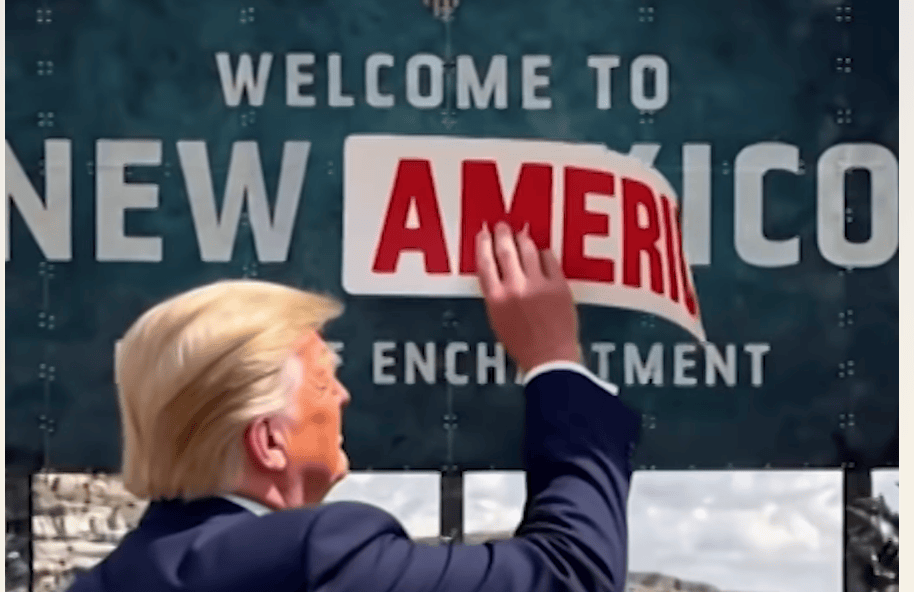
First came the Gulf of America. Then Lake America.
Trump can alter the map today and AI can teach it tomorrow.
Trump is now floating the idea of changing New Mexico to “New America.” He shared an altered map on Truth Social in which “Mexico” was crossed out and replaced with “America.” It would be tempting to dismiss the proposal as legally impossible, historically ignorant, or simply stupid. It may be all three, but dismissing it as another ridiculous Trump idea would miss the larger pattern and problem.
Trump approaches the boundaries of presidential power like a spoiled child approaching a cookie jar. First, he asks whether he can have a cookie. Then he watches the adults. If nobody stops him, he takes one. If they continue looking the other way, he takes another. Eventually, he behaves as if the kitchen belongs to him.
The difference is that Trump is not a child, the presidency is not a kitchen, and the things inside the jar belong to the American people. His provocations are rarely harmless. He floats an idea, studies the reaction, and then moves as far as institutions will permit him to move. The outrageous suggestion is not separate from the action. It is often the first stage of it.
The Word for What Is Missing
There is an elegant word for the quality missing from this style of leadership: élan. Pronounced ay-LAHN, élan is not merely confidence. It is confidence paired with ease, energy shaped by restraint, and skill exercised without visible strain. Élan describes authority that does not need to dominate the room because it has already mastered itself.
Think of élan as a quiet equation: confidence plus ease, energy plus polish, skill without strain. Confidence without ease becomes brittle. Energy without polish becomes noise. Authority without restraint becomes domination. Trump possesses swagger, but swagger is not élan. Swagger announces itself loudly. Élan never has to. When I hear this word, a few presidents come to mind for me. How about for you?
The word comes from French and originally suggested a leap or sudden forward movement. That origin matters because élan is confidence in motion, but it is not reckless movement. It is forward momentum governed by judgment. A leader with élan understands that possessing power does not require using every ounce of it simply because no one has stopped him yet.
Modern political culture rewards nearly the opposite. We confuse volume with authority, spectacle with strength, and impulsiveness with authenticity. Trump has perfected that confusion. He proposes something offensive or absurd on social media, in a press gaggle, or a teleprompter speech, watches everyone scramble to debate it, and then treats the attention itself as evidence that the idea deserves consideration.
The Gulf Was the First Cookie
In January 2025, Trump signed an executive order directing the federal government to replace “Gulf of Mexico” with “Gulf of America” in federal maps, contracts, records, and communications. The order could control terminology used by the United States government. It could not compel Mexico, other countries, or private corporations to accept the new name. The executive order established “Gulf of America” as the name for federal usage and directed the federal geographic database to be changed.
Then something more consequential happened: major mapping companies went along with it. Google announced that users in the United States would see “Gulf of America,” users in Mexico would continue seeing “Gulf of Mexico,” and users elsewhere would see both names. Apple also changed the label for American users. A unilateral presidential assertion migrated from an executive order into the devices millions of people carry in their pockets.
That distinction may sound technical, but maps are not neutral collections of lines and labels. Maps teach. They tell us what belongs to whom, which histories deserve recognition, and whose authority defines reality. When technology companies reproduce a politically imposed name, they do more than update a database. They transform an exercise of power into part of the public curriculum.
Trump learned something from the experience. He reached into the cookie jar, and instead of moving it out of reach, some of the most powerful corporations in the world helped him rearrange the kitchen.
Lake Ontario Was the Second Test
In August 2026, Trump did it again, signing an executive order directing the federal government to call Lake Ontario “Lake America.” Lake Ontario is one of the Great Lakes and is shared by the United States and Canada, yet Trump’s order proclaimed a new name for American federal usage during heightened tensions with Canada. The order directed federal agencies and the Geographic Names Information System to adopt “Lake America.”
This was not merely a purposeful insult to Canada. The name Ontario carries Indigenous history that predates both the United States and Canada. Canadian government sources trace it to an Iroquoian word commonly rendered as kanadario, meaning “sparkling water.” Other scholars and Indigenous leaders connect it to the Wendat word Ontari’io, translated as “great lake,” “beautiful lake,” or “lake of shining waters.” The precise spelling and translation vary, but its Indigenous roots do not. Indigenous peoples, including ancestors of the Haudenosaunee Confederacy, lived around and traveled across the lake for thousands of years before Europeans arrived. The lake’s name preserves a fragment of that much deeper history.
Replacing “Ontario” with “America” is therefore not simply patriotic rebranding. It removes an Indigenous-derived name and substitutes a nationalistic label chosen by the president of one country that does not even surround the entire lake. A name that survived hundreds of years of colonization, international conflict, shifting borders, and the founding of two nations can now disappear from millions of American screens because one president issued an order and two corporations, Google and Apple, updated their databases.
Not every company complied. MapQuest publicly refused to replace Lake Ontario with “Lake America,” demonstrating that private companies retained a choice. Its refusal reportedly propelled the once-dominant mapping service back to the top of Apple’s App Store. That refusal matters because it exposes “we were only following the database” as a corporate decision rather than a technological inevitability. Google and Apple were not powerless. They chose compliance.
Now He Is Reaching for New Mexico
Trump’s next target is New Mexico, and the usual ignorance behind the proposal is breathtaking. The name Nuevo México was used for the region centuries before the United States existed and before Mexico became an independent nation. During New Mexico’s long struggle for statehood, members of Congress repeatedly proposed alternative names, partly because they wanted to weaken the territory’s perceived connection with Mexico. The University of New Mexico’s historical archive documents at least seven proposed alternatives before statehood.
New Mexico’s name carries a complicated history encompassing Indigenous nations, Spanish colonization, Mexican governance, American conquest, and eventual statehood. That history should not be romanticized, but it cannot be improved by erasing “Mexico” and replacing it with a generic nationalist brand. Renaming New Mexico “New America” would not clarify its identity and history. It would distort them.
Trump also lacks the authority to rename a state by executive order. Unlike a federally designated geographic feature, New Mexico is a sovereign state with its own constitution and political institutions. Any legitimate change would have to come through New Mexico’s constitutional process and ultimately its voters. But legality is not the only issue because Trump’s first move is often not to establish legal authority. It is to manufacture familiarity. He introduces the idea, circulates an altered map, allows supporters and opponents to repeat the proposed name, and waits to see who begins treating it seriously. If government agencies, media organizations, technology companies, and political leaders accommodate the language, the impossible begins to look merely controversial. What was once unthinkable becomes negotiable.
Conclusion: Maps Are Part of the Public Curriculum
Maps teach history just as surely as textbooks do. Today, AI systems, search engines, digital maps, and smartphones have become some of the world’s most influential curriculum writers; they write the public curriculum. They quietly determine which names millions of people encounter, which versions of history appear authoritative, and which histories disappear from view.
This is the danger of centralized knowledge in the digital age. Traditional textbooks have serious limitations, but proposed changes ordinarily move through authors, editors, publishers, adoption committees, educators, scholars, and public debate. That process creates friction, and friction can serve as a form of democratic resistance. It gives people time to scrutinize an extreme idea, whether it comes from the political right or the political left, before that idea becomes part of what students are formally taught.
AI and digital platforms collapse that timeline. Within days of the federal order adopting “Lake America” for federal purposes, Google and Apple displayed the new name to American users while MapQuest retained Lake Ontario. That difference matters because the traditional period for vetting, deliberation, correction, and remediation is disappearing. If officials acting in bad faith can alter a central government database and a handful of powerful companies immediately transmit the change through maps, searches, virtual assistants, and AI-generated answers, students can encounter a politically invented name as an apparent historical fact the very next day. The new information can reach the classroom before scholars, educators, journalists, families, or affected communities have a meaningful opportunity to challenge it.
The resulting whipsaw for students and educators may be inevitable. One administration can change a name, digital platforms can distribute it instantly, and the next administration can reverse it just as quickly. Teachers may enter their classrooms one morning to discover that the maps, search results, and AI tools their students use now provide a different answer from the one they provided the day before. Students are then left to wonder whether history changed, whether their teachers were wrong, or whether truth itself is simply whatever the most recent software update says it is.
Once an altered name is repeated across enough authoritative-looking platforms, users may no longer recognize it as a contested political designation. It begins to look like settled history. An AI system can be programmed to repeat the terminology without explaining who changed it, when it changed, where it is recognized, what name preceded it, or whether other governments and communities reject it. The machine is not independently discovering the truth. It is reproducing the choices embedded from corporations that control it.
This makes centralized digital knowledge potentially more unstable than a textbook. A textbook can be challenged in a classroom, supplemented by a teacher, corrected in a later edition, or rejected by a school district. When the same small group of companies controls the maps, influences search results, supplies information to digital classrooms, and shapes the answers produced by AI, one political decision can spread throughout the entire information environment almost instantly.
The central question is therefore larger than whether “New America” sounds more prestigious to Donald Trump. It is whether any president, from either party, should be able to turn a political preference into the default answer produced by the systems people increasingly trust to teach them about the world. In the emerging public curriculum of everyday technology, control over the algorithm and the database is control over the past. When political power can rewrite tomorrow’s lesson overnight, the greatest danger is not that the map has changed. It is that an entire generation may never know who redrew it, or that it was ever redrawn at all.
Please share.
Julian Vasquez Heilig is a nationally recognized public scholar, commentator, and civil rights advocate whose work has appeared on Democracy Now!, MSNBC, Al Jazeera, NBC News, PBS, and Univision. He brings clarity, urgency, and public relevance to complex issues in education, policy, and leadership. For consulting, speaking opportunities, and collaborations, contact jvh@alumni.stanford.edu.





Leave a Reply