Texas erased a 20-point fourth-quarter deficit, Ohio State lost, and somehow the internet decided that the real scandal was the brown students celebrating in the stadium.
As a former UT Austin professor for eight years, where I first earned tenure, and a Michigan alumnus who is always happy to see Ohio State lose, I had more than one reason to enjoy Texas erasing a 20-point deficit in the fourth quarter. Everyone was celebrating, including me. The Suckeyes had lost. It was “OH-NO!” instead of “OH-IO!”
The image at the center of a social media controversy after the game came from an Instagram video showing a group of University of Texas students celebrating in the stands. The scene still felt familiar because sports broadcasts and social-media accounts constantly search for these moments. After a touchdown, a comeback, or a victory, cameras pan across the crowd and briefly turn ordinary fans into symbols of collective joy.
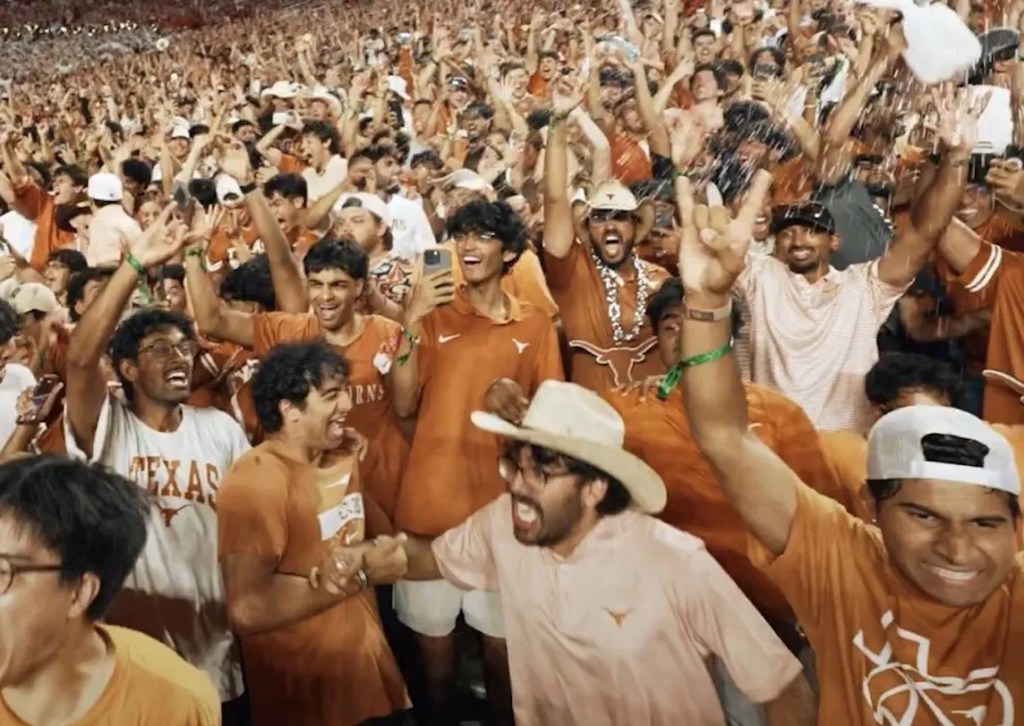
Many of the students in this particular shot appeared to be Indian American. I believe I remember seeing them in the crowd during the game, but the image did not seem remarkable. They were wearing burnt orange, shouting for Texas, and celebrating a historic Longhorn victory. The camera moved on, and so did I, but the internet did not.
Bo French, the Republican nominee for the Texas Railroad Commission, circulated a screenshot and treated the students’ presence as evidence of national decline. He claimed that Americans were being displaced by foreigners. A few seconds of college-football celebration became a racial alarm that eventually attracted more than 40 million views.
French was hardly alone. Memes, videos, and social-media posts I saw after the game online relentlessly criticized the University of Texas because so many Indian American students were visible in the shot. This transformation of an ordinary celebration into political fuel offers a revealing example of parasitic politics. It takes a moment of collective joy, attaches fear and grievance to it, and feeds on the resulting resentment.
The image showed only a sliver of an 11,000-person student section. At least two students targeted by the vitriol have been identified as American citizens. In the Houston Chronicle, UT senior Dhairya Gupta described how disturbing it was to see strangers use his face as evidence that someone else’s place at the university had been stolen.
I keep returning in my mind to how unremarkable the image seemed when I first saw it. I did not wonder whether the students were citizens. I did not imagine that the camera had captured a crisis in immigration or university admissions. I saw college students celebrating their football team because that was exactly what was happening.
Colorblind Until the Camera Finds Brown Faces
Conservative politicians and pundits frequently invoke colorblindness. They accuse civil-rights advocates, scholars, and universities of inserting race into situations where it does not belong. They demand that we stop noticing race whenever someone documents discrimination, segregation, or unequal access to opportunity. Yet when a camera settled on a group of brown students at a football game, racial difference suddenly became impossible to ignore. Their faces became evidence, their celebration became suspicious, and their presence required an explanation.
This version of colorblindness increasingly operates like a switch. Race disappears whenever inequality is named and reappears whenever people of color become highly visible. The ideology asks us to ignore race when discussing who has historically been excluded from the University of Texas, then commands us to notice race when Asian American students occupy several rows of its football stadium.
Political scientist Tali Mendelberg’s research helps explain this maneuver. She found that racial appeals can be particularly effective when they are coded enough to preserve plausible deniability. Politicians can activate racial fears while insisting that they are discussing immigration, fairness, merit, or cultural change. The racial message reaches its intended audience while the speaker denies having delivered one. This selective vision is essential to parasitic politics. Race must remain available as a weapon while disappearing as a subject of learning and analysis. The students’ faces revealed nothing about their citizenship, birthplace, academic qualifications, or admissions histories. Brown skin supplied all the evidence the accusation required, and the racial imagination completed the story.
The actual enrollment facts dismantle that story. Texas law requires 90 percent of each UT freshman class to consist of Texas residents. International students constitute only about 4.3 percent of UT Austin’s undergraduate enrollment. Most UT students come from Texas, and the university’s comparatively larger international population is concentrated among graduate students. A group of South Asian students sitting together at a football game tells us almost nothing about the number of international undergraduates attending UT. Reuters reported the enrollment figures and residency requirements.
What the video actually reveals is that Texas, and America, has changed. Asian American communities have grown throughout Dallas, Houston, Austin, San Antonio, and the state’s suburbs. Their children attend Texas schools, earn high grades, qualify through the state’s admissions systems, and enroll at public universities their families support through taxes. Their appearance at a Longhorn football game reflects the Texas that already exists.
Research on demographic change suggests why images like this can produce such intense reactions. In a series of experiments, Maureen Craig and Jennifer Richeson found that making America’s changing racial composition salient increased perceived group-status threat among white respondents and moved their political attitudes in a more conservative direction. The UT photograph condensed demographic change into a single visual moment, making a future some people fear appear immediate and undeniable.
Merit Until We See Who Earned It
The controversy becomes even more revealing when placed beside the campaign to eliminate affirmative action. For years, Asian American applicants were presented as the central victims of race-conscious college admissions. Conservative organizations argued that universities penalized highly qualified Asian students in order to admit Black and Hispanic applicants.
Students for Fair Admissions used allegations of discrimination against Asian American applicants to challenge admissions practices at Harvard and the University of North Carolina. In 2023, the Supreme Court invalidated Harvard’s program under Title VI of the Civil Rights Act and UNC’s under the Equal Protection Clause of the Fourteenth Amendment. Asian Americans became the human evidence used to dismantle race-conscious admissions.
The political and legal campaign produced an unmistakable expectation. Asian American applicants would receive more offers once universities could no longer consider race, while Black and Hispanic enrollment would decline. Some opponents of affirmative action appeared to anticipate another result as well: a larger proportion of white students at selective universities.
At UT Austin, the first available data following the decision showed no sudden Asian American takeover. The shares of Asian and white freshmen each declined by approximately one percentage point between 2023 and 2024. More students also declined to identify their race or ethnicity, and UT’s automatic-admission system makes simplistic racial interpretations especially unreliable. The university’s racial composition remained comparatively stable. UT reported its 2024 enrollment figures. Yet a photograph of Asian American students was still presented as proof that someone had taken the university away from “Americans.” The political movement that used Asian Americans to attack affirmative action quickly discovered another use for them. They could become the foreigners allegedly taking opportunities from white students.
Political scientist Claire Jean Kim described this recurring dynamic as the “racial triangulation” of Asian Americans. Asian Americans are praised by white Americans relative to Black Americans as disciplined, successful, and deserving while simultaneously being treated as permanently foreign and outside authentic American white identity. The affirmative-action debate relied on the first position. The reaction to the football photograph activated the second.
Here, parasitic politics feeds twice on the same population. It extracts Asian American grievances to weaken affirmative action, then extracts white racial anxiety by portraying Asian American achievement as displacement. Its political value comes from keeping groups suspicious of one another while directing attention away from the larger structures governing educational opportunity.
That reversal exposes the limits of the merit argument. Asian Americans were celebrated when their accomplishments could be used to challenge Black and Hispanic access. Their success became threatening when it was concentrated visibly enough to momentarily fill a television screen at a football game. For some critics, the underlying concern was never simply whether universities followed race-neutral procedures. They carried an expectation about what the results of those procedures should look like. When the outcome contained more brown faces than expected, merit lost its authority and racial suspicion took its place.
Conclusion: What the Camera Saw
The Instagram video from the 2026 Texas Ohio State game did not reveal anyone’s citizenship, birthplace, grades, family history, or path to admission. It showed college students wearing burnt orange and celebrating their team. The people who weaponized the image supplied the rest of the story from their own racial assumptions.
That is the contradiction running through this controversy. Asian Americans are praised as evidence of merit when their achievements can be used to attack affirmative action. When their success becomes too visible, they can be recast as foreigners taking opportunities from “real” Americans. Their belonging expands or contracts according to the political purpose they are being asked to serve.
That is why the Instagram controversy matters. It exposed how quickly demands for colorblindness can disappear when something as simple as a football crowd contains more brown faces than some observers expect or want. The same people who insist that race should not matter in admissions suddenly treated race as the only fact that mattered in the stadium. Parasitic politics thrives on this instability. It takes an ordinary celebration, strips the people in it of their individuality and humanity, and turns their faces into fuel for resentment to Make America Great Again. It needs Americans to look at their neighbors and see competitors, invaders, or replacements rather than fellow citizens.
The students did not create the controversy. They attended a football game, cheered for Texas, and appeared on television. The camera saw Americans celebrating America. The parasites counted the brown faces and saw another meal.
Please share.
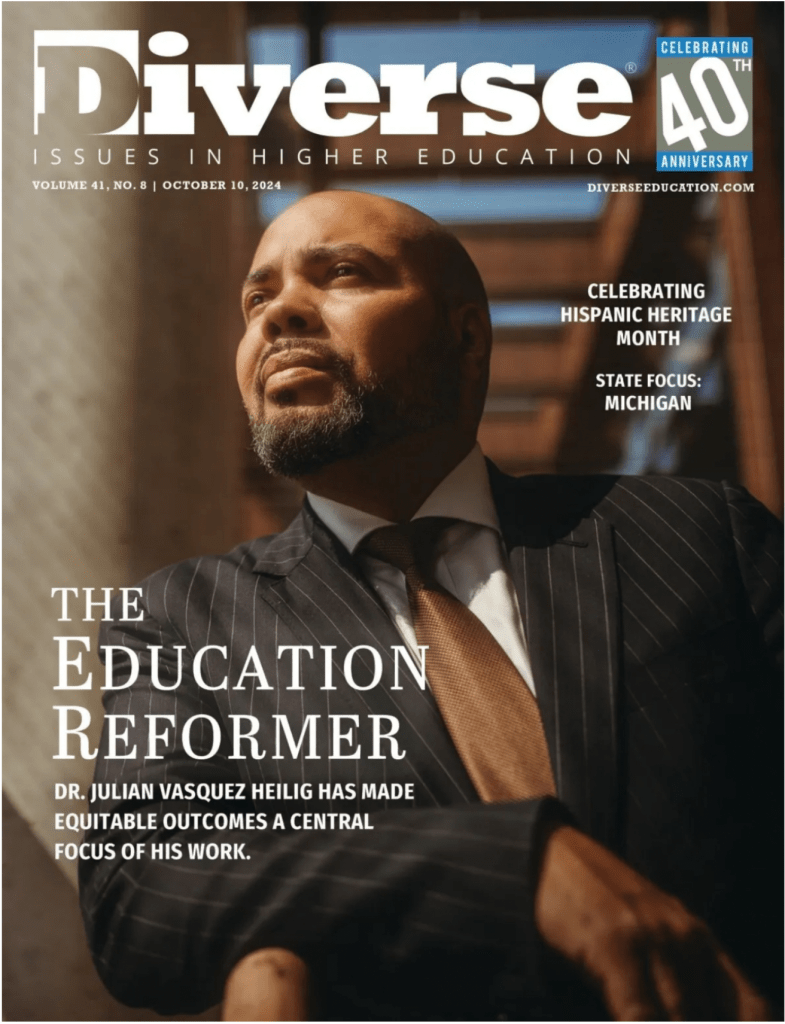
Julian Vasquez Heilig is a nationally recognized public scholar, commentator, and civil rights advocate whose work has appeared on Democracy Now!, MSNBC, Al Jazeera, NBC News, PBS, and Univision. He brings clarity, urgency, and public relevance to complex issues in education, policy, and leadership. For consulting, speaking opportunities, and collaborations, contact jvh@alumni.stanford.edu.



Leave a Reply