
Have you ever encountered someone in an internet comment section who was absolutely, positively certain they were right? Not just confident. Certain. The kind of person who has found a sentence on a website, copied and pasted it, and decided the discussion is over. Perhaps you’ve encountered this person on your Facebook, LinkedIn, or maybe in the comments of a news article online. The internet participaturs often have an extraordinary ability to turn a little bit of information into an enormous amount of confidence.
Recently, I encountered exactly this kind of certainty in the comments section of The Washington Post. A commenter named LexVAP challenged a criticism of charter schools with what he apparently believed was a devastating rebuttal. He even brought citations. Here is his exact comment:
“Are your comments true for all charters in all states? The charters in DC enrollment are lottery based. Given that your comments are incorrect, at least in DC, what are your objections now? “…public charter schools in DC cannot pick and choose students based on academic . herperformance [sic], behavior, or other discriminatory criteria; admission is lottery-based and open to all DC residents, with limited preferences for siblings and staff children.”
dcpcsb.orgcode.dccouncil.gov”
I particularly noticed the confidence of “Given that your comments are incorrect.” Apparently, in their eyes the existence of a lottery has settled decades of research on educational inequality and school choice. Case closed. Never mind that many people have spent their academic careers studying and writing peer-reviewed articles on charter schools, school choice, segregation, and educational equity. According to the commenter, the existence of a lottery was sufficient.
There is just one problem. A lottery determines who gets an available seat, not who gets the opportunity to apply, which grades accept students, or who gets to stay. D.C. law prohibits discriminatory admissions and generally requires lotteries when demand exceeds available seats. But as American history repeatedly reminds us, just because something is legal doesn’t mean it’s fair, and just because the law promises equal opportunity doesn’t mean everyone actually experiences it. Let me quickly explain why in this post. And please stay with me until the end, because there’s a larger life lesson here that goes far beyond charter schools.
Creaming, cropping, and the families who never make it to the draw
Let’s begin with two concepts that charter school researchers have discussed for decades: creaming and cropping. Creaming refers to practices that attract or disproportionately enroll students who are comparatively easier to educate or more likely to perform well academically. Cropping refers to practices that limit access or continued enrollment for students who may require additional resources, accommodations, or support.
The important distinction is that neither requires a school administrator to stand at the lottery door and explicitly reject a child. Kevin Welner and Wagma Mommandi documented 13 ways charter schools can influence their student populations in School’s Choice. These include practices involving recruitment, enrollment information, school requirements, discipline, and continued enrollment. I discussed Welner’s earlier Dirty Dozen work on Cloaking Inequity blog all the way back in 2013. A community can operate a random admissions lottery while using other policies or practices that affect which families ever reach that lottery.
Consider what happens when a parent calls a school to ask about services for a child with a disability or an English learner. Does the school enthusiastically explain how to apply and what services are available? Or does someone suggest that another school might be a better fit? Both children have the legal right to apply and enter after a lottery selection. But only one family may actually submit an application. A lottery selection cannot protect a student who has already been discouraged from entering the school.
This isn’t merely a hypothetical concern. The D.C. Public Charter School Board conducted a mystery caller investigation in 2022. Staff members posed as parents seeking enrollment information for children with disabilities or English learners. The board found initial violations at 20 of 134 charter campuses. Fifteen violations involved English learner access, while five concerned special education. Five campuses had repeat problems on a second call. The charter board deserves credit for conducting the investigation, but the results demonstrate precisely why lottery assurances alone cannot settle questions of equitable access.
What our segregation research found in Washington, D.C.
There is another problem with the internet commenter’s confidence in charter school lotteries. In Choice Without Inclusion?, T. Jameson Brewer, Yohuru Williams, and I analyzed federal enrollment data to compare racial segregation across charter and traditional public schools. Notably, Yohuru took a break from working out and being on the History Channel and other documentaries to help us write this study. In the Common Core data we found in Washington, D.C. that 78.9% of charter school students attended schools where at least 90% of enrollment was nonwhite, compared with 45.1% of students in traditional public schools. That represents a remarkable 33.8-percentage-point difference.
These are descriptive findings, not proof that particular lottery procedures caused segregation. But the results challenge the assumption that school choice lotteries automatically produce better situations for students. A random lottery is not an opportunity policy. It cannot by itself overcome residential segregation, unequal access to information, transportation barriers, or differences in which schools attract and retain particular populations.
Backfilling: the part of the lottery conversation charter advocates often skip
Now let’s discuss something especially important that our confident internet commenter didn’t mention: backfilling. Backfilling occurs when a school brings in a new student to replace one who has left or doesn’t. Charter schools can use lotteries to fill available seats while restricting the grades or periods during which they accept additional students.
Consider Washington Latin Public Charter Schools. The network publicly explains that it generally does not accept new students after ninth grade because of its Latin graduation requirement. D.C. International School, which serves grades six through twelve, lists new applicant entry grades of six through nine for 2026–27. These policies may have educational rationales, but the practical consequence is that a family seeking a tenth-grade placement cannot simply assume every publicly funded school offers an opportunity to enter.
Recent data underscore this concern. According to the D.C. Office of the State Superintendent of Education, during 2024–25, approximately 38% of tracked midyear transfers originated at charter schools, but only 17% ended at charter schools. DCPS received 82% of those transfers. Moreover, 79% of students transferring midyear were economically disadvantaged. These statistics do not establish why individual students transferred or whether specific schools deliberately refused to replace departing students. They do show how unevenly the responsibility for educating mobile students was distributed.
Not All Lottery Tickets Are Created Equal: Who Gets to Jump the Line?
Our confident internet commenter also assured readers that D.C. charter school lottery preferences are limited to siblings and staff children. Not quite. D.C. law permits several additional preferences that can significantly influence who receives an available seat. Consider D.C. International School, where students from five designated partner charter elementary schools receive priority in the sixth-grade admissions lottery. Two children living in the same city can apply to the same school, but the child who previously attended a partner school has an advantage. Both entered the lottery. They just didn’t enter with the same odds.
And that’s not the only example. D.C. law permits qualifying charter schools to reserve up to 50% of seats for children of active-duty military personnel. Other authorized preferences can prioritize students with disabilities or students designated as at-risk. They serve different purposes, and some are explicitly intended to expand opportunities for underserved students. But they demonstrate that D.C.’s current charter admissions system is considerably more complicated than our commenter suggested.
Vasquez Heilig, J., Brewer, J., & Williams, Y. (2019). Choice without inclusion? Comparing the intensity of racial segregation in charters and public schools at the local, state and national levels. Journal of Education Sciences, 9(3), 1-17.
A lottery can be perfectly random while giving different groups of children very different chances of admission. Preferences, eligibility requirements, available seats, and entry restrictions all shape who gets in. A fair drawing does not necessarily mean equal opportunity. So when someone insists that charter schools cannot selectively enroll students because they use lotteries, my response to the internet commenter is simple: You haven’t looked closely enough at the research, or how these lotteries actually work.
Conclusion: The Worst Kind of Wrong Is Being Certain You’re Right
There are few things more dangerous than being wrong while absolutely convinced you’re right. Not because being wrong is unusual. We all get things wrong. The danger comes when confidence replaces curiosity, when a quick Google search substitutes for understanding, and when winning an argument becomes more important than learning something.
Earlier in my life, I taught in charter schools, served on their boards, donated financially, and even enrolled my own child in one. Having experienced charter schools from nearly every angle, and conducted more than a decade of research on their policies and outcomes, I now understand that the reality is far more complicated and problematic than a simplistic claim about lotteries copied from a regulatory website. Experience taught me to ask questions. Research taught me to question what I thought I knew.
That’s why I believe charter schools should face greater transparency requirements about who applies, who enrolls, who leaves, which grades remain open, and how many vacancies are actually backfilled. Enrollment counseling, special education access, language services, and exclusionary discipline deserve continued scrutiny. D.C.’s own mystery caller investigations demonstrate why oversight matters.
But the larger lesson has very little to do with charter schools. Finding a law that prohibits discrimination is not evidence that discrimination doesn’t happen. Finding a statistic that supports your position doesn’t mean you’ve understood the data. And finding a source that agrees with you doesn’t mean you’ve discovered the truth. These distinctions matter in education, politics, business, science, and just about every argument unfolding on the internet.
So, to LexVAP and anyone else who mistakes finding a sentence on a website for winning an argument: You brought a source. I brought more than a decade of research, enrollment data, school policies, and firsthand experience. But even that doesn’t make me immune to being wrong. The difference is that I’m willing to follow the evidence wherever it leads, including when it challenges what I once believed.
The most dangerous person in a debate isn’t someone who doesn’t know the answer. It’s someone who doesn’t know what they don’t know, but is absolutely certain they do. And the most important thing we can teach our children isn’t how to win an argument. It’s how to recognize when the evidence tells them they’ve lost one.
Please share. This lesson goes well beyond charter schools.
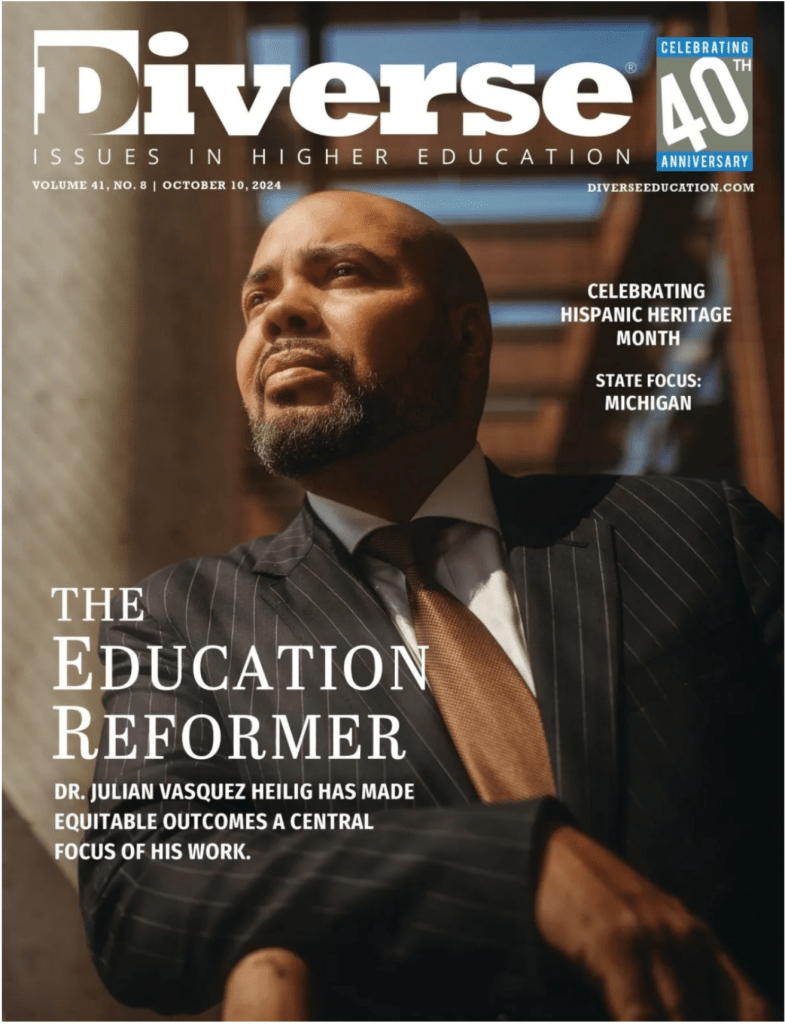
Julian Vasquez Heilig is a nationally recognized public scholar, commentator, and civil rights advocate whose Cloaking Inequity blog and Without Fear or Favor LinkedIn newsletter have garnered nearly 2 million views since 2025. Featured on Democracy Now!, MSNBC, Al Jazeera, NBC News, PBS, and Univision, he brings clarity and urgency to education, policy, and leadership. For consulting, speaking, and collaborations, contact jvh@alumni.stanford.edu





Leave a Reply