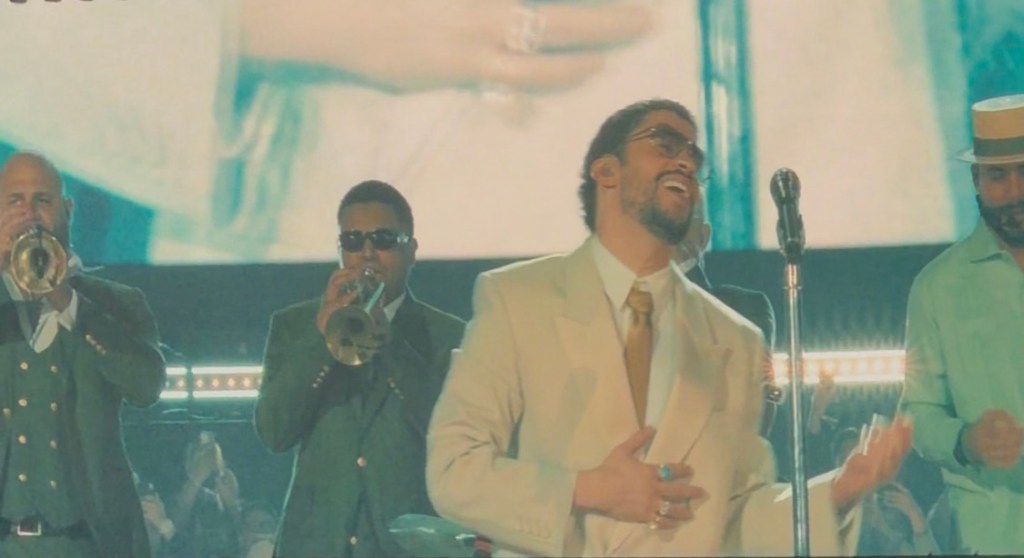
When I walked into the Bad Bunny concert in Mexico City this past Wednesday—research notebook in my pocket, the arena vibrating before the first beat even dropped—I felt a mix of joy, pride, and excitement that caught me off guard. I’ve seen Kendrick. I’ve seen Sade, Janet Jackson, Ricky Martin, Maná, Santana, Celia Cruz, and others whose music shaped entire eras. But I had never felt this. Something deeper. Something cultural. Something personal. More on this in a moment.
My journey with Bad Bunny didn’t begin on a streaming playlist or in a stadium packed with fans. It began in 2019, underground—literally. The basement venue at the La Concha Resort in San Juan, Puerto Rico, was called Fifty Eight back then, a late-night lounge with low ceilings, too-loud speakers, and a local crowd that moved as if the music itself were a shared inheritance. Around ten in the evening, a song came on that stopped me mid-thought. I pulled out my phone, hit Shazam, and watched an answer appear: “Vete.” Bad Bunny. That moment was a spark. Wait. Who?
In the years that followed, I kept trying to chase that feeling back to its source. This past summer, I tried hard to return to Puerto Rico to see him perform his Debí Tirar Más Fotos Tour live in San Juan, but the timing never aligned. Instead, I watched with equal parts joy and jealousy as friends across my Facebook feed posted photo after photo from his concerts—selfies in merch, videos of roaring crowds, captions written in pure adrenaline.
Then came a November 2025 conference in San Juan. At a private dinner for the Learning Policy Center, several attendees mentioned they had bought Bad Bunny tickets for that week, only to learn he was performing in Santo Domingo, not Puerto Rico. For an hour, I tried to engineer the impossible: a quick hop to the Dominican Republic between conference sessions. But I had two presentations I couldn’t, in good conscience, vanish from. So once again, the universe said not yet.
Last week, I had a new spontaneous idea: Bad Bunny’s Debí Tirar Más Fotos Tour visit to Mexico City. Maybe this would finally be the moment when everything aligned. Because the truth is, “Vete” didn’t just introduce me to Bad Bunny. It opened the door to a cultural force I didn’t yet understand—a political and artistic force that has only grown in relevance, urgency, and global significance.
Something Deeper and Much Older
And maybe part of my determination to experience him live came from something much, much older in me. I have always regretted that I didn’t get to know Bob Marley’s music when it was changing the world in real time. I discovered him later, almost by accident, flipping through CDs at a T.J. Maxx decades ago. I brought an album home, pressed play, and felt something crack open. I fell in love with Marley’s voice, his politics, his tenderness, his fire. I eventually traveled to Kingston to walk through his home, to see the rooms where he wrote, rehearsed, dreamed. I watched the recent film about him with the kind of attention usually reserved for Detroit Lions football.
So when I say that Bad Bunny isn’t just another artist, I say it with the weight of that history. I think I have lived long enough to recognize when a musician becomes a movement. And somewhere between a San Juan basement lounge in 2019 and the missed San Juan concerts of the past summer, I realized something larger was happening.
Bad Bunny isn’t just a star. He is, in many ways, the Bob Marley of our generation.
Most people underestimate what it means for an artist to become a cultural force. They assume global impact is about popularity, streaming numbers, sold-out stadiums or Super Bowl invites. But those metrics only describe reach, not meaning. The true test of influence is whether an artist alters how people understand themselves, their communities, and what is possible in the world. That is why, when you look beyond the surface, Bad Bunny is not simply another superstar. He is, in many ways, the Bob Marley of our generation.
This comparison will make some readers pause. Marley is sacred ground for millions. But if you sit with the parallel long enough, the shape of it becomes hard to ignore. Both artists rose from small islands to global prominence. Both rejected expectations placed on them by the music industry. Both used their platforms to tell uncomfortable truths about identity, class, colonialism, and the struggle for self-determination. And both understood that music is not merely entertainment. It is a political act, a cultural negotiation, and a declaration of existence.
Bad Bunny’s ascent reveals a pattern we’ve seen before: unique eras produce an artist who reframes what representation means in a world determined to ignore certain voices. Marley did this in the 1970s with reggae. Bad Bunny is doing it now with reggaetón and Latin trap.
A Voice That Centers the Margins
Bob Marley emerged from a Jamaica shaped by colonial history, class tension, and racial hierarchies. His music was not only about rhythm and melody; it carried the weight of political urgency and spiritual affirmation. He sang for those whose voices never reached the halls of power.
Bad Bunny, in another century and another context, is doing something similar. He speaks for communities historically dismissed in the global music market: Puerto Ricans navigating colonial ambiguity, working-class youth negotiating precarity, queer fans who have rarely seen themselves taken seriously in Latin urban music, and diasporic Latinos who rarely get to see their languages, bodies, and realities centered on the world stage.
He tells love stories but also sings about wage workers, street economies, police violence, environmental destruction, and the quiet brutality of inequality. He insists on speaking Spanish everywhere he goes, refusing the pressure so many artists face to translate themselves into English to be legible to American audiences. This refusal is political and radical. It reclaims cultural space. It is Marley’s “get up, stand up,” delivered through a new sonic landscape.
Art as Resistance and Social Witness
Cultural critics often forget that Marley’s global fame grew out of music that was fundamentally resistant. He was documenting the injustice of a world that preferred not to look at itself too closely. Bad Bunny follows this lineage.
He has used award shows to call out government corruption in Puerto Rico. He has amplified the stories of murdered trans women. He has highlighted the failures of disaster relief, the violence of displacement, and the invisibility and colonialism imposed on island communities.
Where Marley used roots reggae to expose global inequities, Bad Bunny uses reggaetón as a modern vehicle for the same work. Music becomes testimony, and testimony becomes collective courage. Bob Marley became a global figure while never allowing Jamaica to be overshadowed by the systems that historically exploited it. He insisted that the world recognize the island on its own terms.
Bad Bunny is doing this with Puerto Rico. He refuses to be culturally annexed by the United States. He performs his identity unapologetically, and in doing so, he forces mainstream audiences to confront their limited understanding of the island. He has revived conversations about colonial status, self-governance, and dignity. He uses fame to hold a mirror up to the structures that have shaped life for Puerto Ricans for more than a century. Like Marley, he reminds us that the world pays attention only when someone demands it.
When An Artist Becomes a Movement
Most musicians entertain. Only a few become movements. Marley did not simply sing songs. He carried the emotional architecture of a people into the global consciousness. Bad Bunny, in this era, is doing the same thing.
When I walked into his concert Wednesday night in Mexico City, the first thing that struck me was the scale. People on social media have said the crowd in my videos looked like Times Square, and they’re right. Tens of thousands of people moved with a single rhythm, singing in unison, chanting “Benito,” and sustaining an energy that never broke for the entire show. It felt less like a concert and more like a collective gathering built on joy, identity, and shared recognition.
What didn’t surprised me was the feeling of cultural pride running through the night. In his comments to the crowd, there was a clear sense of Latino pride and solidarity with the people of Mexico: not as a performance, but as an acknowledgment of the people who made his rise possible. You could feel the room react, not with celebrity worship, but with a kind of mutual affirmation and affection.
Even the design of the show reflected that ethos. The experience was intentionally egalitarian. He didn’t limit the intimate moments to the fans closest to the stage; he built a second stage deep in the arena so the people in the very back, a section usually forgotten, were treated to at least seven songs with him barely a few yards away. The message was subtle but unmistakable: everyone mattered.
That’s also what makes his music feel larger than entertainment. It functions as social commentary—urgent, grounded, and unafraid. His emergence has expanded what Latin artists can be in global markets. He has shattered linguistic ceilings, cultural stereotypes, and geographic boundaries. He has shown that art created in marginalized spaces can reshape the world when delivered with clarity, courage, and purpose.
And there’s a reason his work resonates beyond fandom. A generation that feels overlooked, overworked, and misunderstood sees him not as a distant celebrity, but as a reflection of their own struggle to be fully human in systems that often treat them as invisible and glorifies billionaires. That’s why the room felt the way it did: unified, electric, and profoundly seen.
The Work of Cultural Healing
Marley’s music helped people locate hope in the middle of hardship. Bad Bunny’s music does the same for millions today. It offers joy without denial, rebellion without nihilism, and vulnerability without shame. In a world that feels increasingly fractured, that combination doesn’t just entertain, it restores something essential in us.
Bad Bunny is not literally Bob Marley. But he is the Marley of this era because he fulfills the same deeper purpose: he tells a truth powerful enough to move people from where they are to where they have not yet been. He expands our sense of what is possible. He creates community across borders—geographic, linguistic, emotional—that once felt unbridgeable. He reminds us that art, at its best, is not an escape from the world but a way to reimagine it.
And maybe that’s why this concert meant so much to me. I realized I wasn’t just watching a performance. I was watching a generation find its voice. I was watching people see themselves reflected on a scale the world can no longer ignore. I was watching music become a form of cultural healing—personal, political, and profoundly human.
Artists who do that do not simply make music.
They make movements.
They make memory.
They make meaning.
And that is why his rise matters far beyond the charts, or even the stadiums.
Oh, and Super Bowl. It’s happening.
Julian Vasquez Heilig is a Bad Bunny fan who believes that music is one of the most powerful archives of social truth. A nationally recognized policy scholar and civil rights advocate, he examines culture not as entertainment alone but as a lens through which people understand belonging, resistance, and possibility. From his first encounter with “Vete” in a late-night Puerto Rican club to researching crowd energy at a Mexico City arena, he approaches Bad Bunny’s work with the same curiosity he brings to public policy: What does this moment reveal about who we are and who we are becoming?





Leave a Reply