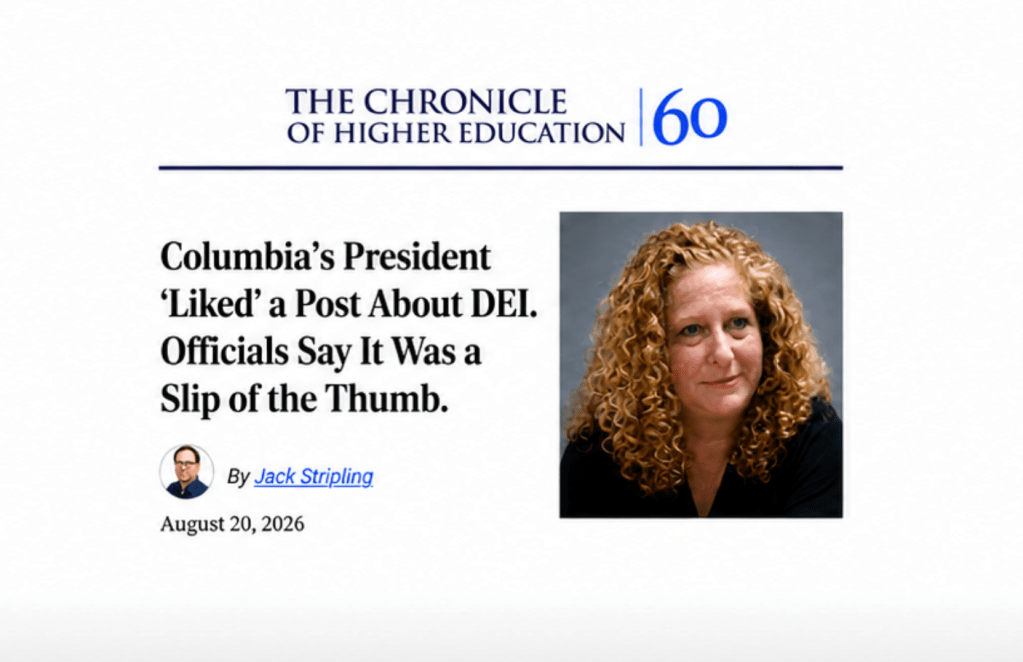
Yesterday, I did not expect my blog to generate a front-page story in The Chronicle of Higher Education, much less one involving an Ivy League president.
But that is exactly what happened after Columbia University President Jennifer Mnookin’s “slip of the thumb” accidentally liked my LinkedIn post responding to Tyler Austin Harper’s essays in The Atlantic. Before long, a Chronicle of Higher Education reporter was emailing and calling with questions, Columbia was issuing a statement, and my argument about race and higher education had become a lesson about modern politics. By the end of the day, I had spoken with both Jack Stripling, who wrote the article, and Mnookin herself. What began as an ordinary moment of public engagement became an unusually revealing example of how narrowly we define what university leaders are permitted to consider in the current political moment.
I had noticed earlier that day that President Mnookin liked my post because LinkedIn highlighted her name among those engaging with my work. I did not think twice about it. My two recent posts about Harper (He Picked a Fight With Black America. I’m Here to Finish It) and Arday (The Death of Jason Arday) have reached approximately 80,000 readers across the world in just a few days via LinkedIn and my Cloaking Inequity blog. In fact, over the past year, approximately two million people have engaged with my public scholarship. I truly appreciate everyone who takes the time to read and debate, including university presidents seeking to stay informed about important conversations in higher education.
The Chronicle emphasized in it’s story my description of Harper’s work as “garbage,” which undoubtedly makes for the most sensational quote. But I promise my argument involved considerably more than one colorful word. I examined how claims about supposedly unqualified Black professors circulate, how individual experiences become sweeping judgments about Black scholars, and how some audiences recruit Black voices to legitimize conclusions they already want to believe. Those are substantive questions about race, power, authority, evidence, and the public narratives shaping higher education. Please read the actual post before deciding that my analysis begins and ends with “garbage.”
The President Is Not the Problem
Columbia’s statement explained that Mnookin’s reaction resulted from “rapid scrolling with poor mobile phone reception,” and I don’t question that explanation. Anyone who uses a smartphone knows accidental reactions happen. But more importantly, a university president should be able to encounter a scholarly argument without that encounter becoming an institutional emergency and front page news. Scrolling past a post does not mean endorsing it, and staying informed about higher education should not itself become controversial.
I appreciate that Mnookin is paying attention. University leaders should have the space to read The New York Times, The Atlantic, The Chronicle, Washington Examiner, blogs, public scholarship, and whatever else helps them understand the rapidly changing landscape of higher education. They should encounter conservative arguments, progressive arguments, and perspectives that do not fit comfortably into either category. Engaging ideas across the spectrum does not make leaders inconsistent or unprincipled. It equips them to understand the concerns, experiences, and disagreements shaping the communities they serve. Presidents lead better for all communities when they are allowed to listen beyond the boundaries of their own institutions and assumptions.
Breakfast Encounter With a Big Ten President
I recently saw a Big Ten university president while having breakfast at a hotel in Los Angeles. We talked for a bit, and I asked a difficult question about an issue affecting higher education. The president hedged, hawed, circled the matter, and ultimately did not answer. I understood exactly what was happening because I knew the price of speaking frankly. One unguarded sentence can become a headline, a trustee complaint, a donor problem, or a political controversy.
That exchange was not evidence that the president lacked intelligence or conviction. Because I know they have both of those from their prior scholarship. But it revealed how thoroughly institutional leadership can train someone to guard every word. Even an informal breakfast conversation becomes an exercise in managing risk. The president’s non-answer was an answer of its own. Survival had taught the president the value of remaining professionally unreadable.
Here is an uncomfortable truth. Boards probably did not hire your university president, superintendent, nonprofit executive, or foundation president to fight. They hired someone to manage, navigate, and survive politics. Search committees advertise bold, transformational, visionary, courageous leaders, but institutional advancement frequently rewards caution. Courage is celebrated until it inconveniences someone powerful, and curiosity becomes suspicious when it leads somewhere politically uncomfortable.
By the time leaders reach the highest levels, they have usually survived decades of institutional filtering. They learn which donors cannot be angered, which trustees cannot be challenged, and which politicians must be handled carefully. They watch who gets promoted, who gets punished, and whose phone mysteriously stops ringing as search firms quietly move on. The system does not need to announce that it filters out fighters. It simply rewards those who learn not to fight.
You Are a Leader Now. We Own Your Voice.
I learned this lesson when I became a dean. Executive administrators would call me about things I had written on Twitter, even though my posts were carefully considered and often grounded in research and theory. (I no longer have Twitter) I was explicitly told that leadership meant surrendering my voice. The message was unmistakable: You are a leader now, and your voice no longer belongs to you. Eventually, the phone does not have to ring because you hear it before you speak.
I wish I could say I always resisted those pressures. I have told the story before of sitting in a trustees meeting as a provost while students needed someone to stand up for them. I knew what I believed, and I understood why someone needed to say it. But I did not speak soon enough. By then, I had learned the rules so thoroughly that nobody needed to remind me. Leadership requires judgment, diplomacy, and sometimes restraint. But there are moments when calculation becomes cowardice, and I still reckon with my own silence that day. The dean who once received calls about his tweets had become the provost who anticipated the consequences before opening his mouth. That is how institutions teach people to censor themselves.
Leaders Must Be Free to Listen
None of this means every cautious leader lacks courage. Some protect vulnerable people through strategies that outsiders never see. Others face political realities capable of harming students, employees, and entire institutions if handled recklessly. We should extend Mnookin grace and support for the slip of her thumb because of the complexity of those responsibilities. Columbia faces extraordinary scrutiny, and she deserves the space to stay informed without broad information gathering being treated as a declaration of institutional policy.
More importantly, we need to be comfortable with our leaders engaging ideas across the political and intellectual spectrum. That includes reading writers they agree with, writers they disagree with, and writers whose arguments challenge prevailing institutional assumptions. A president who listens only to familiar voices cannot fully understand the different communities a university serves. Exposure to disagreement strengthens judgment, expands perspective, and makes more thoughtful leadership possible. Mnookin and other university presidents should have that freedom because it helps them lead better for everyone.
But grace for individuals should not prevent scrutiny of institutions. If presidents cannot safely appear to encounter contested ideas, what message does that send to faculty, students, and administrators that report to them? If reading, listening, or engaging becomes politically hazardous and media worthy, the boundaries of acceptable conversation inevitably narrow. Universities cannot defend intellectual inquiry while requiring their leaders to fear ordinary encounters with disagreement. The problem in the current political moment is larger than one president and one LinkedIn reaction and one Chronicle story.
I appreciated speaking with both Stripling and Mnookin yesterday, and I hope this moment encourages reflection rather than consternation. Please read the actual essays about Tyler and Arday and consider their arguments (links above). Decide whether their substance deserves more attention than a provocative word or an accidental social media interaction. Yesterday, my blogging unexpectedly became a front-page story involving an Ivy League president. The lesson should not be that leaders need to stop gathering information. It should be that we must give them the freedom to encounter ideas, understand their communities, and lead by having the broadest possible perspective.
Please share.
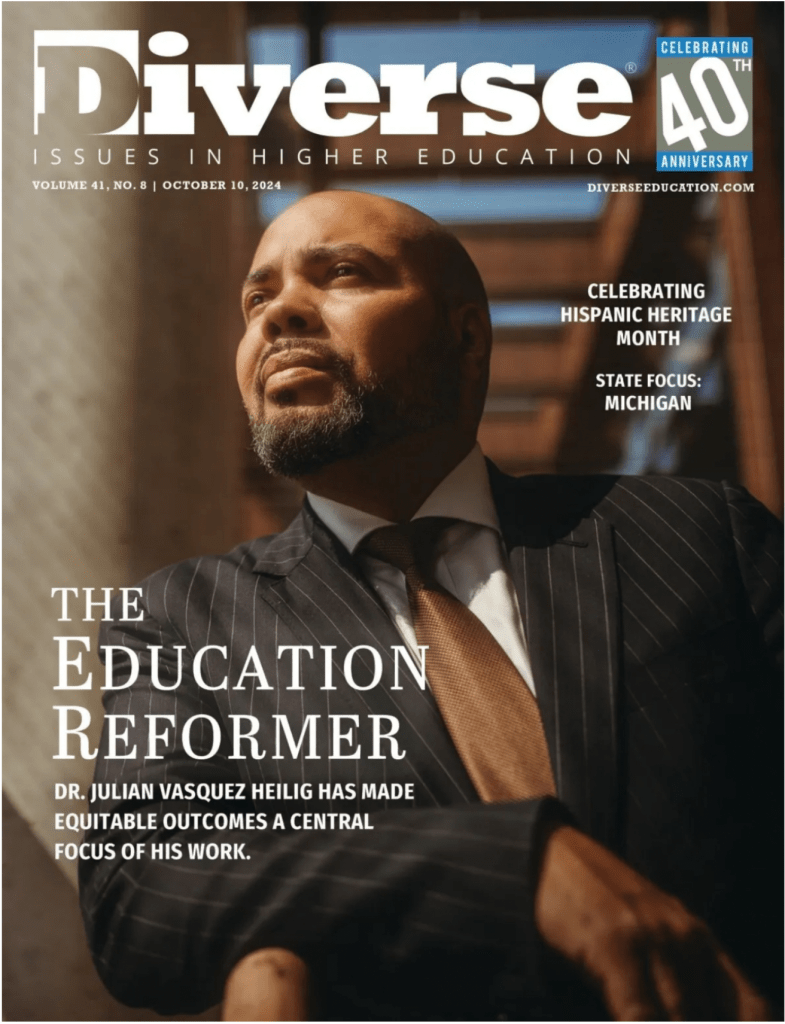
Julian Vasquez Heilig is a nationally recognized public scholar, commentator, and civil rights advocate whose work has appeared on Democracy Now!, MSNBC, Al Jazeera, NBC News, PBS, and Univision. He brings clarity, urgency, and public relevance to complex issues in education, policy, and leadership. For consulting, speaking opportunities, and collaborations, contact jvh@alumni.stanford.edu.




Leave a Reply