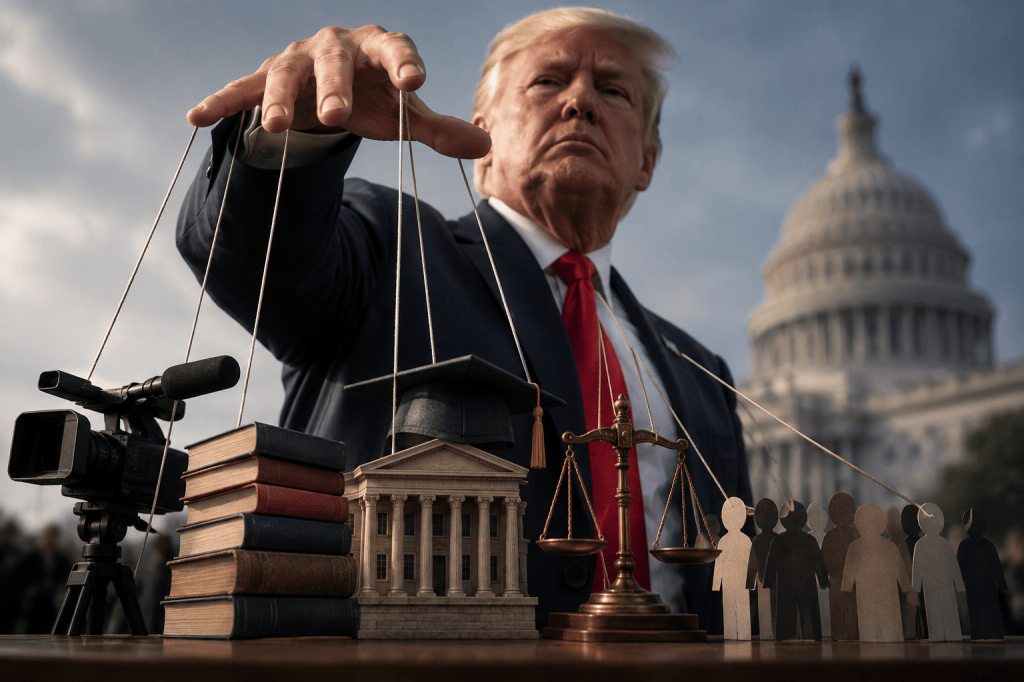
There is a line usually attributed to Nazi propagandist Joseph Goebbels: “Accuse the other side of that which you are guilty.”
There is no reliable evidence that Goebbels actually said those exact words. But watching American politics right now, it is difficult not to think about the political strategy captured by the line. For decades, the right has told us that liberals and the left are afraid of competition. Conservatives said universities practiced viewpoint discrimination, conservative professors could not get hired, conservative students were silenced, DEI was ideological coercion, affirmative action substituted preferences for qualifications, and the mainstream media suppressed ideas it did not like.
However, conservatives have never lacked power in American life. They have controlled presidencies, Congress, statehouses, governorships, courts, governing boards, enormous donor networks, foundations, think tanks, media organizations, universities, and the Supreme Court. The story is not that conservatives suddenly discovered power. What is striking now is how some conservative political leaders are using grievance, government, and institutional power to change the terms of the market place of ideas they spent decades demanding.
Start at the White House Gate
Trump recently banned CNN, MS NOW, and Politico from White House grounds. Their journalists had credentials revoked, and the three organizations filed another federal lawsuit arguing that the administration is violating their First Amendment rights (again). Trump has publicly attacked their journalism and claimed without evidence that the organizations represent a national security threat. Think about that. Trump is not simply saying CNN is wrong and asking Americans to watch somebody else. The president controls access to the White House, and his administration is unconstitutionally using governmental power against news organizations whose coverage he dislikes.
The supportive response from other television networks is revealing. After CNN was prevented from fulfilling its scheduled television pool assignment, the major networks, including Fox News, refused to replace it and suspended pooled television coverage of the president. Even Fox recognized the institutional stakes when government decides which journalists are acceptable.
Now imagine Barack Obama doing the same thing to Fox News. Obama actually had a contentious relationship with Fox, and in 2009 his administration attempted to exclude Fox from one single pooled interview before other networks objected and the administration relented. More recently, Obama invoked that history at Colgate University while criticizing Trump’s action, asking listeners to imagine him simply declaring that Fox News was banned permanently.
The constitutional principle supporting the freedom of the press should not depend on whose viewpoint is being punished. If Obama confiscating Fox credentials because he hated its coverage would have been unacceptable, Trump doing it to CNN and others should raise the same constitutional and public concern.
Government Does Not Have to Hold the Microphone
Then there is the ongoing drama between Jimmy Kimmel and FCC Chairman Brendan Carr. The government does not own ABC, but broadcasters operate within a federal regulatory system in which licenses and regulatory decisions matter enormously. That is why government pressure does not have to look like a communist official walking into a studio and switching off a microphone like you might see in the USSR. Power in the US is now operating through licenses, funding, regulatory reviews, governing boards, accreditation, appropriations, appointments, and the knowledge that an institution controlling something you need is unhappy with what you are saying.
This is where the authortarian pattern of the Trump administration becomes more revealing than any individual controversy. The mechanism may change, but the underlying question remains the same: Why does Trump need to intervene in the competition of ideas? If Kimmel’s program is terrible, viewers can stop watching. If CNN’s journalism is terrible, viewers can change the channel. If conservative media and conservative ideas are more compelling, audiences are free to choose them. Why, then, does government power need to enter the marketplace of ideas to pressure, punish, ban, or cancel the competition?
Ban the Books
Move from television studios to school libraries and the same power question appears in another form. PEN America documented 6,870 instances of school book bans during the 2024-25 school year and nearly 23,000 since 2021. Its data show that books dealing with race, racism, sexuality, gender and historically marginalized groups have been prominent targets.
Parents absolutely have a right to make decisions about what their own children read. But “I do not want my child reading this book” is fundamentally different from “therefore your child should not be able to read it either.” The first is the reading list for your kid. The second is power over somebody else’s reading list. That distinction matters because this debate is too often dressed up as simply expanding “values” and parental freedom. Freedom cannot mean that one group receives the power to eliminate books for everyone else.
Now Follow the $100 Million
Higher education makes the power function impossible to miss. I spent eight years as a professor at the University of Texas at Austin, where I also held courtesy faculty appointments in both African and African Diaspora Studies and Mexican American Studies. I know these intellectual communities from the inside, as communities of scholars, students, research, teaching, and intellectual debate, not as abstractions in somebody else’s culture war.
That is why what is happening at UT is not an abstract debate for me. In the post, “Provost William Inboden and the Cancellation of Black, Latino, Indigenous and Gender at Texas: Is It 1950 Again?,” I discussed UT’s decision to end stand-alone majors in African and African Diaspora Studies, Mexican American and Latina/o Studies, and Women’s and Gender Studies. The university has offered academic and administrative explanations for those changes, but those explanations raise substantial questions of their own, particularly when placed within the broader political environment that the provost Inboden has introduced surrounding race and gender scholarship. Faculty critics have argued that what is happening on campus cannot be separated from that context.
But there is another way to understand institutional priorities in higher education: follow the money. Walk across the same campus and the contrast is difficult to miss. In 2025, the UT System Board of Regents announced a $100 million investment. To be clear, there is nothing wrong with studying constitutional government, Western civilization, free markets, political philosophy, individual liberty, or the great books. Those subjects belong at a great university. The problem is not that these ideas are being studied. The problem is the extraordinary disparity in how different intellectual traditions are are now being treated.
Follow the money, and the rhetoric about a neutral marketplace of ideas becomes much harder to accept at face value. A marketplace does not normally work by taking institutional power out of one corner while pouring $100 million into another. That is not merely ideas competing with ideas. It is people with authority deciding which intellectual enterprises receive extraordinary institutional support and which must navigate cancellation.
That is why the questions should be uncomfortable. Who gets the building? Who gets the faculty lines? Who gets the new majors? Who gets the $100 million? Who loses the stand-alone major? Who gets institutional protection and expansion? Who is told that administrative considerations require retrenchment? And, most importantly, who gets to decide which ideas deserve extraordinary resources to flourish? If conservatives want to defend a marketplace of ideas, then the principle should apply consistently. Let the ideas compete.
Whatever Happened to Merit?
This is where the hypocrisy argument becomes especially difficult to avoid. For decades, conservative politics attacked affirmative action because institutions supposedly should not put their thumbs on the scale. Conservatives attacked quotas because qualifications were supposed to matter more than institutional preferences. The message was merit, merit, merit.
Okay.
Then apply merit to your ideas too. If this new scholarship is extraordinary, publish it. If the research is groundbreaking, scholars will cite it. If the professors are brilliant, universities will compete to hire them. If students find the curriculum compelling, they will enroll. Why does it need a $100 million institutional boost from a governing board? And why does that extraordinary investment occur while Black Studies, Latino Studies, and Gender Studies lose their stand-alone majors?
The juxtaposition raises a serious question about what critics might call viewpoint affirmative action. After decades of attacking preferences, right wing political leaders are supporting extraordinary institutional resources for an intellectual project they favor while other intellectual traditions face consolidation and elimination.
Then Take the Same Idea National
Trump’s accreditation agenda extends the question beyond Texas. His 2025 executive order directed the Department of Education to reform accreditation while calling for institutions to “appropriately prioritize intellectual diversity” among faculty. The administration argues that its approach combats ideological conformity and unlawful discrimination. Those are claims that can be debated on their merits, but accreditation is hardly an ordinary intellectual debate because accreditation is tied to access to enormous amounts of federal student aid.
Think about the contradiction. Conservatives spent decades arguing against quotas. Now the Trump administration wants universities to demonstrate intellectual diversity while government increasingly influences what intellectual diversity is supposed to mean. How many conservative professors constitute intellectual diversity? Who counts as conservative? Does a libertarian count? What about a religious traditionalist or liberal? Who decides when the ideological mixture is correct? Once government starts answering those questions, we are getting remarkably close to the thing conservatives spent decades claiming to oppose: political preferences substituting for qualifications.
This Is About Power
Political science has language for what we are watching. Institutional development, policy feedback, venue shopping, and institutional layering describe how political actors build capacity and pursue objectives through different institutions over time. There does not need to be a secret room with cigars where somebody planned everything forty years ago. Political movements build think tanks, legal organizations, donor networks, media organizations, judicial pipelines, governing-board influence, and political institutions because institutions convert ideas into durable power.
That is also why I am skeptical of the popular “TACO” idea that Trump Always Chickens Out. A court can block one route, an institution can resist another, and political pressure can force a retreat somewhere else. That does not necessarily mean Trump’s objective disappears. He tries another door. White House access. FCC authority. Federal funding. Accreditation. State appropriations. Governing boards. University presidents. Curriculum rules. Different doors, different legal authorities, different circumstances. More lawsuits. But each provides another mechanism through which government can politically influence and control the environment in which ideas compete.
Conclusion: Why Does Trump Need to Protect Conservative Ideas?
This is where the whole argument comes together for me. Conservatives have spent decades demanding competition. They told us affirmative action was unfair because everyone should compete on merit. They told us universities needed intellectual diversity because no ideology should control the marketplace of ideas. They told us liberal institutions were weak because they could not tolerate competing viewpoints.
Fine.
Then compete.
Write better books. Produce better research. Build better arguments. Teach better courses. Create television programs people would rather watch than Jimmy Kimmel and Colbert. Produce journalism people trust more than CNN. Develop scholarship students find more compelling than Black Studies or Latino Studies. If your ideas resonate, people will choose them. But don’t tell me you believe in intellectual competition while government removes your competitors from the field. Don’t preach merit while politically favored intellectual projects receive extraordinary institutional advantages. Don’t spend decades condemning quotas and preferences and then demand government intervention to guarantee your political viewpoint a place in the university.
And don’t call that a free marketplace of ideas. Conservatives have always had power. The difference worth examining now is how some right-wing government officials are using that power, not simply to argue for their ideas, but to change the conditions under which competing ideas are allowed to survive. That is what makes this moment so revealing. If conservative ideas are stronger, they should not need the president, government regulators, governing boards, public money, accreditation rules, or threats of government action to make people listen to them. They should be able to compete and win on their own.
So I am left with one question that runs through this entire story: If conservative ideas are really better, why do they need Donald Trump and interventions from federal and state governments to protect them? Why not simply let those ideas compete?
You cannot preach “do as I say, not as I do” when it comes to free speech. You cannot demand free speech for me but not for thee. And you cannot celebrate the marketplace of ideas while, at the same time, using government power to pressure institutions, threaten consequences, weaken competing viewpoints, and create incentives for universities to privilege politically favored ideas.
That is the contradiction at the heart of this debate. If you need Trump and the enormous power of government to tilt the marketplace of ideas in your direction, then do not tell me you believe in a free marketplace of ideas. A marketplace whose government chooses which ideas receive protection and which ideas bear the pressure is not free.
Please share.
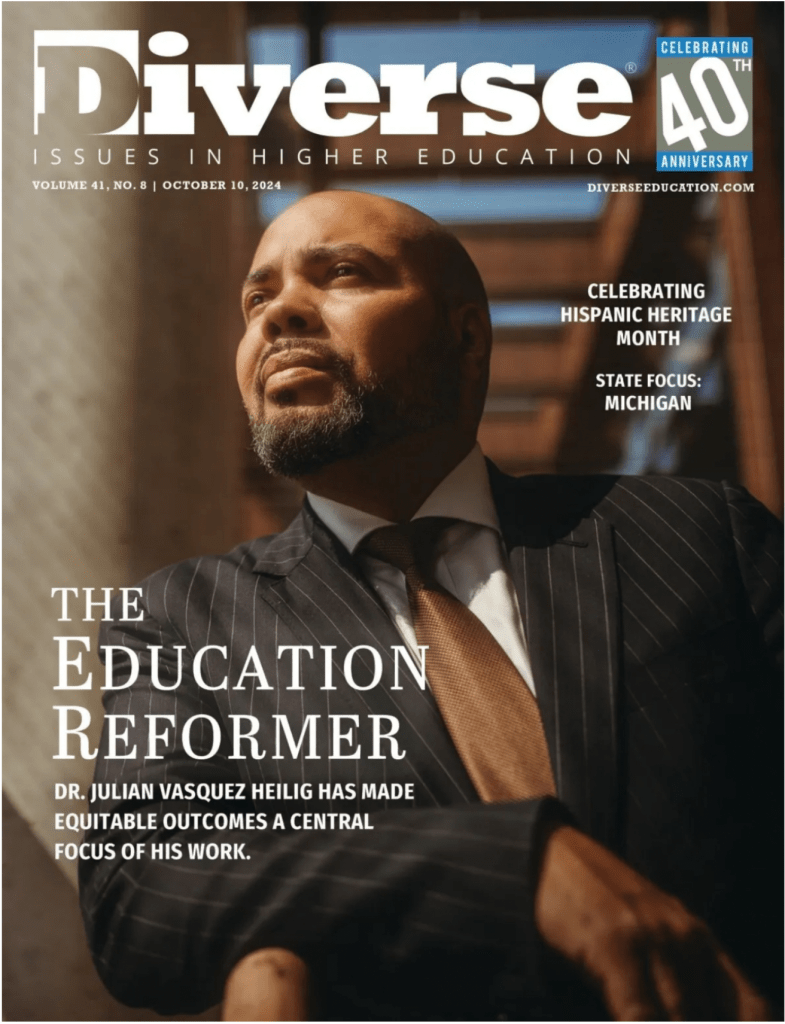
Julian Vasquez Heilig is a nationally recognized public scholar, commentator, and civil rights advocate whose work has appeared on Democracy Now!, MSNBC, Al Jazeera, NBC News, PBS, and Univision. He brings clarity, urgency, and public relevance to complex issues in education, policy, and leadership. For consulting, speaking opportunities, and collaborations, contact jvh@alumni.stanford.edu.




Leave a Reply