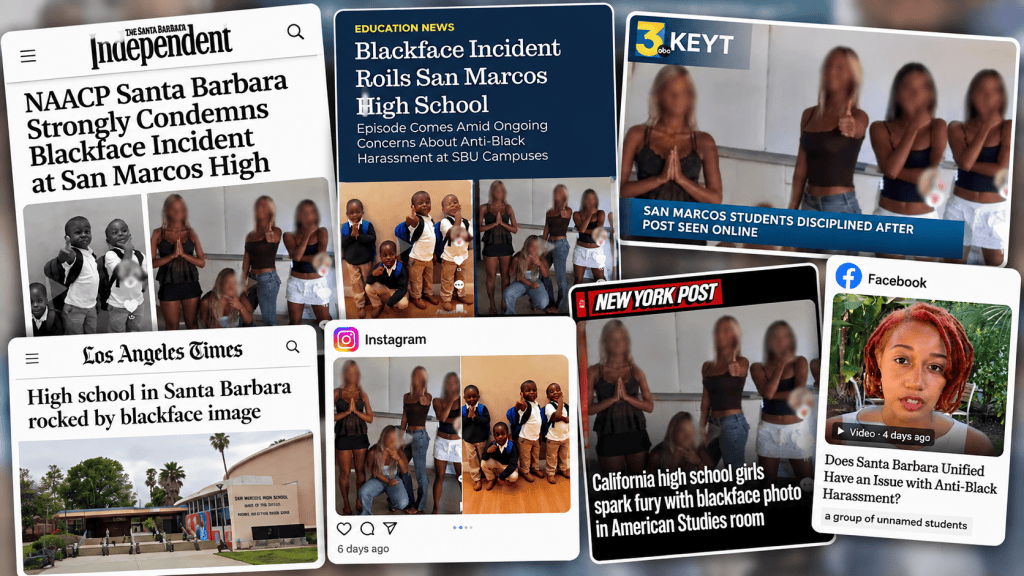
An image goes viral. The community is outraged. Students are disciplined. Statements are issued. Eventually, the headlines move on. But we should ask a bigger question: What did anyone learn?
That is the question after four students at San Marcos High School in Santa Barbara were shown recreating an AI image of young Black boys with their faces allegedly artificially darkened. The image circulated online and eventually went viral on TikTok. The Santa Barbara NAACP rightly demanded accountability, describing the episode as “Blackface in the digital age.”
That phrase gets to the heart of the problem. Artificial intelligence, TikTok, filters, memes, and group chats give old prejudice new technology, but technology does not erase history. A young person can create and distribute an image in seconds, potentially without understanding that what appears to be a joke carries nearly two centuries of racial caricature behind it. The harm can reach targeted students immediately, while the digital record can follow the students responsible for years.
Consider what happened just days ago to sports broadcaster Braiden Bell. The Portland Trail Blazers announced the 29-year-old as their new television play-by-play announcer. Within hours, he lost the job after racist, sexist, and other offensive social-media posts from his teenage years surfaced. Bell apologized and said he wrote them when he was 15 and that they did not reflect who he is today. His case raises legitimate questions about adolescent judgment, growth, accountability, and forgiveness, but it also offers schools a warning: we should not wait until our students are 29 to teach them that the internet has a forever memory.
There is another important detail in the San Marcos story. The incident was reported through Santa Barbara Unified’s Safe to Speak Up system before it became a broader controversy. Administrators contacted families, imposed consequences, and said they were educating the students responsible while supporting those affected. Santa Barbara therefore had a reporting system, and someone used it. The harder question for every school district is: What happens after someone speaks up?
The NAACP Is Right to Stand Up
Santa Barbara NAACP President Connie Alexander has argued that the problem extends beyond four students. Black students from Dos Pueblos High School had previously appealed to the school board about racism, and the organization has called for clearer protocols, effective training, transparency, and consistent responses. When students and civil rights organizations raise concerns before the cameras arrive, schools should treat those warnings as opportunities for prevention.
I take a special interest in Santa Barbara because I opened the district’s 2025 school year with a keynote at its large welcome-back event for educators. I came away wanting its students, educators, families, and leaders to succeed, and I still do. That support also means being willing to serve as a critical friend, celebrating progress, listening to the community, and offering support when students and community members are concerned. Concern offered in that spirit is not opposition; it is an expression of investment. And the lessons here extend far beyond Santa Barbara. Every school district should be asking what it would do if this happened tomorrow. More on five things every school district should do in just a moment.
When History Becomes “Tradition”
In 2017, while I served as statewide education chair for the California NAACP, Anaheim Union Superintendent Mike Matsuda invited me to Savanna High School to discuss its “Rebel pride,” Confederate imagery, and mascot with their students and faculty. A school enrolling primarily students of color had inherited traditions from another era without necessarily giving students the historical knowledge needed to understand them.
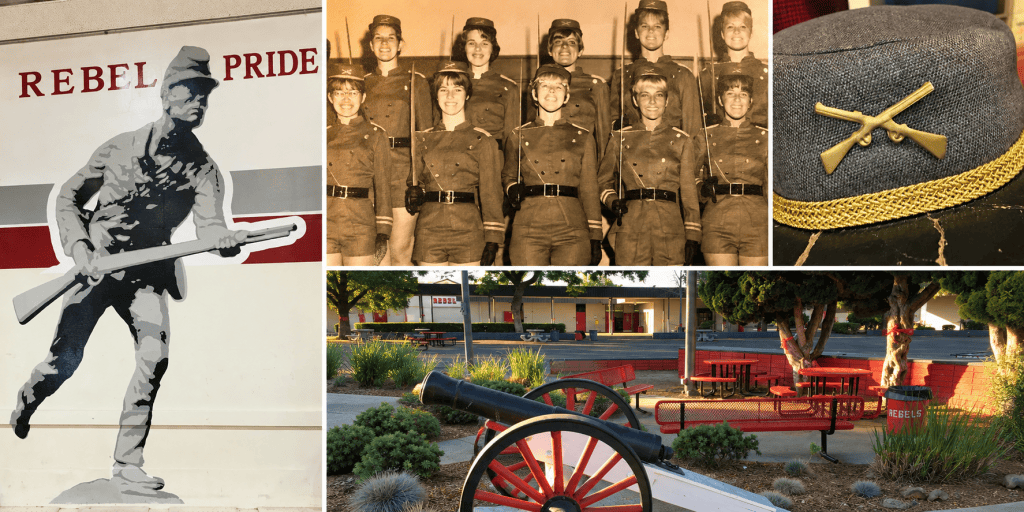
My message was not simply to remove a symbol. It was to teach the history. Students then studied slavery, the Confederacy, and the meaning of its symbols, then voted overwhelmingly to replace or rebrand the mascot. The district board ultimately removed Confederate references while retaining the Rebels name.
Years later, I experienced the issue as a father. At Lexington Christian, a student in my daughter Lucia’s middle-school art class made a Confederate flag specifically to offend her because of her African American heritage. The school suspended him, but after his parent intervened, the principal reversed the suspension. Students learned something from that reversal too. Schools teach through curriculum, but they also teach through what adults tolerate, whose pain matters, and whether rules survive powerful interests.
The Illusion of Inclusion
Before asking how students can be ignorant of the history behind blackface or Confederate imagery, educators should ask an uncomfortable question: What have we actually taught them?
My colleagues Keffrelyn Brown, Anthony Brown, and I examined that question in our Harvard Educational Review study, “The Illusion of Inclusion.” Analyzing Texas social studies standards, we found that a curriculum can appear to include communities of color while marginalizing the depth and context of their experiences (Vasquez Heilig, Brown, & Brown, 2012). Mentioning Martin Luther King Jr., Delores Huerta, slavery, or the civil rights movement is not the same as teaching students how race and racism shaped American institutions.
That problem is particularly important now. Texas still offers high-school African American and Mexican American ethnic studies courses, and Florida requires African American history, yet both states have imposed extensive restrictions affecting how race-related concepts can be taught. Florida also rejected the pilot AP African American Studies course in 2023. The issue is therefore more complicated than states have simply “banned ethnic studies.” The question is what students are actually allowed learn and understand.
The debate extends into higher education. At the University of Texas at Austin, where I was a tenured professor for eight years, Cultural Diversity and Global Cultures courses were among undergraduate curriculum requirements discontinued in 2025. UT recently reorganized several academic units associated with race, ethnicity, gender, and culture as I discussed in the post Provost William Inboden and the Cancellation of Black, Latino, Indigenous, and Gender at Texas: Is It 1950 Again?.
We cannot express shock when students fail to understand blackface while simultaneously narrowing or cancelling opportunities through which they might learn its history. The question is not merely “Is it included?” but “What are students learning from what is included?”
So what should schools do?
Five Things Every District Should Do
1. Protect students first, not the institution. When harm occurs, the first question should not be, “How do we keep this from becoming a controversy?” It should be, “What do the students who were harmed need from us right now?” Stop the conduct, preserve the evidence, check privately on affected students, watch for retaliation, and make sure students know which adult will stand courageously with them. Research links racial discrimination during adolescence to socioemotional distress and poorer academic outcomes (Benner et al., 2018). Also, we should never make historically marginalized students responsible for teaching everyone else why what happened to them was wrong.
2. Make accountability fair, consistent, and meaningful. Investigate what actually happened. For example, get to the bottom of: Who created the image? Who altered it? Who posted it? Who deliberately spread it? And distinguish students who amplified the harm from those who preserved or shared evidence to report it. Consequences should not depend on whose parents have the most power, which school a student attends, or whether an incident attracts media attention. Restorative practices can help students understand the harm they caused and repair relationships, but they should not become a substitute for accountability. Schools also have to ensure that students who engage in similar conduct face consistent consequences. (Augustine et al., 2018).
3. Teach the history before students repeat it. We cannot continually act shocked that young people do not understand blackface, Confederate imagery, antisemitism, racial stereotypes, sexism, and other forms of historical degradation if we are unwilling to teach the history that gives those acts meaning. Give teachers strong curriculum, primary documents, credible scholarship, museums, archives, and the support to teach difficult history even when some parents would rather their children not encounter it because they might feel “uncomfortable.” Teaching about historical degradation and marginalization does not assign inherited guilt to children; it gives them knowledge. Inclusion and opportunity for all students have to live in the curriculum, professional learning, and everyday life of the school.
4. Build relationships with the NAACP and community before you need them. In 2017, Anaheim Union Superintendent Mike Matsuda did not wait for the Savanna High controversy to resolve itself; he invited the California NAACP into a difficult conversation with students. That kind of relationship matters. Santa Barbara already has community infrastructure, including the Committee Advancing Black Achievement, Wellness, and Excellence (CABAWE). District leaders should meet regularly with these organizations, share relevant climate and discipline data, include them in policy and curriculum conversations, establish clear ways to elevate unresolved concerns, and respond when Black students say they do not feel safe or heard. But partnership cannot mean co-optation. The NAACP’s job is not to protect a school district from criticism. Its job is to represent the community, ask difficult questions, and hold institutions accountable when they fail students.
5. Tell the public what happens after someone speaks up. A reporting system is not evidence that a problem has been solved; it is evidence that someone has asked the institution to respond. Districts should publicly report what they can about response times, patterns of harassment, retaliation, disciplinary consistency, recurrence, school climate, and whether students trust adults enough to report what they experience. Tracking these patterns helps leaders see problems earlier and respond more effectively. Communities are more likely to trust institutions that acknowledge harm and explain what they are doing about it than institutions that minimize or hide it. Districts should not simply collect data and file it away. They should discuss the patterns publicly, explain what they are learning and changing, and report back on whether those changes worked. The real measure of a reporting system is not how many reports it receives, but what happens after a student has the courage to make one.
Students Are Watching
Every student is learning from what adults do next. They are learning whether adults take their experiences seriously and whether racial and other types of degradation and marginalization brings meaningful accountability. Teachers are learning whether administrators will support them, and parents are learning whether policies remain consistent when controversy becomes uncomfortable.
The students responsible are learning too. Accountability and grace are not opposites. Young people need consequences when they harm others, but education should help them understand what they did and become adults better than their worst adolescent moment. The Bell case with the Portland Trailblazers reminds us that the digital world may preserve that moment whether or not they change.
My experiences at Savanna High, with the California NAACP, in Santa Barbara, through my research on the illusion of inclusion, and as Lucia’s father have taught me that students are always learning from our response. They learn from what we teach and what we leave out, what adults challenge and what they tolerate, and whether we stand by children when doing so becomes difficult.
What did anyone learn? That is the question that Santa Barbara’s viral image leaves for every school in America. Students harmed by prejudice should learn that adults will stand with them. Students responsible for harm should learn that accountability is real, and that growth is still possible. And every student should learn enough history to recognize racism before repeating it. If all we do is discipline four students, issue a statement, and wait for the internet to move on, we have missed the lesson. The time to teach the history behind the next incident is before it happens.
Please share.
Julian Vasquez Heilig is a nationally recognized public scholar, commentator, and civil rights advocate whose work has appeared on Democracy Now!, MSNBC, Al Jazeera, NBC News, PBS, and Univision. He brings clarity, urgency, and public relevance to complex issues in education, policy, and leadership. For consulting, speaking opportunities, and collaborations, contact jvh@alumni.stanford.edu.
References
Augustine, C. H., Engberg, J., Grimm, G. E., Lee, E. L., Wang, E. L., Christianson, K., & Joseph, A. A. (2018). Can restorative practices improve school climate and curb suspensions? RAND Corporation.
Benner, A. D., Wang, Y., Shen, Y., Boyle, A. E., Polk, R., & Cheng, Y.-P. (2018). Racial/ethnic discrimination and well-being during adolescence: A meta-analytic review. American Psychologist, 73(7), 855–883.
Dee, T. S., & Penner, E. K. (2017). The causal effects of cultural relevance: Evidence from an ethnic studies curriculum. American Educational Research Journal, 54(1), 127–166.
National Museum of African American History and Culture. (n.d.). Blackface: The birth of an American stereotype. Smithsonian Institution.
Paluck, E. L., Porat, R., Clark, C. S., & Green, D. P. (2021). Prejudice reduction: Progress and challenges. Annual Review of Psychology, 72, 533–560.
Replogle, J. (2017, November 6). Anaheim’s Savanna High considers replacing Confederacy-inspired Rebel mascot. LAist/KPCC.
Santa Barbara NAACP. (2026, October 2). NAACP Santa Barbara strongly condemns the Blackface incident at San Marcos High. Santa Barbara Independent.
U.S. Department of Justice. (2023). Justice Department secures agreement to remedy racial harassment of Black and multi-racial students in Kentucky school district.
Vasquez Heilig, J., Brown, K. D., & Brown, A. L. (2012). The illusion of inclusion: A critical race theory textual analysis of race and standards. Harvard Educational Review, 82(3), 403–424.
Vo, T. (2017, November 7). Anaheim’s Savanna High School to get new “Rebel” mascot. Voice of OC.




Leave a Reply